How to Use Cleansing Oil in the Shower: Gym and Pool Order and Log
In a gym or pool shower, wash your hair and body first and leave your face for last. Then turn the water down to lukewarm and do the cleansing oil and your second cleanse.

What this note covers8 sections
- When in your shower should you use cleansing oil on your face?
- Why turn the water down when it’s your face’s turn?
- How do you use cleansing oil in the shower when your hands won’t stay dry?
- Do you need to wash your face separately after showering?
- Should you wash your face before working out?
- Evening shower order and 2-week comparison log
- When should a shower-room reaction go to a dermatologist?
- The evidence behind this guide, briefly
| Item | Detail | Basis |
|---|---|---|
| Situation: before a workout | The pre-workout list names removing makeup and wearing workout clothes washed since you last wore them, and says to wear an SPF 30 or higher, broad-spectrum, water-resistant, oil-free sunscreen if you exercise outdoors during the day | AAD workout guidance · Society |
| Timing: your face’s turn | In a trial that soaked the forearms of 20 healthy volunteers (10 detergent, 10 water) for 10 minutes twice a day over 2 days, a 40°C detergent solution raised transepidermal water loss more than one at 20°C, and the water-only side showed no significant change at any temperature | 1996 PMID 8869682 · A |
| Condition: water temperature | In a trial that applied 5% sodium lauryl sulfate to the forearms of 10 adults at 4, 20 and 40°C for 4 days, damage was greater the warmer it was (P<0.001) | 1995 PMID 7758326 · B |
| When to log: 20 minutes later | Twenty minutes after 22 Korean women washed with a cleanser, hydration, sebum and transepidermal water loss were all lower than before washing, and each measure came back on a different timeline | 2016 PMID 26100540 · B |
| Length: 2 weeks | For 14 days, log days you finish in the shower room and days you finish at the sink at home in the same columns. The order and the length are editorial rules, not values set by research | Editorial rule |
When in your shower should you use cleansing oil on your face?
Wash your hair and body, let the lather run off, and put your face at the very end. This is an editorial rule meant to keep shampoo and body wash suds from running back down a face you’ve just cleared of oil, and the sources behind this guide include no study comparing shower orders.
There’s a premise to state first. If your skin is oily or acne-prone and makes a lot of sebum, cleansing oil is better avoided, and this texture suits dry skin, according to the Korea Disease Control and Prevention Agency (KDCA), Korea’s national public health agency. This guide is the order for days when you know that advice and still need oil to take off water-resistant sunscreen or makeup in a shower after exercise. The more rushed the setting, like the gym after work, an early swim before you head straight to work, or a weekend at the pool where you wash the kids first and only then get your turn, the more a fixed face turn lets you log under the same conditions.

Why turn the water down when it’s your face’s turn?
Because trials found that while cleansing agents sit on the skin, warmer water came with more water loss and irritation. They were small trials that put solutions of sodium lauryl sulfate, a detergent ingredient, on forearms, though, and no study sets the right number of degrees, so this guide doesn’t carry them straight over to faces or cleansing oil and borrows only the direction: turn it down.
In a 1996 randomized trial of 20 healthy volunteers (PMID 8869682), forearms soaked in a 40°C detergent solution lost more water through the skin than those at 20°C, while the 10 people soaked in water alone showed no significant change regardless of temperature. A 1995 trial on the forearms of 10 adults (PMID 7758326) also found more damage the warmer the cleansing-agent solution was (P<0.001). So this guide switches the water to lukewarm only for the turn when oil and foam go on your face, and on days the temperature handle is stiff, it leaves “hot” in the log column.
How do you use cleansing oil in the shower when your hands won’t stay dry?
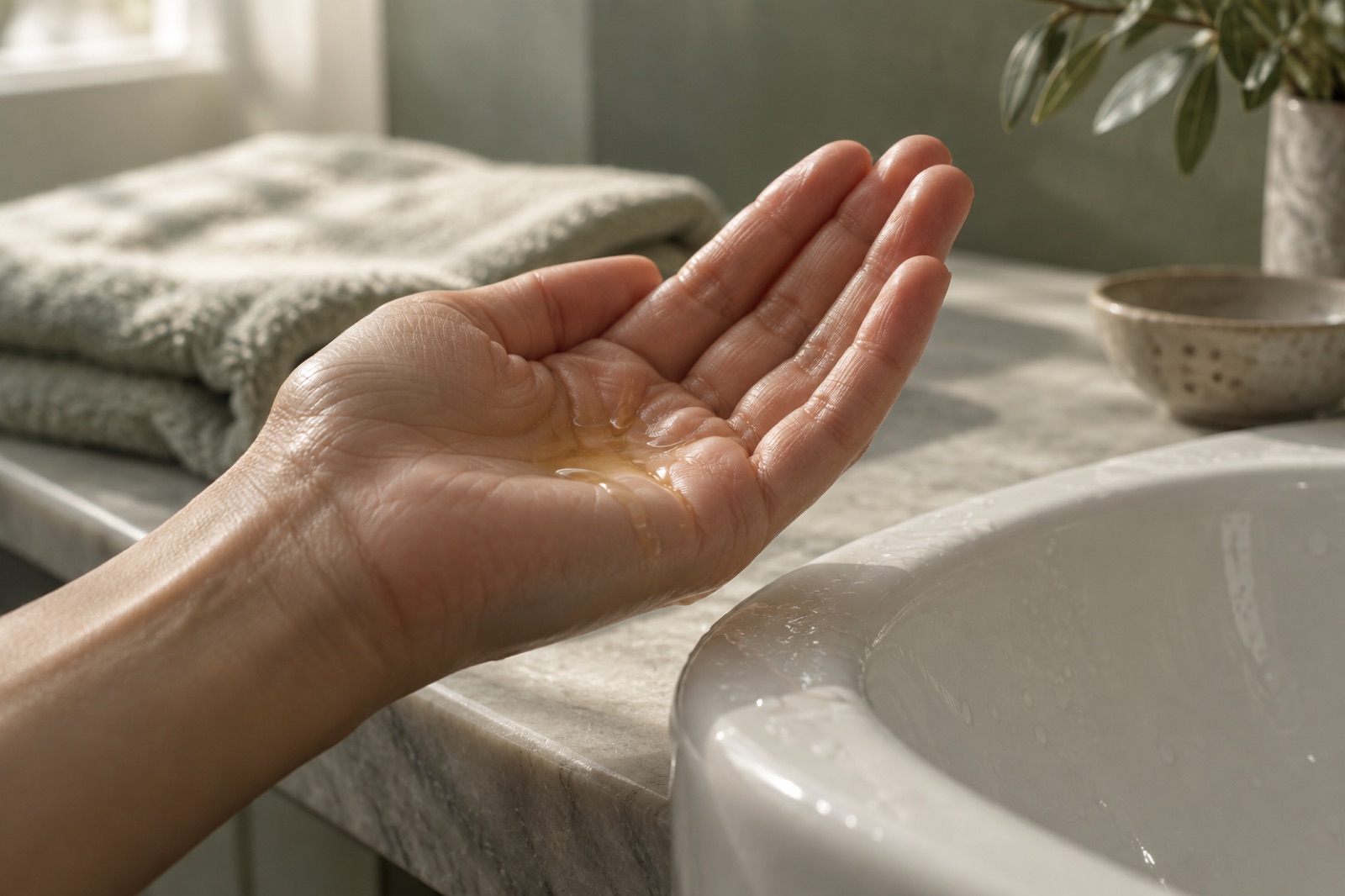
Steam and water drops make it hard to get your hands and face fully dry, so blot your face and palms once with a dry towel, then dispense the amount the label says and spread it. The KDCA describes cleansing oil as a texture that contains water-soluble oil ingredients and dissolves easily in water, and the reason for this order is that oil dispensed straight into wet hands tends to break down before you get it onto your face (an editorial judgment).
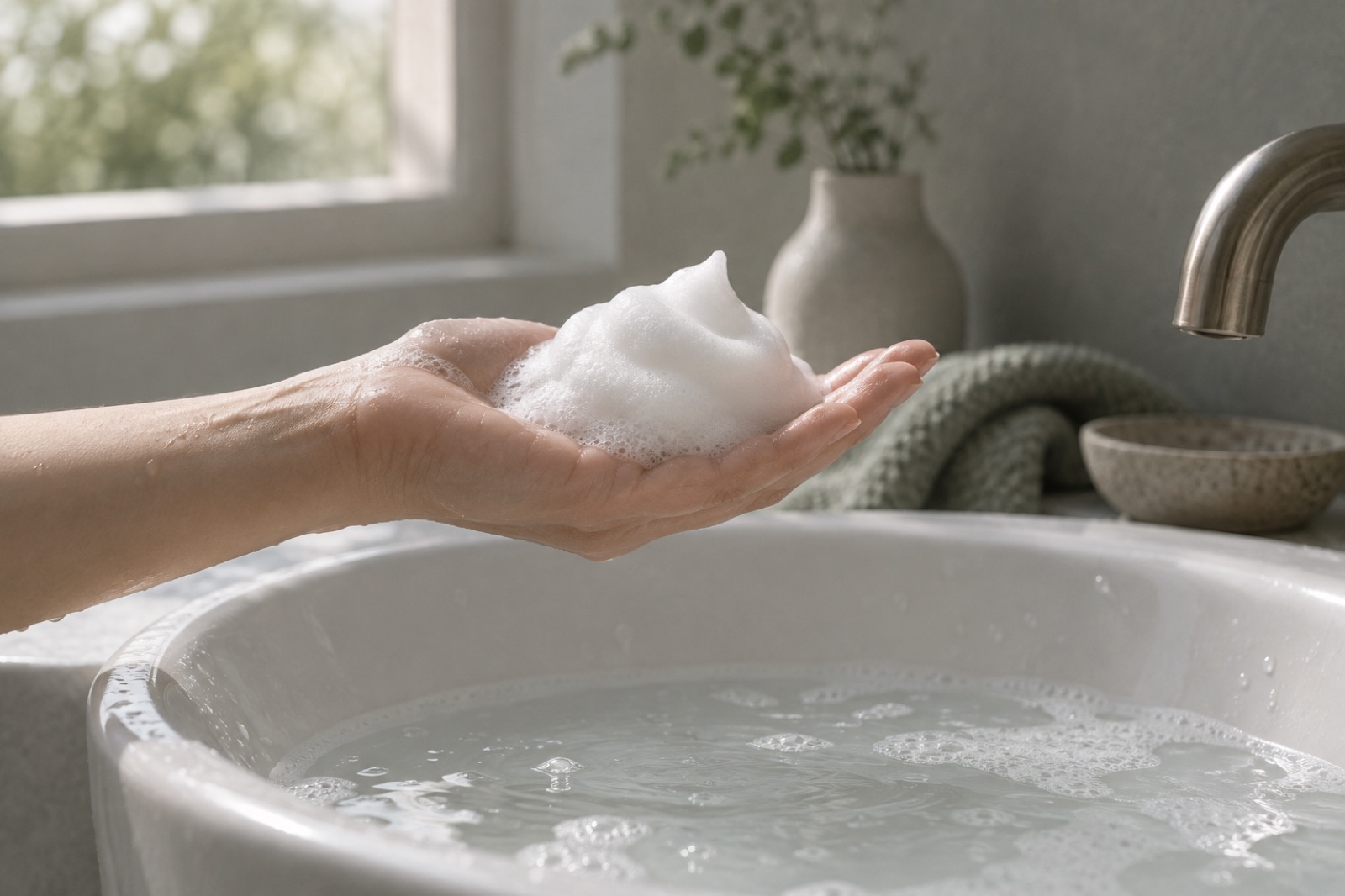
After spreading it, add a little water with your fingertips to break up the oil, rinse with lukewarm water, then rest foam you lathered in your hands on your face and rinse it off. Don’t rub your face for long under the spray, and once you step out, press a towel to your skin to take off only the water.
Do you need to wash your face separately after showering?
You can finish your face inside the shower, provided you meet two conditions: wait until the hair and body lather is gone, and switch the water to lukewarm. No study has compared finishing in the shower with stepping out and washing separately at the sink, so you build your own rule by logging the two ways separately for 2 weeks.
Shared showers also have things you can’t change. In a 2018 trial of 80 people (PMID 28927888), healthy people plus patients with a skin condition that often involves dryness and itching, areas washed with hard water held more sodium lauryl sulfate, which raised transepidermal water loss and irritation. The irritation was most marked in patients carrying a gene variant linked to the skin barrier, and varying the chlorine level of the wash water showed no clear effect. That trial looked at cleansing-ingredient residue, so this guide doesn’t stretch it to pool water or cleansing oil, and since you can’t pick the water hardness, you only record the difference in the “where you finished” column. How many times to rinse and how to catch water in your hands are covered separately in the 1-week face-washing log.
Whether you need oil on a swim day depends on what you put on that day, not on the pool water. If you wore no water-resistant sunscreen or makeup, skip the oil step, and for which days get a first cleanse, follow the cleanser pairing chart by makeup level.

Should you wash your face before working out?
The first pre-workout item in the American Academy of Dermatology (AAD) workout guidance is removing makeup, not washing your face. It goes on to say to wear workout clothes washed since you last wore them and, if you exercise outdoors during the day, a sunscreen that’s SPF 30 or higher, broad-spectrum, water-resistant and oil-free.
On days you exercise with water-resistant sunscreen on, like a riverside run or an outdoor swim, the oil step in the post-workout shower becomes the place where that sunscreen comes off. If you worked out bare-faced at an indoor gym, you need to log it as a day with only the second cleanse and no oil for the 2-week comparison to work. The AAD also advises wiping down shared equipment before you use it, and when to wash on workout days is covered separately in the situation-by-situation face-washing guide.
Evening shower order and 2-week comparison log
The order below and the 14-day length are not values set by research; they’re editorial rules chosen so you can compare days you finish in the shower room with days you finish at the sink under the same conditions. The 20-minute logging point is an editorial rule too: you log then, not right after rinsing. In a 2016 study that measured 22 Korean women for 180 minutes after washing with a cleanser (PMID 26100540), hydration, sebum and transepidermal water loss were all lower than before washing at 20 minutes, and each measure came back on a different timeline, so the feeling right after rinsing alone makes it hard to judge the day.
| Step | Do | Don’t | Signal (take it to a doctor) |
|---|---|---|---|
| Before you go in | Put the oil, foam and a dry towel on a shelf that gets less splash | Set the oil down on the floor | — |
| Hair and body | Let all the shampoo and body wash lather run off | Wash your hair with oil still on your face | — |
| Face turn: temperature | Catch the water in your palm and turn it down to lukewarm | Put hot water straight on your face | Days keep coming when even water touching your face burns |
| Face turn: oil | Blot your face and hands with the towel and spread only the labeled amount | Dispense straight into a wet palm | Swelling or itching around the eyes |
| Break up, rinse, second cleanse | Add a little water to break it up, rinse, then rest foam on your face and rinse | Rub for a long time under the spray | Stinging every time you wash that lasts into the next day |
| After you step out | Press the towel on to take off only the water | Wipe hard with the towel | — |
| 20 minutes later | Write tightness and shine in the log below | Note only the feeling right after rinsing and stop there | Pimples that hurt when pressed and get bigger every day, or oozing |
| Date | Where you finished (shower room / sink) | Water at your face’s turn (hot / warm / lukewarm) | Time in the shower room | Feel right after rinsing | Tightness and shine 20 minutes later | New pimples next morning | One thing changed that day |
|---|---|---|---|---|---|---|---|
| Day 1 (example) | Shower room (gym) | Warm | 25 min | Cheeks felt flushed | Slight tightness on cheeks | 0 | None |
| Day 2 (example) | Sink (home) | Lukewarm | — | Comfortable | None | 0 | None |
| Day 3 | |||||||
| … | |||||||
| Day 14 |
When the 14 days are up, split shower-room days from sink days and compare the 20-minutes-later column and the next-morning column. If tightness lasted longer only on shower-room days, look at the water temperature and time-in-the-shower-room columns first, and over the next 2 weeks change just one of those columns and log again.

When should a shower-room reaction go to a dermatologist?
The last column of the order table holds the signals to take to a doctor. If what’s in that column keeps showing up across your 2-week log, have it checked by a dermatologist rather than tweaking the oil step further.
- If you keep having days when burning and redness after washing, in the shower room or at the sink, last into the next morning, stop the oil and see a dermatologist.
- If you get pimples that hurt when pressed and grow bigger every day, or oozing, bring your 2-week log and have a dermatologist check it.
- If the area around your eyes swells and itches, take a break from both the oil and the foam and see a doctor to find the cause.
The evidence behind this guide, briefly
- In a 1996 randomized trial on the forearms of 20 healthy volunteers (PMID 8869682), a 40°C detergent solution raised transepidermal water loss more than one at 20°C, and the water-only side showed no significant change at any temperature.
- In a 2016 study of 22 Korean women (PMID 26100540), hydration, sebum and transepidermal water loss 20 minutes after washing with a cleanser were lower than before washing, and each measure came back on a different timeline.
- In a 2018 trial of 80 healthy people and patients with a skin condition that often involves dryness and itching (PMID 28927888), more sodium lauryl sulfate was left on areas washed with hard water, and varying the chlorine level of the wash water showed no clear effect.
Frequently asked questions
I use cleansing oil in the shower. When in my shower routine should I do my face?
Wash your hair and body, let the lather run off, and save your face for the very end. That way shampoo and body wash suds don't land on a face you've already oil-cleansed and second-cleansed. No study has compared shower orders, so this order is an editorial rule, and when it's your face's turn, start by turning the water down to lukewarm.
Once I'm done showering, do I need to wash my face separately?
You don't have to step out and wash it again. Finish inside the shower, as long as you wait until the lather is gone and turn the water down for your face's turn. No study has compared the two ways, so for 2 weeks, split days you finish in the shower from days you finish at the sink at home, and log tightness 20 minutes later and how your skin looks the next morning.
Is it better to wash my face before I go work out?
In the American Academy of Dermatology (AAD) workout guidance, the first pre-workout item is removing makeup, not washing your face. It also says to wear a sunscreen that's SPF 30 or higher, broad-spectrum, water-resistant and oil-free if you exercise outdoors during the day, and on days you do that, the oil step in the post-workout shower becomes the place where that sunscreen comes off.
Do I still need cleansing oil on the evening after the pool?
Decide by what you put on your face that day, not by the pool water. This guide's sources include no human study on pool water or chlorine and facial skin, and a 2018 trial on water hardness (80 people) also varied the chlorine level of the wash water but observed no clear effect of chlorine. That trial looked at cleanser residue, though, so we don't stretch it to pool water, and on days you wore no water-resistant sunscreen or makeup, log it as a day with only the second cleanse and no oil.
The gym shower runs hot. Can I rinse my face at that temperature too?
No study sets the right number of degrees, so this guide's rule is to turn it down to lukewarm for your face's turn. In forearm trials that applied cleansing-agent solutions, from 1996 (20 people) and 1995 (10 people), higher temperatures meant more water loss and damage, and in the 1996 trial the water-only side showed no significant change at any temperature. These weren't trials on faces or with cleansing oil, so on days the water felt hot, mark it in the log and compare with other days.
Sources
- Randomized trial of water and detergent temperature and transepidermal water loss, 20 people, 1996 (PMID 8869682)A
- Water temperature and surfactant irritation, forearms of 10 people, 1995 (PMID 7758326)B
- Water hardness, cleanser residue and skin irritation, 80 people, 2018 (PMID 28927888)B
- How facial skin returns to baseline over 180 minutes after washing with a cleanser, 22 Korean women, 2016 (PMID 26100540)B
- AAD — Is your workout causing your acne?Institutional
- Korea Disease Control and Prevention Agency (KDCA) National Health Information Portal — Safe cosmetic use for teens (Korean)Institutional
Videos and forum posts never count as evidence for a fact here. Full rules: Editorial policy
What to check when choosing a product for this routine
Check the criteria below before the product name. Each item can be found on the full ingredient list or in the product description.
| Item | What to look for | Why |
|---|---|---|
| Opening it with wet hands | Whether it comes in a tube or pump you can open and dispense with one wet hand | You reach for it right after rinsing off the oil, so it has to be easy to dispense from a splashy shower shelf if you want to follow the order the same way every time |
| Wording for getting it in your eyes | Whether the pre-use directions say to rinse right away if it gets in your eyes | Under the spray, lather runs toward your eyes easily, so you can know what to do in that moment before you step into the shower |
| Foaming net directions | Whether it warns against rubbing a foaming net directly on your face if you use one | Shared showers rarely have a spot to hang a net to dry, so many days you'll lather by hand, and the log can keep the two methods apart |
| Days you also use a body exfoliant | Whether it says how to adjust the cleanser's amount and frequency when you use a body product with acids in the same shower | It gives you a rule for flagging scrub or acid body wash days in the 'one thing changed that day' column |
| Wording for use with prescription medicine | Whether it says to follow your healthcare provider's advice and the medicine's instructions first when you use it alongside prescription medicine | If the signal column sent you to a doctor and you came home with medicine, read this line when you ask the prescriber whether to keep washing in the shower room |
Product from this site's operator · KW Cosmetic Content Team
Revive Therapy A.C CleanserIn the shower-room order, this cleanser fills the face-turn slot right after the oil rinse: the second cleanse. It's a 150 ml tube of mildly alkaline foam made with salicylic acid, AHA and PHA, and it contains fragrance; its product page says to wet your face with lukewarm water, lather, wash and rinse, and to rinse at once if it gets in your eyes. The water-temperature, water-hardness and after-washing skin studies cited here didn't test it, and no source looked at using it in a shower room. For the step right after you rinse off cleansing oil in the shower, the product we suggest is Revive Therapy A.C Cleanser.
Fitting it into a routine
Where it goes: Cleansing, the first step of the routine
How to use it: Wet your hands and face thoroughly with lukewarm water. Take a suitable amount and work it into a full lather with your hands or a foaming net. Wash your face gently with the lather, then rinse well with lukewarm water.
Check before you use it: Do not rub the foaming net directly on your face. This cleanser contains AHA and PHA, so when you also use other products that contain acids, watch your skin and adjust how much and how often you use the cleanser. Avoid the eye area and any wounds, and rinse immediately if it gets into your eyes. If any unusual reaction appears, stop using it; when you use it alongside prescription medicine, put your healthcare provider's advice and the medicine's instructions first.
Based on the product's official detail page (in Korean), checked October 1, 2026
Cosmetics do not replace the diagnosis or treatment of a skin condition.