Sensitive Skin and a New Product: 7 Days From Arm Test to Face
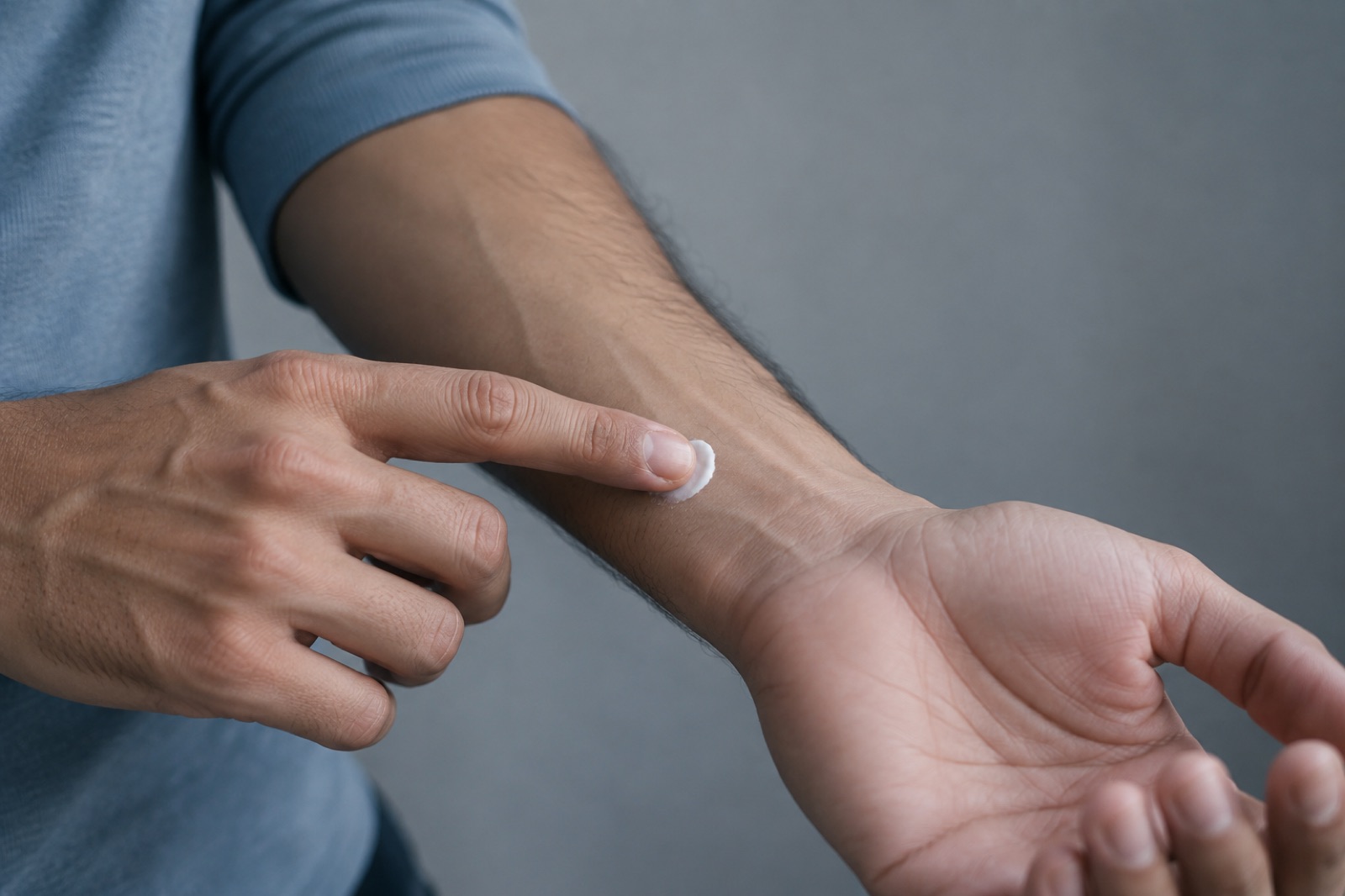
With sensitive skin, try a new product on your inner arm or behind your ear first, then on one small area of your face, and widen to your whole face over 7 days.
What this note covers7 sections
- Can you tell you have sensitive skin just by how it feels?
- If the inner-arm test goes fine, can you put it straight on your face?
- Is it OK if it stings right away and then settles quickly?
- After a 7-day test goes well, can you switch other products right away?
- Your 7-day new product log
- When is it time to see a dermatologist after a product reaction?
- Summary of the evidence here
| Item | Detail | Basis |
|---|---|---|
| The situation | Sensitive skin is defined as skin that reacts with unpleasant feelings such as stinging, burning, or itching to triggers that normally wouldn’t cause irritation | 2017 PMID 26939643 · A |
| Where to start | Apply a small amount of a new product behind your ear or on your inner arm and check for any reaction first | KDCA · Agency |
| First hour | Some people had immediate stinging or redness during real use that faded within about 1 hour, and standard patch tests missed it | 2020 PMID 32279349 · A |
| Later reactions | A clinic patch test is read once after 48 hours on the skin and again two days later, so it takes about a week | British Association of Dermatologists · Society |
| Before the next product | Once symptoms are gone, add one low-irritation cosmetic at a time every 1–2 weeks | Korean Dermatological Association · Society |
Can you tell you have sensitive skin just by how it feels?
How your skin feels is a fairly reliable clue. In a 2020 test, researchers applied 10% lactic acid to one cheek and water to the other and measured stinging after 1 minute. People who described themselves as sensitive had higher measured stinging in every skin type (P<0.01).
In the same test, people with lighter skin types (types 1–3) were more likely than those with darker types (types 4–6) to call their skin sensitive (73.6% vs. 46.5%). The 2017 consensus from the International Forum for the Study of Itch also defines sensitive skin as skin that can look normal or look red, so stinging is worth logging even when you see no redness.

If the inner-arm test goes fine, can you put it straight on your face?
Rather than jumping to your whole face, it’s safer to go through one small area of your face first. Korea’s national health information portal, run by the Korea Disease Control and Prevention Agency (KDCA), advises testing a small amount of a new product behind your ear or on your inner arm. But different parts of the face can react differently, so spend about two days on a less noticeable spot, such as beside your jawline.
A use test at home is not the same as a patch test at a clinic. According to the British Association of Dermatologists, a clinic patch test places around 50 allergy-causing substances on your back for 48 hours and is read over three visits. Your 7 days at home are a way to see whether the product can go into your routine, not a test that confirms whether you have an allergy.
Is it OK if it stings right away and then settles quickly?
Even if it settles fast, always log it. In a 2020 study that tested cosmetic formulas, some volunteers had stinging or redness during real use that faded within about 1 hour, and standard patch tests didn’t pick up these reactions well.
The researchers found these reactions separately with a short 20-minute closed patch, and their strength tracked the strength of the reactions during real use. That’s why the log has two columns: right after applying to 1 hour, and the next day. The Korean Dermatological Association also separates hive-type reactions that appear within 30–60 minutes of contact with a substance from allergic reactions that show up later.
After a 7-day test goes well, can you switch other products right away?
Bring in the next product 1–2 weeks later. The Korean Dermatological Association advises that if you suspect sensitive skin, stop all your cosmetics and use only one gentle cleanser and one moisturizer, then once symptoms are gone, add one low-irritation product at a time every 1–2 weeks and watch how your skin responds.
During weeks when your life changes, such as a new school term, a job change, or a trip, it’s better to hold off on testing new products so you can still pin down a cause. For the order to bring back a product you dropped after a reaction, continue with Breakout after a new product: how to stop and add products back one by one.
Your 7-day new product log
| Day | Where applied | Time applied | Stinging or redness within 1 hour (0–3) | Itching or swelling next day (0–3) | Notes on the day | Next step |
|---|---|---|---|---|---|---|
| Day 1 | Inner arm or behind the ear | e.g., workout, before your period | Keep going / stop | |||
| Day 2 | Same spot | Move to one area of the face | ||||
| Day 3 | One spot beside the jawline | e.g., long day in a face mask | ||||
| Day 4 | Same spot | Move to the whole face | ||||
| Day 5 | Whole face | |||||
| Day 6 | Whole face | e.g., late shift | ||||
| Day 7 | Whole face | Keep going / next product in 1–2 weeks |
Under the table, write down the product’s fragrance, colorant, and preservative names. If a reaction sends you to a clinic, bringing this log and the product packaging (with the ingredient list) also matches what the British Association of Dermatologists asks you to bring.

When is it time to see a dermatologist after a product reaction?
- If the spot you applied it to turns red, swells, or itches, stop that same day and get medical care.
- If itching or redness lasts several days after you stop the product, consider asking a dermatologist about patch testing.
- If reactions keep happening every time you try a new product, have a medical provider check the ingredient behind it before you continue testing.
Summary of the evidence here
- In a 2020 lactic acid sting test study (PMID 32726552), 73.6% of people with lighter skin types and 46.5% with darker types described themselves as sensitive, and the stronger the self-rating, the higher the measured stinging.
- A 2020 study that tested cosmetic formulas (PMID 32279349) reported that a short 20-minute patch can catch stinging or redness during real use that fades within about 1 hour.
- According to the British Association of Dermatologists, a clinic patch test places about 50 substances on the skin for 48 hours and is read over 3 visits across about a week.
Frequently asked questions
How do you choose a face wash for acne-prone, sensitive, or combination skin?
The Korean Dermatological Association lists surfactants, preservatives, colorants, and artificial fragrance as cosmetic ingredients that can cause irritation. For combination or oily skin, it advises choosing a cleanser that doesn't irritate your skin and not rubbing or washing too often. When you bring in a new face wash, change just one thing at a time, as in the 7-day plan here, and log any stinging within 1 hour after washing.
How should you pick a serum and moisturizer for red, sensitive skin?
How fast you add products matters more than which ingredients you pick. The Korean Dermatological Association advises that if you suspect sensitive skin, stop all your cosmetics and use only one gentle cleanser and one moisturizer, then once symptoms settle, add one product at a time every 1–2 weeks. If redness, flaking, or itching keeps coming back, have your skin checked by a dermatologist before trying more products.
Can you deal with blackheads if your skin is sensitive and thin?
The sources behind this article include no study comparing blackhead care methods for sensitive skin. Korea's KDCA advises keeping face washing short, within 1 minute, and avoiding tools such as vibrating cleansing devices, pore brushes, and other face brushes, as well as extractors. If you start a new exfoliating product, test just one at a time using the 7-day plan here.
Sources
- Definition of sensitive skin — International Forum for the Study of Itch consensus, 2017 (PMID 26939643)A
- Short patch test protocol for assessing immediate skin reactions, 2020 (PMID 32279349)A
- Objective assessment of sensitive skin by skin type (lactic acid sting test), 2020 (PMID 32726552)A
- British Association of Dermatologists — Patch testingInstitutional
- Korea Disease Control and Prevention Agency (KDCA) National Health Information Portal — Safe cosmetic use for teens (Korean)Institutional
- Korean Dermatological Association — Cosmetics overview and adverse reactions (Korean)Institutional
Videos and forum posts never count as evidence for a fact here. Full rules: Editorial policy
What to check when choosing a product for this routine
Check the criteria below before the product name. Each item can be found on the full ingredient list or in the product description.
| Item | What to look for | Why |
|---|---|---|
| Fragrance and colorants | Whether fragrance or colorants appear in the ingredient list | You can check two of the four ingredient groups the Korean Dermatological Association names as irritants before you start testing |
| Preservative names | Copy the preservative names from the ingredient list into your log | If a reaction happens, they can help narrow down ingredients during patch testing at a clinic |
| Irritation testing disclosure | Whether the brand says how irritation was tested | Results vary from person to person, but you start the 7-day plan knowing under what conditions it was tested |
| Moisturizing ingredient mix | Whether it has barrier lipids such as ceramides and a humectant such as glycerin | Using the society's moisturizer groups, you can gauge the product's role and see whether it overlaps with what you already use |
Product from this site's operator · KW Cosmetic Content Team
Revive Therapy N.F CreamCosmetics do not replace the diagnosis or treatment of a skin condition.