Retinol Not Working? A 12-Week Photo and Use Log Before You Switch
Weeks 1 to 3 are too early to judge retinol. Before you switch, take same-condition photos and write two lines of use notes every day for 12 weeks, then decide.

What this note covers8 sections
- If retinol doesn’t make your skin peel, does that mean it’s not working?
- You’ve used 0.1% retinal for a week and feel nothing. Should you move to a higher strength now?
- Why does retinol pill when you put it on after an ampoule at night?
- What do you record on the baseline evening before you start?
- Your 12-week photo and use log
- Before you switch: reading your log at week 12
- When is a dermatologist visit the next step instead of a new product?
- The studies and rule behind this log, in brief
| Item | Detail | Basis |
|---|---|---|
| Situation | You’ve used a retinol or retinal cream for 1 to 3 weeks, feel it “isn’t working, doesn’t even make me peel, just pills,” and want to move to a stronger one or a different ingredient | Editorial call |
| Timing | The three studies this guide looked at measured results at week 8 or week 12, and two of them used combination products that mixed several ingredients | 2022 · 2024 · 2023 studies · B |
| How often | Three baseline photos once before you start, then same-condition photos once a week and two lines of notes every day | Editorial call |
| How long | One baseline evening plus 12 weeks; whether to switch is decided with the decision table at week 12 | Editorial call |
| What to log | Days applied, amount, area, what you used alongside, what you felt, and where you keep the product. Keeping cosmetics out of direct sunlight is a caution that applies to all cosmetics under Korean law | Korea’s Enforcement Rule of the Cosmetics Act, Annex 3 · Institution |
If retinol doesn’t make your skin peel, does that mean it’s not working?
Not peeling, on its own, can’t tell you whether retinol is doing anything or not. Two of the studies this guide looked at checked irritation separately, with patch testing or as how well people tolerated the product, and measured results with other tools.
A 2022 study in which 23 adults aged 45 to 68 with sun-damaged skin used a retinol product for 12 weeks recorded their skin with noninvasive imaging devices, such as reflectance confocal microscopy and optical coherence tomography, along with questionnaires. It was an open-label study without a control group, but it was clear about what it measured and with which tools, and how much skin flaked was not among its outcomes. You don’t have those devices at home, so same-condition photos take their place, and flaking goes separately in the ‘what you felt’ box.
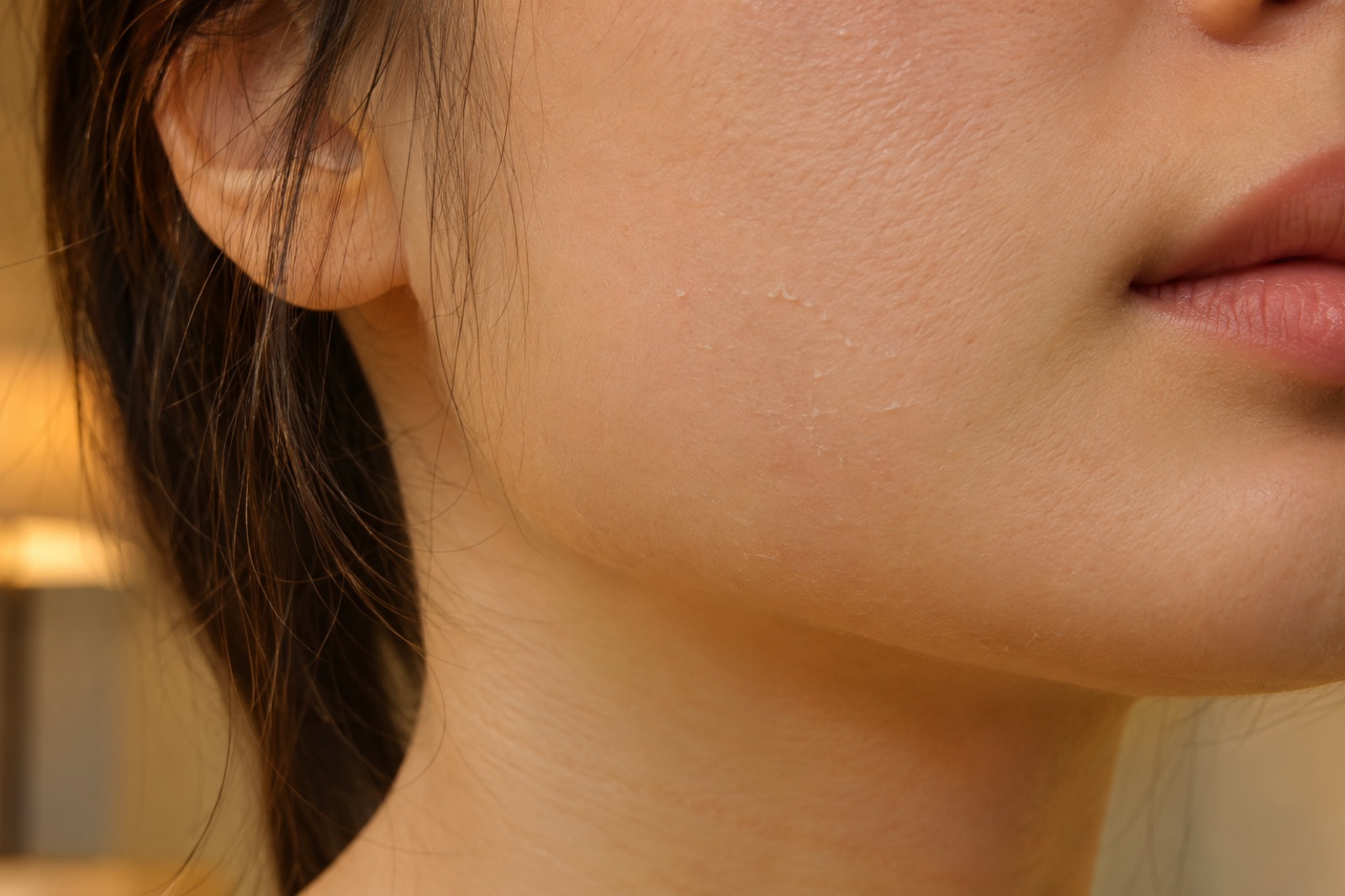
If you’re flaking more now that winter has set in, there’s no way to tell without notes whether retinol is behind it or the dry air and indoor heating. That week, write the flaking in the ‘what you felt’ box and the days you ran the heat in the variables box.
You’ve used 0.1% retinal for a week and feel nothing. Should you move to a higher strength now?
One week is far earlier than the points at which the studies measured results, so it isn’t the day to decide on a switch. This guide doesn’t cover how to raise the strength; you decide from the log once 12 weeks are filled in.
A 2024 study in which 32 women used a combination serum with 0.1% retinal plus peptides and ceramides looked at results at week 8, and 57% of the participants had sensitive skin. A 2023 study in which 32 middle-aged women applied a combination essence with 0.1% supramolecular retinol and acetyl hexapeptide-1 twice a day also watched for 8 weeks. Both were combination-product studies without a control group, so neither should be read as a result for retinal or retinol alone. What they share is that neither drew a conclusion at week 1.
Say you’re a college student who got a retinal cream as a gift and want to set your retinol aside after one week. The moment you switch, your log goes back to week 0.
Why does retinol pill when you put it on after an ampoule at night?
No study behind this guide looked at why pilling happens, so this guide doesn’t settle on one reason. Pilling isn’t a sign of results or of irritation; it belongs in the box where you note how much you used and how dry the product before it had gotten.
On nights it pills, write the name of the product you put on before it, the amount you used (pea-size, or a number of drops), roughly how long you waited after the step before, and where it pilled. If it only pilled on nights you got home from working late and applied it in a hurry, those rows will show the pattern. Keep the application order to what each product’s label says, and don’t change the products before and after it for 12 weeks. This log doesn’t decide whether your ampoule and retinol go well together.
What do you record on the baseline evening before you start?
Before deciding to keep going or switch, make tonight week 0: take three photos and write down what you hope won’t increase. Without this one evening, you’ll have no starting point to compare against at week 12.
Take the photos after washing in the evening and before applying retinol, in the same spot with only one indoor light on: front, left and right. Keep the distance between your phone and your face, and the angle of your head, the way you set them the first time. If you get home from work at a different time every day and the light keeps changing, pick one light that’s always the same, such as the bathroom ceiling light.

| Variable to hold steady | What to write in week 0 | What to do in a week it changes |
|---|---|---|
| Retinol product | The one product and the day you opened it | If you add or switch to another retinol or retinal product, start over at a new week 0 |
| Cleanser and moisturizer | The names you use now | Mark the week you changed them and read the rows after it separately |
| Where you keep it | Where it sits (bathroom shelf, dresser, etc.) | If it’s a spot that gets direct sunlight, move it and mark the day you moved it |
| Season and heating | The month you started | Mark the week you started running the heat or air conditioning |
| Sleep | The time you usually fall asleep | Mark weeks packed with all-nighters or late nights at work |
Your 12-week photo and use log
Each day gets two lines. On the first, write whether you applied it that day, how much and where, and whether you kept the products before and after it the same. On the second, write what you felt, such as stinging, pilling, flaking or greasiness.

| Week | Photo conditions check | Days applied | Amount and area | Used alongside | What you felt | Changed / not changed |
|---|---|---|---|---|---|---|
| Week 0 (baseline) | After evening wash, before applying, one indoor light, 3 shots | — | — | Names of the ampoule and moisturizer you use now | How redness and flaking look right now | One line on what you hope won’t increase |
| Week 1 | 3 shots, same spot and distance as week 0 | e.g., 3 of 7 days | e.g., 1 pea-size amount, skipping around the eyes and mouth | Same as week 0? Y/N | Stinging, pilling, flaking, greasiness | Side by side with week-0 photos |
| Week 2 | Same | |||||
| Week 3 | Same | |||||
| Week 4 | Same | At week 4, side by side with week 0 | ||||
| Weeks 5–8 | One row per week | At week 8, side by side with week 0 | ||||
| Weeks 9–11 | One row per week | |||||
| Week 12 | Same | 12-week total | Mark weeks it changed | Mark weeks it changed | Mark boxes that kept coming back | Week 0, 8 and 12 photos side by side |
If even one condition was different in a given week, mark it next to the box and leave that week’s photos out of the comparison. Leave days you didn’t log blank instead of filling them in from memory.
Before you switch: reading your log at week 12
Even at week 12, you don’t rule on whether retinol is working; you only look at what the log holds.
| How your log looks at week 12 | How to read it | What to do next |
|---|---|---|
| Many weeks with empty photo or days-applied boxes | Not enough to compare | Hold off on deciding and keep logging for as many weeks as were left empty |
| Stinging or pilling rows keep coming back under the same conditions | A sign to look at amount and days applied before the product | Go back over the amount and the days you apply it, within the range on the product’s label, and log that change too |
| Redness, stinging or peeling keeps going even on days off | Not something to keep logging through | Stop applying it and see a doctor |
| Nothing uncomfortable, only ‘not changed’ entries | Now is the time to decide whether to switch | If you switch, start the new product from week 0 again |
| Some weeks partway through where your cleanser, moisturizer or storage spot changed | The weeks before and after are under different conditions | Compare the stretch before and the stretch after separately |
When is a dermatologist visit the next step instead of a new product?
- If red spots, swelling or itching appear where you applied it, stop the retinol, and if it keeps going after you stop, take your log and photos to a dermatologist.
- If stinging or peeling won’t settle even on days you didn’t apply it, or the skin oozes, stop logging and see a dermatologist.
- If you’re using prescription retinoids (medicines) or another medicine you put on your skin, ask the clinic that prescribed it before you switch or add a cosmetic retinol.
- If you’re pregnant, planning a pregnancy or breastfeeding, talk with your doctor before you keep using retinol or switch products.
The studies and rule behind this log, in brief
- A 2022 open-label study (PMID 35691012) in which 23 adults aged 45 to 68 with sun-damaged skin used a retinol product for 12 weeks measured results with noninvasive imaging devices and questionnaires, and had no control group.
- A 2024 study (PMID 39496127) in which 32 women (57% with sensitive skin) used a combination serum with 0.1% retinal, peptides and ceramides looked at results at week 8; it was a manufacturer-run study without a control group that checked irritation separately with patch testing.
- A 2023 study (PMID 37538317) in which 32 middle-aged women applied a combination essence with supramolecular retinol twice a day for 8 weeks also compared before and after use without a control group.
- Korea’s Enforcement Rule of the Cosmetics Act, Annex 3 (amended February 18, 2022), sets “keep out of direct sunlight” as a storage caution that applies to all cosmetics.
Frequently asked questions
If retinol doesn't make my skin peel, does that mean it's not working?
There's no basis for reading it that way. Two of the studies this guide looked at checked irritation separately, with patch testing or as how well people tolerated the product, and measured results with other tools (one used imaging devices and questionnaires). Your log keeps the two apart too: flaking goes in the 'what you felt' box, and differences you see in photos go in the 'changed / not changed' box.
I've used a 0.1% retinal product for a week and feel no irritation and no results. Can I switch to a higher strength right away?
None of the studies behind this guide drew a conclusion at week 1; the ones it looked at watched for 8 or 12 weeks. If you switch now, you're left with one week of notes, and the next product starts over from the same place. This guide doesn't cover how to move up in strength. Decide whether to switch with the decision table after your 12-week log is filled in.
Why does my retinol pill when I put it on after an ampoule at night?
No study behind this guide looked at what causes pilling, so it isn't pinned on how ingredients get along. On nights it pills, write down the product you put on before it, the amount you used, roughly how long you waited after the step before, and where it pilled. Over time you may see a pattern, such as pilling only on nights you rushed. For application order, follow what each product's label says.
Can I use a retinol ampoule and a retinal cream on the same day?
No study behind this guide layered the two on the same evening, and this guide doesn't rule on whether that's okay. But if you use two retinol-family products during your 12-week log, you can't tell which one a stinging day or a change belongs to. Use only one while you log. If you're already using both, write both in the 'used alongside' box, and make the day you drop one your new week 0.
When should I see a doctor before switching retinol products?
If red spots, swelling or itching show up where you applied it and keep going after you stop, or if it oozes and the stinging won't settle, see a dermatologist before trying a different product. If you're using prescription retinoids (medicines), ask the clinic that prescribed them first, and if you're pregnant or breastfeeding, ask your doctor first. Bringing your log and photos makes it easier to explain what changed and when.
Why did my skin look glowy the first day on retinol but feel greasy the second day?
No study behind this guide measured glow or greasiness, so this guide doesn't name a reason or read it as a sign that retinol is working. In the 'what you felt' box, write how much you used that day and whether your moisturizer and cleanser were the same as the day before. A few days later, you can compare whether it happens again under the same conditions.
My skin flared up after I started retinol. Could it be because the product wasn't stable?
You can't judge a product's stability at home, so this log won't tell you whether that's the cause. Write down the day you opened it, whether you kept it somewhere that gets direct sunlight, and how much you used that day. If red spots, swelling or itching appear, stop applying it, and if it keeps going after you stop, bring your log to a dermatologist.
Can I tell from the ingredient list which ingredients make products pill?
No study behind this guide shows that a specific ingredient causes pilling, so you can't sort it out ahead of time from the ingredient list alone. Instead, on nights it pills, write down the amount and how dry the product before it had gotten, then compare those rows with nights it didn't pill.
Sources
- Facial skin of 23 sun-damaged adults examined with noninvasive imaging devices after 12 weeks of a retinol product (open-label study without a control group), 2022 (PMID 35691012)B
- 32 women (57% with sensitive skin) using a combination serum with 0.1% retinal, peptides and ceramides for 8 weeks, and how well it was tolerated, 2024 (PMID 39496127)B
- 32 middle-aged Chinese women using a combination essence with supramolecular retinol and acetyl hexapeptide-1 twice a day for 8 weeks, 2023 (PMID 37538317)B
- Korea's Enforcement Rule of the Cosmetics Act, Annex 3: Precautions for Use — common provisions, storage and handling (amended February 18, 2022) (Korean)Institutional
Videos and forum posts never count as evidence for a fact here. Full rules: Editorial policy
What to check when choosing a product for this routine
Check the criteria below before the product name. Each item can be found on the full ingredient list or in the product description.
| Item | What to look for | Why |
|---|---|---|
| Retinol or retinal on the label | Whether the full ingredient list has no retinol-family names such as retinol or retinal | For 12 weeks the retinol family stays limited to the one product you're logging, so the days-applied box points to that product alone |
| Names of acid ingredients | Whether the full ingredient list has names classed as acids, such as capryloyl salicylic acid, lactic acid or gluconolactone | If it does, write them in the 'used alongside' box in week 0, so on a night that stings you can check those names too |
| Where it goes in the routine | Whether the product page lists it as the last step of the routine | Keeping the spot after retinol on the same product for all 12 weeks keeps the 'products before and after' notes steady on nights it pills |
| No added fragrance | Whether fragrance is left out, going by the full ingredient list | On a night the 'what you felt' line says stinging, there is one fewer name besides retinol to suspect |
| Stop-use wording | Whether the product page has a caution to stop using it and get advice if anything unusual appears | On a day you stop, you can note in that day's row whether you paused the moisturizing step too or took out only the retinol |
Product from this site's operator · KW Cosmetic Content Team
Revive Therapy N.F CreamA 50 ml cream with 4 ceramides and 5 types of hyaluronic acid and no added fragrance per its full ingredient list; it completed a low-irritation patch test, and results vary by person. It has no retinol or retinal, has no test data on skin using retinol, and is unrelated to this guide's studies. Its ingredients include capryloyl salicylic acid, lactic acid, gluconolactone and niacinamide, so let your skin's reaction decide whether to use it on retinol evenings, and stop if redness or stinging keeps up. It goes last, after ampoule. To keep moisturizing to one product during the 12-week log, the product we suggest is Revive Therapy N.F Cream.
Fitting it into a routine
Where it goes: After ampoule, the last step of the routine
How to use it: After toner and ampoule, take a suitable amount and spread it gently from the center of the face outward. On areas where dryness bothers you, layer a small amount once more to finish.
Check before you use it: If red spots, swelling, itching or any other unusual reaction appears during or after use, stop using it and consult a dermatologist. Avoid using it on areas with wounds, and check the full ingredient list and expiry date on the latest packaging first.
Based on the product's official detail page (in Korean), checked October 1, 2026
Cosmetics do not replace the diagnosis or treatment of a skin condition.