Retinol Pores, First 4 Weeks: Flaking vs. Pore Days by Area and Time
In the first 4 weeks, don't judge your pores. Write down flaking and tightness separately from the areas where pores stood out, at the same three times each day, so you can tell them apart.

What this note covers8 sections
- Pores look different morning and night. Is that the retinol?
- My skin is flaking and peeling after retinol. Should I keep using it?
- Small bumps came up after starting retinol. Is my skin just adjusting?
- I bought a retinol serum and a pore serum together. Do I need to use both?
- What do you decide after 4 weeks, and what do you put off?
- Your first 4 weeks on retinol: an area and time-of-day log
- When should you see a dermatologist during these 4 weeks?
- The evidence behind this log, in three points
| What to set | What the sources showed | Basis |
|---|---|---|
| When to look | When 47 and 57 people’s faces were photographed right after waking, after the morning wash and after the evening wash, pore area and roughness fluctuated most right after waking | 2021 study · B |
| Skin condition and strength | In a study comparing retinoids half a face at a time in 253 healthy volunteers, lower concentrations caused less irritation, and normal skin tolerated them better than sensitive skin | 2004 half-face study · A |
| Formulation | Even at the same concentration, changing the base formulation generally gave lower irritation scores across three 24-hour patches over 5 days | 1998 patch test · A |
| Log length and frequency | Log the 7 days before you start as a baseline week, then fill three columns a day for 28 days | Editorial choice |
| When to stop and get advice | As a general precaution, it states that if red spots, swelling, itching or similar symptoms appear on the applied area due to direct sunlight, you should consult a medical specialist or other professional, and that use on wounds should be avoided | Korea’s Enforcement Rule of the Cosmetics Act, Annex 3 · Institution |
Pores look different morning and night. Is that the retinol?
Not necessarily. The same face shows its pores differently over a single day, so comparing two looks taken at different times can’t separate out retinol’s share.
A 2021 study in Japan (47 and 57 people) photographed faces right after waking, after the morning wash and after the evening wash; pore area and roughness fluctuated most right after waking, and redness fluctuated most after the evening wash. The study also reported results after 4 weeks of using one product, but it had no control group, so only the daily fluctuation is used here. That’s why the log skips the moment you get up and makes “10 minutes after the morning wash” its first column. Even if getting ready for work shifts the time you wash, keep the 10-minute gap after washing.

My skin is flaking and peeling after retinol. Should I keep using it?
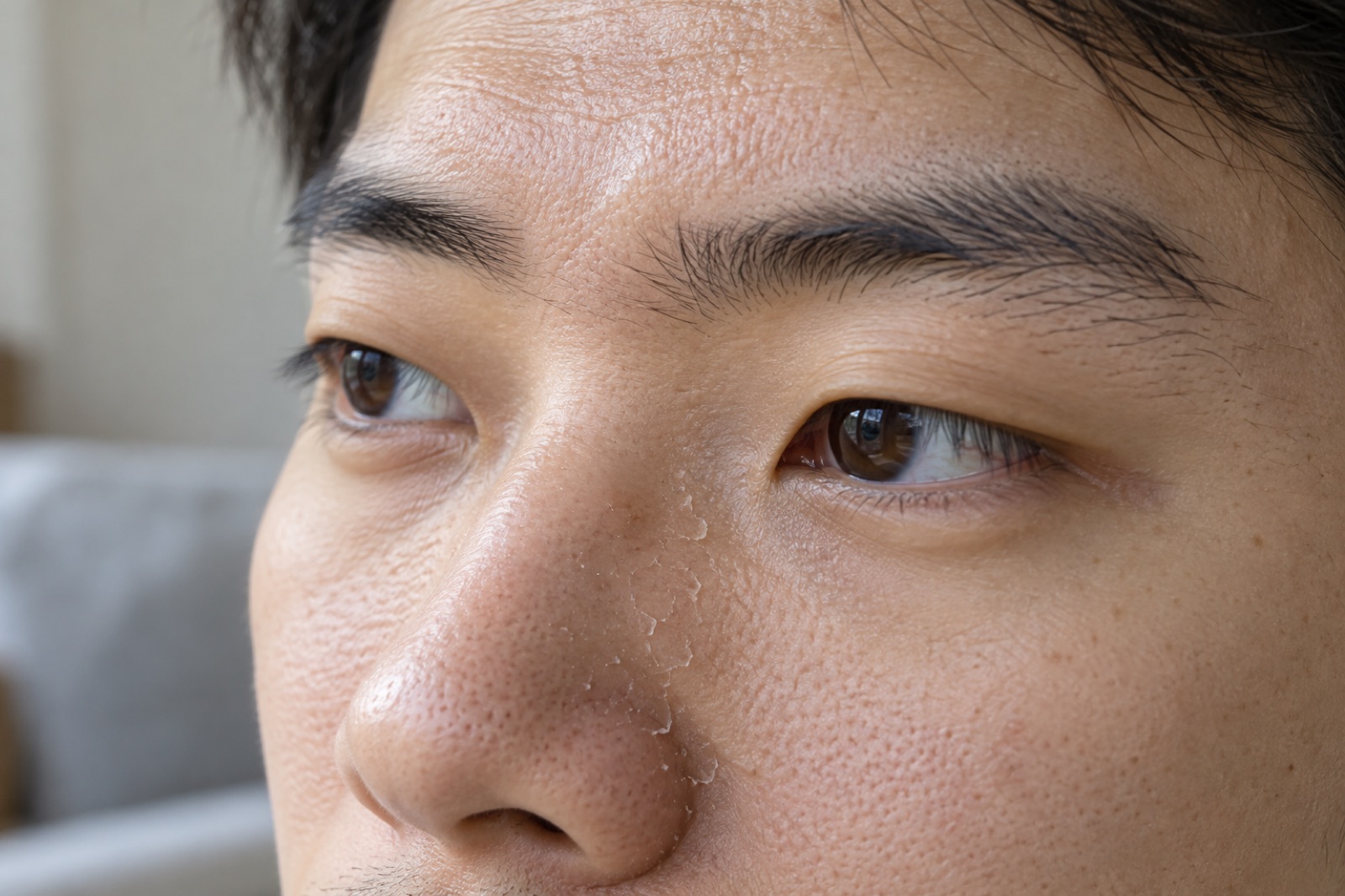
If it’s some, keep going at the same frequency and keep logging; if a lot lasts more than 3 days, or red spots, swelling or itching appear, stop. If your pores also looked more visible on a day you flaked, leave that day’s pore column out of the comparison.
The studies below looked at prescription retinoids, not cosmetic retinol, but the factors that made a difference are still worth knowing. In a 2004 study comparing half faces in 253 healthy volunteers, lower concentrations caused less irritation, and the authors wrote that skin vulnerability may be the most important factor. In a 2022 split-face trial in which adult women with acne applied the same ingredient as a lotion on one cheek and a cream on the other, the cream side already showed more redness, flaking and dryness at the 2-week point. That’s why the flaking column and the pore column are kept apart from the start.
Small bumps came up after starting retinol. Is my skin just adjusting?
There’s no basis for calling it an adjustment period. First, use your log to sort out whether the bumps came up where you applied retinol and where flaking appeared, and whether anything else was different that day.
Split the face into four columns: nose, inner cheek, outer cheek and forehead. If you applied retinol to your whole face but the bumps gathered only on the outer cheek where mask straps rub, look at them together with the mask in the other-factors column. If they gathered in a week around your expected period or a week of late nights at work, mark that week separately. If red, painful bumps or ones with pus are mixed in, see a doctor rather than carrying on with the log.
I bought a retinol serum and a pore serum together. Do I need to use both?
Bring in only one for the first 4 weeks. If you start both the same week, you can’t tell which product to tie changes in the flaking and pore columns to.
If you logged the retinol first for 4 weeks, give the pore serum its own 4 weeks after that and keep writing on the same chart. During that time, don’t change the cleanser, toner or cream you already use, either. A 2024 literature review also summarized that retinoids’ stability and irritation vary with the derivative, the delivery system and the ingredients combined with them, so even under the same “retinol” name, switching products means starting the log over.
What do you decide after 4 weeks, and what do you put off?
What you decide after 4 weeks goes only as far as whether to keep going at your current frequency or stop. Don’t judge from 4 weeks whether your pores changed; keep filling in the same columns.
If the flaking and tightness column goes back to none within 2 weeks and only the pore column is left, that’s your starting point for comparing pores. Cosmetic studies that measured pores also watched over a longer period than this. If you had skipped nights, line up the rows for days after skipping with the rows for days after applying; if flaking is still a lot even the day after a skipped night, look first at other factors such as heating or air conditioning, or a change in how you wash.

Your first 4 weeks on retinol: an area and time-of-day log
Fill in three time points on one row a day. Instead of scores, write only none, some or a lot, and the names of areas.
| Date | Retinol last night | 10 min after morning wash — flaking and tightness | 10 min after morning wash — areas where pores stood out | Out or 2 hours into makeup — where makeup lifted | Before evening wash — shiny areas | Other factors that day |
|---|---|---|---|---|---|---|
| Baseline week (days 1–7 before starting) | Not applied | None, some or a lot | Mark nose, inner cheek, outer cheek or forehead | e.g., beside the nose | e.g., forehead | Period, late nights, mask, heating or AC, new product |
| Week 1 (days 1–7) | Applied / skipped | |||||
| Week 2 (days 8–14) | Applied / skipped | |||||
| Week 3 (days 15–21) | Applied / skipped | |||||
| Week 4 (days 22–28) | Applied / skipped | |||||
| Side by side | One row after a skipped night ↔ one row after an applied night | Compare the flaking column | Compare areas | Same spot or not | Same spot or not | Whether both days had the same factors |
Without a baseline week, you can’t tell whether what’s in the week 1 area column is simply how your skin already was. On days you use a sebum softener, a pore strip or an exfoliating product, write it in the other-factors column, and leave the next day’s row out of the side-by-side comparison.
When should you see a dermatologist during these 4 weeks?
- If red spots, swelling or itching go on for a few days even after you stop the retinol, bring your log and see a dermatologist.
- If spots where flakes peeled crack and sting, or start to ooze, stop applying and see a doctor.
- If red, painful pimples or ones with pus increase over the 4 weeks, seeing a doctor comes before continuing the log.
- If you already use a topical product you got from a medical provider, ask them first before adding retinol.
The evidence behind this log, in three points
- In a 2021 study that photographed the faces of 47 and 57 young Japanese women three times a day (PMID 34198790), pore area and roughness fluctuated most right after waking, and redness after the evening wash, of any time in the day.
- In a 2004 half-face comparison in 253 healthy volunteers (PMID 15624747), lower retinoid concentrations caused less irritation, and normal skin tolerated them better than sensitive skin.
- In Korea, the Enforcement Rule of the Cosmetics Act, Annex 3 (amended February 18, 2022), states that if unusual symptoms appear on the applied area due to direct sunlight, you should consult a medical specialist or other professional, and that use on wounds should be avoided.
Frequently asked questions
My skin is flaking and peeling after retinol. Should I keep using it?
If your morning flaking column reads some, keep going at the same frequency and keep logging; if it reads a lot for more than 3 days, or red spots, swelling or itching show up with it, stop. Leave peeled spots out of where you apply for a while and mark them in the area column. If it doesn't settle down even after you stop, bring your log and see a doctor.
Small bumps came up after starting retinol. Is my skin just adjusting?
Deciding ahead of time that it's an adjustment period can make you miss other causes, so don't judge it by that label. First check in your log whether the bumps overlap the area where you applied retinol, and whether a mask, your period or a new product fell in the same week. If red, painful bumps or ones with pus are mixed in, see a doctor.
I bought a retinol serum and a pore serum together. Do I need to use both?
Use only one for the first 4 weeks. If you open both the same week, you can't tell which product to tie the days you flaked and the days your pores stood out to. After the 4-week log for the first one ends, log the other one fresh for another 4 weeks.
Can I take a few days off retinol and start again?
You can take a break and start again; mark the skipped nights as skipped in the retinol-last-night column. Lining up the morning rows after skipped nights with the morning rows after applied nights and comparing the flaking column gives you something to go on when deciding whether to space it out more. This guide doesn't set a schedule such as how many times a week to work up to.
What happens if you use too much retinol?
The sources behind this guide don't include data comparing what happens when the amount goes up. A day you used more is a new condition in itself, so write it in the other-factors-that-day column, and check in the area column whether the spots that flaked the next day are inside the area you applied.
Can I use retinol on a day I used a sebum softener or a pore strip?
For the first 4 weeks, keeping them on separate days fits the log better. Write the day you used a softener or a strip in the other-factors-that-day column, and leave the next morning's flaking column out of the side-by-side comparison. Starting a new exfoliating product at the same time as retinol also waits until after the 4 weeks.
My makeup makes flaking stand out while I'm on retinol. What should I do?
The 2-hours-into-makeup column is exactly where you write down that moment. If the spots where makeup lifted match the areas in your morning flaking column, you can tell it was a day flaking, more than your pores, made your makeup lift. Write it in the other-factors column too on days you changed your cushion compact or puff.
If I use retinol at night, can I just rinse with water in the morning?
This guide doesn't decide how you wash. Whether you rinse with water or use a cleanser, keeping the same method for 4 weeks is the condition for the log, and either way the morning columns get filled 10 minutes after washing. Write any day you changed methods in the other-factors column.
How do I tell if bumps on the side of my cheek are dead skin or sebum?
It's hard to judge at home whether it's dead skin or sebum. Instead, just write down how that spot changes between two columns: 10 minutes after washing and 2 hours into makeup. If the bumps stay the same for weeks, or small white, hard grains linger for a long time, have a doctor check them.
Sources
- Daily fluctuation of facial pore area, roughness and redness in young Japanese women, 47 and 57 participants photographed three times a day, 2021 (PMID 34198790)B
- Half-face tolerability comparison of prescription retinoids in 253 healthy volunteers, 2004 (PMID 15624747)A
- Patch-test irritation of prescription retinoid formulations, three 24-hour patches over 5 days, 1998 (PMID 9555821)A
- Same prescription retinoid as lotion vs. cream, 2-week split-face comparison in adult women with acne, 2022 (PMID 35946981)A
- Review of retinoid derivatives, nanolipid carriers and combined ingredients for stability and skin irritation, 2024 (PMID 38952060)A
- Korea's Enforcement Rule of the Cosmetics Act, Annex 3 — Precautions for use, 1. General precautions (re Article 19(3), amended February 18, 2022) (Korean)Institutional
Videos and forum posts never count as evidence for a fact here. Full rules: Editorial policy
What to check when choosing a product for this routine
Check the criteria below before the product name. Each item can be found on the full ingredient list or in the product description.
| Item | What to look for | Why |
|---|---|---|
| Step listed after cleansing | Whether the product page says it's used right after cleansing, before moisturizing products | Keeping the slot after cleansing on one product for the 28 days you add retinol means the 10-minutes-after-the-morning-wash column gets filled under the same conditions every day |
| Acids, ethanol, fragrance | Whether the full ingredient list or the pre-use notes name an acid such as salicylic acid, ethanol or fragrance | In a week your flaking column reads a lot, you can already have what you applied alongside it written in the other-factors-that-day column |
| Red spots or swelling note | Whether it says to stop using it and get advice if red spots, swelling or itching appear | You can lay the signal your log sets for stopping and the product's own stop point side by side on one line |
| Eye area and wound note | Whether it says to avoid the eye area and wounds | It becomes easier to leave spots that sting after peeling out of where you apply, and to mark them separately in the area column |
| How long one bottle lasts | Whether the volume is listed, so you can use it for 5 weeks including the baseline week without switching to another toner | If your toner changes partway, from that day on the flaking column no longer points to retinol alone |
Product from this site's operator · KW Cosmetic Content Team
Revive Therapy N.F TonerThe retinoid irritation studies and the daily pore-fluctuation measurements cited in this guide did not test this toner, and there is no test data on using it with a retinol product. It is a mildly acidic (pH 5.5–6.5), 150 ml toner with a low-irritation formula, though skin varies, and it contains ethanol 3.0%, fragrance and salicylic acid. Its product page places it after cleansing and before moisturizing products; avoid the eye area and wounds, and stop if red spots, swelling or itching appear. The product we suggest for the after-cleansing slot you leave unchanged during your first 4 weeks with a retinol product is Revive Therapy N.F Toner.
Fitting it into a routine
Where it goes: After cleansing, before your moisturizing products
How to use it: After cleansing, pour a suitable amount onto your palm or a cotton pad. Smooth it gently along the skin's texture, or press it in lightly with your palms until absorbed. Then follow with whichever moisturizing products your skin needs at the time.
Check before you use it: Contains ethanol 3.0%, fragrance and salicylic acid. When you use it together with other products that contain acids, watch how your skin reacts and adjust how often you use it, and avoid the eye area and any wounds. If red spots, swelling, itching or any other unusual reaction appears, stop using it and consult a dermatologist.
Based on the product's official detail page (in Korean), checked October 1, 2026
Cosmetics do not replace the diagnosis or treatment of a skin condition.