Retinol Schedule for Beginners: 8 Weeks From Twice a Week to Daily
Start retinol with one thin layer at night, two nights a week, watch how your skin reacts, and build up to nightly use over the course of 8 weeks.

What this note covers9 sections
- Retinol schedule for beginners: can you use it every day from the start?
- What happens if you apply too much retinol?
- Why do you apply retinol at night?
- What should you do on rest nights?
- Can you use retinol with vitamin C, AHA, or BHA on the same day?
- Can you start with retinal if you’ve never used retinol?
- First 8 weeks of retinol: schedule
- When should retinol irritation send you to a doctor?
- Where the numbers on this page come from
| Point | Detail | Source |
|---|---|---|
| Starting frequency | A consensus of 133 dermatologists ranked gradual, spaced-out nighttime application among its most strongly agreed recommendations (28 of 34 reached consensus) | 2024 PMID 38972576 · A |
| Rest nights | The same consensus saw moisturizing, sun protection, and cleansing as important supports for managing irritation | 2024 PMID 38972576 · A |
| Common reactions | Common side effects of topical retinoids are dryness, itching, burning, and redness, and sunburn is a concern with sun exposure | Korean Dermatological Association · institution |
| Retinol irritation | The group applying 0.5% retinol once a day for 12 weeks reported more peeling and stinging than the comparison group (44 people) | 2019 PMID 29947134 · A |
| Trial length | The average length of 23 randomized trials of topical agents for photoaging was 8 weeks (4 to 36 weeks) | 2025 PMID 40707570 · A |
Retinol schedule for beginners: can you use it every day from the start?
With retinol, rather than applying it daily from the start, beginning at two nights a week and building up over 8 weeks matches expert consensus. In a 2024 Delphi consensus where 133 dermatologists rated 34 recommendations, 28 (82.3%) reached consensus, and one of the items with the highest agreement was gradual, spaced-out application at night.
That consensus was about prescription retinoids, so we don’t apply it directly to cosmetic retinol, but cosmetic retinol can be irritating too. In a 2019 trial comparing 44 people over 12 weeks, the group applying a 0.5% retinol cream once a day reported more peeling and stinging than the comparison cream group applying twice a day. If you start on two nights at least three days apart, such as Monday and Thursday, it is easier to tell which night caused a reaction.
What happens if you apply too much retinol?
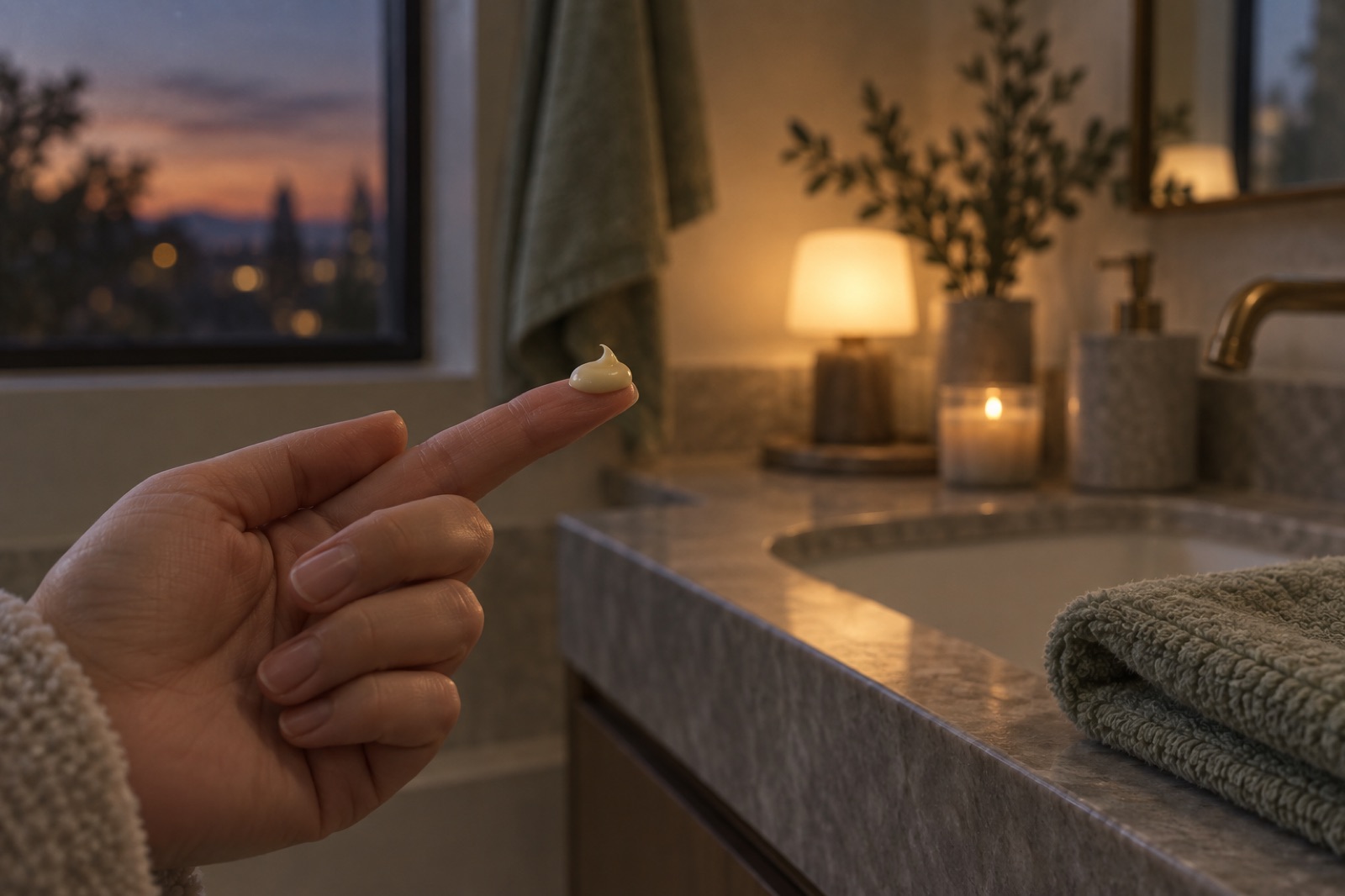
In the evidence for this page we found no human study that put a larger amount side by side with a smaller one, but it is safer to assume the chance of irritation goes up. Even with 0.5% retinol just once a day, more peeling and stinging were reported than in the comparison group in the 2019 trial (44 people).
One of the items the 2024 dermatologist consensus agreed on most strongly was also “gradually, with spacing.” So this schedule raises the number of nights you apply it instead of the amount. Keep the amount per application fixed at just enough to spread thinly over your whole face, and for the first 2 weeks use less on, or skip, the sides of the nose and around the mouth, which dry out easily. For the same reason, don’t layer it on thickly in the hope of easing the stinging. For a moisturizing cream to use on rest nights, see How to Use Panthenol Cream the Day After Exfoliating or Shaving.
Why do you apply retinol at night?
Because it tends to cause dryness and redness, nighttime, with less sunlight and friction, is easier on your skin. The Korean Dermatological Association, a Korean medical society, lists dryness, itching, burning, and redness as common side effects of topical retinoids, and says sunburn is a concern with sun exposure.
The same association explains that retinoids speed up the turnover of skin cells so dead skin cells shed. White flaking beside the nose and around the mouth in the first few weeks can look like part of this process. So don’t skip sunscreen the morning after a retinol night, and if you have a long day of exercise or outdoor activity coming up, move the night before into a rest slot.
What should you do on rest nights?
On rest nights, the job is moisturizer, sunscreen the next morning, and keeping exfoliating products off the same schedule. The 2024 consensus also named moisturizing, sun protection, and cleansing as important supports for managing irritation.
A 2026 international expert consensus on ingredients around aesthetic procedures rated retinoids, glycolic acid, and salicylic acid unsuitable on the day of a procedure. That is a procedure setting, but resting both retinol and acids on days your skin is sensitive points the same way. If you have a dermatology procedure scheduled, leave the retinol slots empty that week as the clinic doing the procedure advises.
Can you use retinol with vitamin C, AHA, or BHA on the same day?
For the first 8 weeks, don’t overlap them at the same time of day: keep vitamin C in the morning and retinol at night, and rest acids (AHA, BHA) for the length of the schedule. The evidence on this page has no study that compared layering these ingredients at the same time against separating them, so this layout simply picks the option that lets you tell reactions apart.
Just as the 2026 consensus on ingredients around procedures grouped retinoids, glycolic acid, and salicylic acid as unsuitable on the day of a procedure, don’t gather these ingredients into one night while your skin is sensitive.
| Day | Morning | Night (weeks 1–2) | Night (week 5 onward) |
|---|---|---|---|
| Mon | Vitamin C → sunscreen | Retinol → moisturizer | Retinol → moisturizer |
| Tue | Sunscreen | Moisturizer only | Retinol → moisturizer |
| Wed | Vitamin C → sunscreen | Moisturizer only | Moisturizer only |
| Thu | Sunscreen | Retinol → moisturizer | Retinol → moisturizer |
| Fri | Vitamin C → sunscreen | Moisturizer only | Retinol → moisturizer |
| Sat | Sunscreen | Moisturizer only | Moisturizer only |
| Sun | Sunscreen | Moisturizer only | Moisturizer only |
The week-5-onward column is an example matched to the every-other-night stage of the schedule. Bring AHA or BHA back once a week, on a night you rest retinol, only after the 8-week schedule is done and your scores stay at 0–1 with nightly use, and leave retinol out that night so they don’t overlap. Storing a vitamin C product continues in How to Store Vitamin C Serum, Read Its Label, and Spot Oxidation, and how often to use acids when you bring them back continues in AHA BHA in Your First 2 Weeks: Day-by-Day Plan and Stop Signs.
Can you start with retinal if you’ve never used retinol?
We found no study comparing people who skipped retinol and went straight to retinal, so if you are new, starting retinal at the same pace is the safer choice. In a 2018 trial where 40 Korean women used a retinaldehyde 0.1% or 0.05% cream twice a day for 3 months, both strengths were well tolerated, but the design had no placebo group.
In a trial the same year of 55 women with photoaging, adverse reactions over 8 weeks with a 0.1% retinaldehyde combination cream were 12 times fewer than with glycolic acid peels. The comparison was a professional procedure, so it can’t be read to mean retinal is gentler than retinol. That is why we suggest first confirming you were comfortable using retinol every night for 8 weeks, and only then weighing a switch.
First 8 weeks of retinol: schedule
| Weeks | Retinol nights | Rest nights and next morning | What to log | Condition to move up |
|---|---|---|---|---|
| Weeks 1–2 | Twice a week (Mon, Thu) | Moisturizer only / sunscreen in the morning | Dryness, stinging, redness 0–3 | All at 0–1 |
| Weeks 3–4 | Three times a week (Mon, Wed, Fri) | Moisturizer only, pause exfoliating products | Same items, areas that peeled | All at 0–1 |
| Weeks 5–6 | Every other night | Thicker moisturizer on rest nights | Same items, days outdoors | Scores of 2 or higher last no more than three days |
| Weeks 7–8 | Every night | Sunscreen in the morning | Same items, mark period and late-work days | Stays at 0–1 with nightly use |
| After 8 weeks | Keep going or every other night | Same | Your 8-week score trend | Decide whether to switch to retinal |
If a score of 2 or higher lasts more than three days, drop back to the previous frequency and stay there for 2 more weeks. Just as the average length of 23 randomized trials of topical agents for photoaging (3,905 people) was 8 weeks, treat 8 weeks as the minimum unit for judging your schedule, and don’t switch products before then.
When should retinol irritation send you to a doctor?
- If you get swelling, oozing, or intense burning, stop retinol and see a dermatologist.
- If redness and stinging don’t settle after you drop back one step and rest for 2 weeks, consider seeing a dermatologist.
- If tiny bumps or breakouts haven’t eased for months and you want to push retinol harder, first ask a dermatologist whether you need a prescription retinoid.
- If you are pregnant or planning a pregnancy, talk to your doctor before using it.
Where the numbers on this page come from
- In a 2024 Delphi consensus of 133 dermatologists (PMID 38972576), 28 of 34 recommendations (82.3%) reached consensus, and gradual, spaced-out nighttime application along with moisturizing and sun protection got the highest agreement.
- In a 2019 trial comparing 44 people over 12 weeks (PMID 29947134), the group applying a 0.5% retinol cream once a day reported more peeling and stinging than the comparison group.
- In a 2018 trial where 40 Korean women used a retinaldehyde cream for 3 months (PMID 29663701), both the 0.1% and 0.05% strengths were well tolerated, but there was no placebo group.
Frequently asked questions
Can I use retinol every day when I'm just starting?
We don't suggest daily use from the start. A 2024 Delphi consensus of 133 dermatologists ranked applying retinoids gradually, spaced out, and at night as its most strongly agreed recommendation. That consensus was about prescription retinoids, but starting cosmetic retinol at twice a week and building up over 8 weeks fits the same direction.
Why do you use retinol at night?
Retinoids speed up the turnover of skin cells and can cause dryness and redness, so nighttime, with less sunlight and friction, puts less strain on your skin. The Korean Dermatological Association lists dryness, itching, burning, and redness as common side effects of topical retinoids and warns about sunburn with sun exposure. That is why you should not skip sunscreen the next morning.
Can you start with retinal if you've never used retinol?
We found no study comparing people who skipped retinol and started directly with retinal. In a 2018 trial where 40 Korean women used a retinaldehyde 0.1% or 0.05% cream for 3 months, both strengths were well tolerated, but there was no placebo group. If you are new to this, it is safer to start retinal at two nights a week, too, and build up at the same pace.
Sources
- Preventing and managing topical retinoid irritation, Delphi consensus of 133 dermatologists, 2024 (PMID 38972576)A
- 0.5% bakuchiol vs 0.5% retinol cream, 12-week randomized trial, 44 participants, 2019 (PMID 29947134)A
- Retinaldehyde 0.1% and 0.05% cream in 40 Korean women, 3-month randomized trial, 2018 (PMID 29663701)A
- 0.1% retinaldehyde cream vs glycolic acid peels over 8 weeks, 55 women with photoaging, 2018 (PMID 30027612)A
- Network meta-analysis of 23 randomized trials (3,905 people) of topical agents for photoaging, 2025 (PMID 40707570)A
- Skincare ingredients before and after aesthetic procedures, international expert Delphi consensus, 2026 (PMID 42087526)A
- Korean Dermatological Association — Acne vulgaris, side effects of topical retinoids (Korean)Institutional
- Korean Dermatological Association — Dermatologic therapies: functional cosmetics (Korean)Institutional
Videos and forum posts never count as evidence for a fact here. Full rules: Editorial policy
What to check when choosing a product for this routine
Check the criteria below before the product name. Each item can be found on the full ingredient list or in the product description.
| Item | What to look for | Why |
|---|---|---|
| Fragrance on the label | Whether fragrance appears on the full ingredient list | On a night your stinging score goes up, there's one less cause besides retinol to sort out |
| Step in the routine | Whether the directions say where it goes, such as last in the routine after ampoule | Keeping the same order on rest nights and retinol nights lets you compare 8 weeks of scores under the same conditions |
| Note on layering | Whether it says to add a little more on dry areas | In weeks 5–6, you can mark 'thicker moisturizer on rest nights' separately for flaking spots like beside the nose or around the mouth |
| Stop-use note | Whether it says to stop if red spots, swelling or itching appear | In a week you drop back a step after three days at 2 or more, you can decide by the label whether the cream stops too |
Product from this site's operator · KW Cosmetic Content Team
Revive Therapy N.F CreamIn this schedule, the cream belongs in the 'moisturizer only' box on your rest nights. It's a 50 ml cream with 4 ceramides and 5 types of hyaluronic acid, with no added fragrance and a completed low-irritation patch test, but there's no test data on using it alongside retinol, and it's unrelated to the consensus and studies cited here. Its product page lists it last in the routine, after ampoule. For the moisturizer box you keep on rest nights through all 8 weeks, the product we suggest is Revive Therapy N.F Cream.
Fitting it into a routine
Where it goes: After ampoule, the last step of the routine
How to use it: After toner and ampoule, take a suitable amount and spread it gently from the center of the face outward. On areas where dryness bothers you, layer a small amount once more to finish.
Check before you use it: If red spots, swelling, itching or any other unusual reaction appears during or after use, stop using it and consult a dermatologist. Avoid using it on areas with wounds, and check the full ingredient list and expiry date on the latest packaging first.
Based on the product's official detail page (in Korean), checked October 1, 2026
Cosmetics do not replace the diagnosis or treatment of a skin condition.