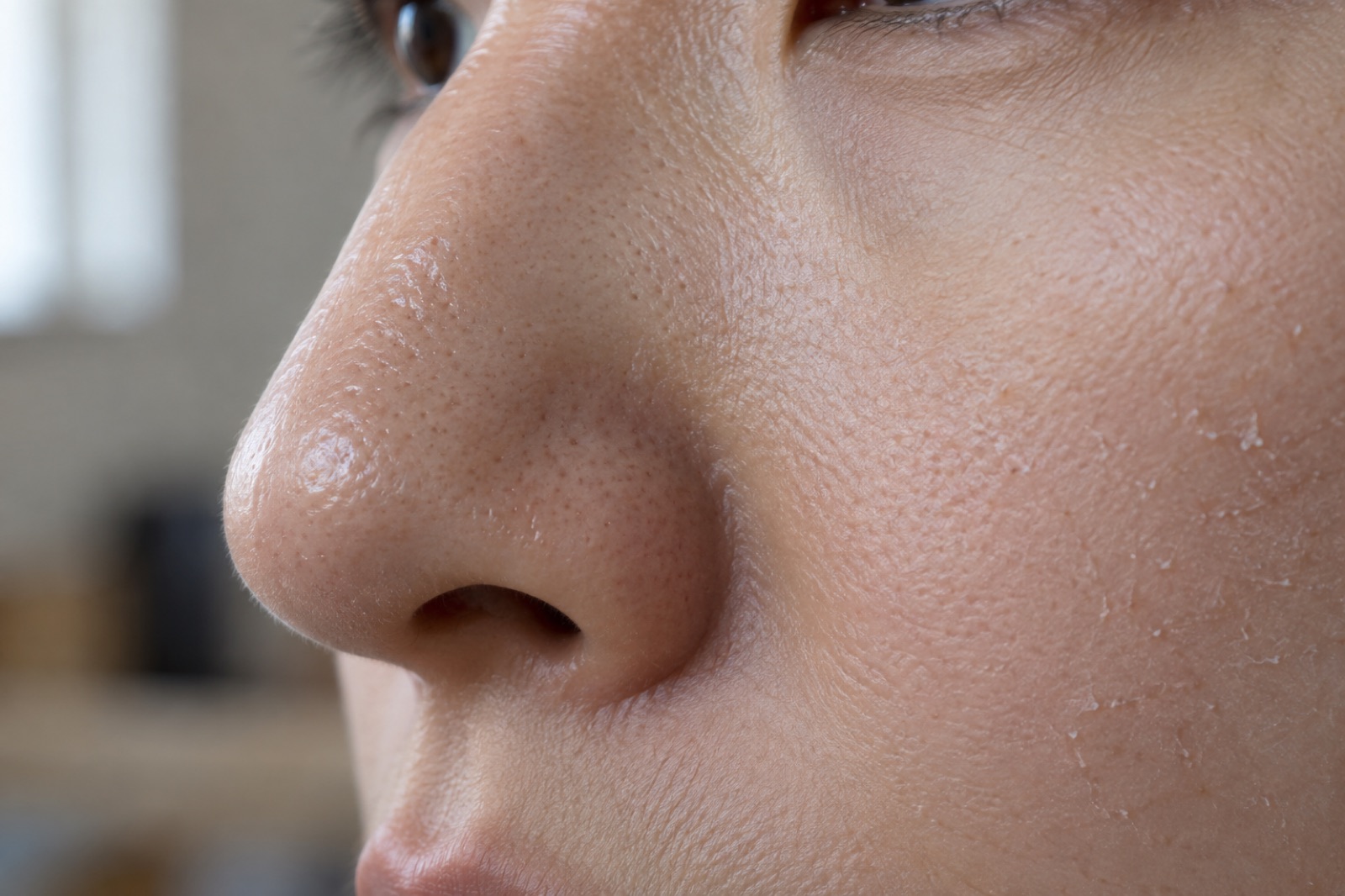
Oily Skin in Summer, Dry in Winter: Split Care by Face Zone
When seasons change, each part of your face can react differently. In summer, use a little less on your T-zone, and in winter, add one extra layer of moisturizer to your cheeks.
What this note covers7 sections
- Why does your T-zone get shinier in summer?
- How should you handle tight cheeks under winter heating?
- Do your T-zone and cheeks change the same way each season?
- Should you switch your cleanser, sunscreen and cushion compact with the seasons too?
- Season and zone plan, plus a 2-week check for season changes
- When is it time to talk to a dermatologist?
- Evidence summary for this guide
| Situation | Detail | Basis |
|---|---|---|
| Summer heat | Sebum output rises 10% for every 1°C increase in body temperature, so sebum and sweat can both climb in summer | KDCA (Korea) · Institution |
| Heated indoor air in winter | After 6 hours in a winter room at 23.05% humidity, facial roughness rose 7.38% on the side without cream, while the side with cream showed no significant change | 2023 PMID 37357654 · A |
| Forehead vs. cheeks | In a study of 100 Korean men, forehead water loss differed by season (21.41 in summer vs. 17.40 g/h/m² in winter), but the cheeks showed no seasonal difference | 2022 PMID 35677917 · A |
| Overall seasonal picture | The 11 studies on season and climate had mixed results, and the 2 on indoor humidity found no correlation between humidity and water loss | 2022 PMID 35677917 · A |
| 6 weeks of winter moisturizing | When 16 young women applied moisturizer to one side of the face twice a day for 6 weeks, that side had higher hydration and lower water loss | 2003 PMID 14571069 · B |
Why does your T-zone get shinier in summer?
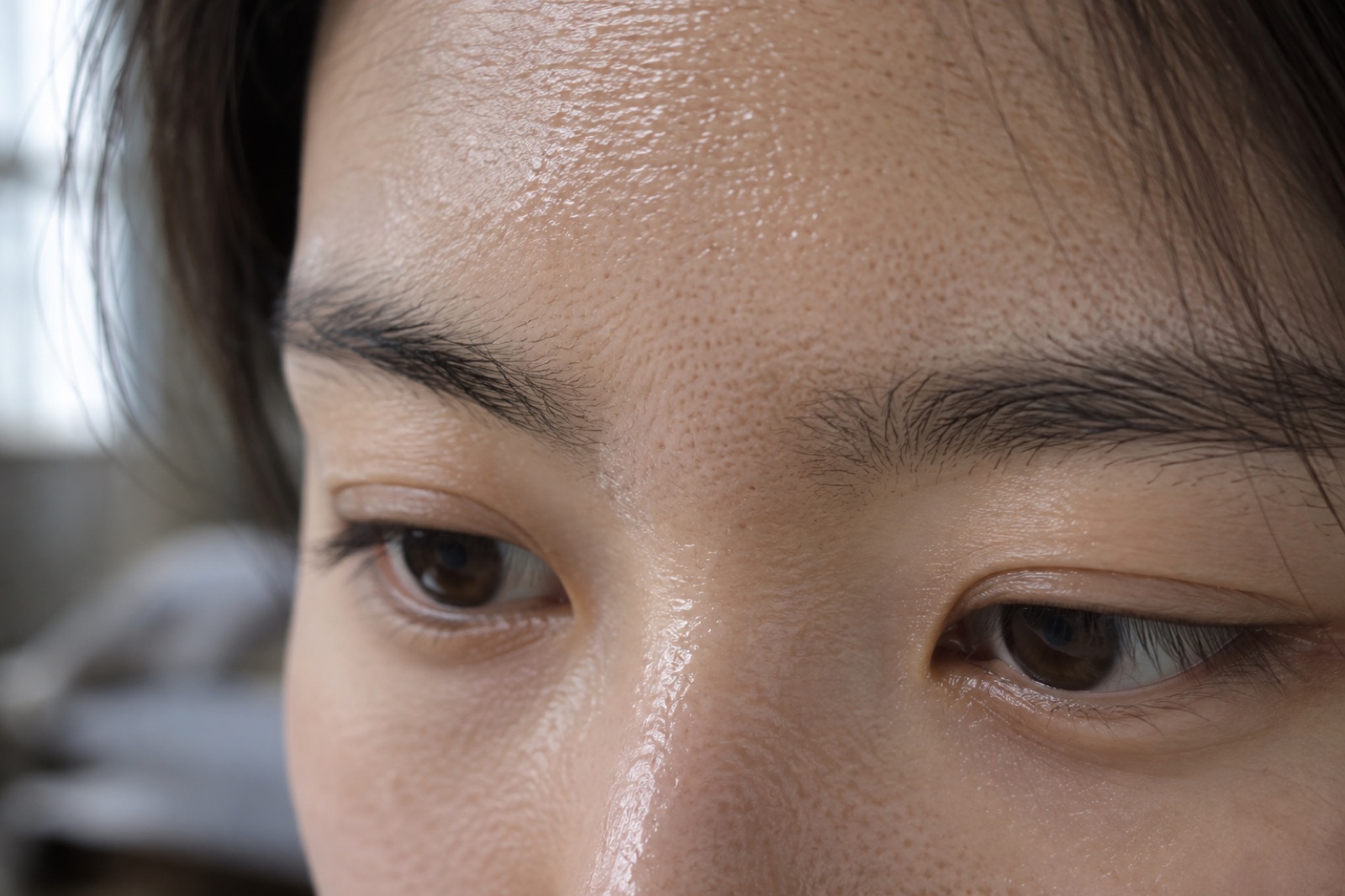
When heat raises your body temperature, sebum tends to go up, so your T-zone gets shinier on summer afternoons even with the same products. The Korea Disease Control and Prevention Agency (KDCA) explains that sebum output rises 10% for every 1°C increase in body temperature, which can make quiet acne flare in summer.
In this season, try applying one less round of toner and lotion on your forehead and nose while keeping the same spring amount on your cheeks. On days you spend a long time in the sun, like walking to class or working outdoors, press a blotting paper on your T-zone once around 3 p.m. and write down how many times you blotted. On days spent in a strongly air-conditioned office, your cheeks may actually feel tight, so score your T-zone and cheeks separately on the same day.

How should you handle tight cheeks under winter heating?
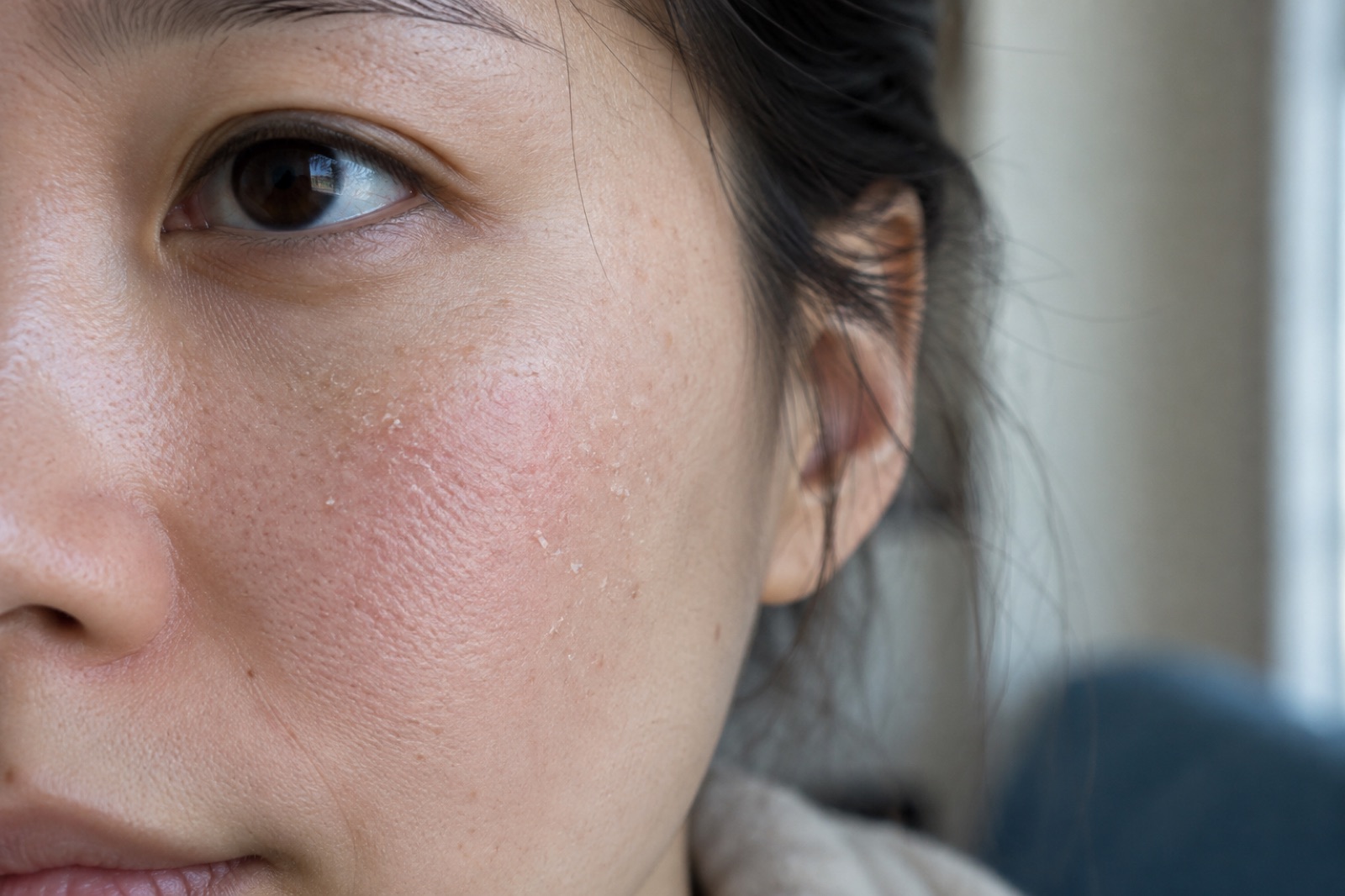
On days spent in dry, heated rooms, adding one extra layer of moisturizer to your cheeks comes first. In a 2023 Korean study, 20 women who stayed 6 hours in a winter room at 23.05% humidity showed a 7.38% rise in roughness and a 5.84% rise in a wrinkle index on the side of the face without cream, while the side with cream showed no significant change.
In the same study, water loss on the untreated arm rose 26.70% after 6 hours. In a 2003 split-face trial, 16 people who moisturized one side of the face for 6 weeks in winter also had higher hydration on that side. Both studies are small and tested multi-ingredient products, so keep “one more layer on the cheeks in winter” as the default and decide the T-zone separately by watching its shine score.
Do your T-zone and cheeks change the same way each season?
They may not. A study of 100 Korean men in a 2022 systematic review (15 human studies) found higher forehead water loss in summer and no seasonal difference for the cheeks or arms, and a study of Czech women also reported no seasonal difference for the cheeks.
However, a study of 206 Chinese women found the opposite: forehead water loss was higher in fall and winter than in summer. The review authors concluded there is no consensus on how seasons affect skin, and a 2016 review on humidity also reached no conclusion. So rather than deciding “always dry in winter, always oily in summer,” score each zone for two weeks and check which way your own skin moves.
Should you switch your cleanser, sunscreen and cushion compact with the seasons too?
If you do, change only one item per season. The KDCA recommends an oil-free gel-type sunscreen, an oil-free liquid foundation and moisturizer for skin with acne, using products labeled non-comedogenic, and removing makeup every night.
If you switched to a gel sunscreen for summer, leave your foam cleanser and cushion compact alone for those 2 weeks. The Korean Dermatological Association divides toners into astringent and softening types and says to use them differently on high-oil areas and the rest of the face. You can apply the same principle with a single product by simply changing the amount on your T-zone and cheeks.
Season and zone plan, plus a 2-week check for season changes
| Season | T-zone (forehead, nose) | Cheeks and jawline | Watch first |
|---|---|---|---|
| Summer | One less round of toner and lotion | Same amount as spring | Afternoon shine score |
| Winter | One thin layer | One extra layer of lotion or cream | Post-wash cheek tightness score |
| Spring and fall transitions | Start from last season’s amount | Start from last season’s amount | The 2-week table below |
| Day | What you changed (one thing only) | Afternoon T-zone shine (0–3) | Cheek tightness (0–3) | Hours of AC or heating | Where new breakouts appeared |
|---|---|---|---|---|---|
| Day 1 | e.g., added one layer of lotion to cheeks | ||||
| Day 4 | No change | ||||
| Day 7 | No change | ||||
| Day 14 | Keep / Undo |
On day 14, if cheek tightness went down and the T-zone score stayed the same, keep the change. If T-zone shine or breakouts went up, keep the extra layer on your cheeks only or undo it.
When is it time to talk to a dermatologist?
- If cracking, itching or redness on your cheeks lasts more than 2 weeks even after adding moisturizer, see a dermatologist.
- If flaking spreads widely beyond your face to your body every winter, have a dermatologist check whether it is just seasonal dryness.
- If breakouts are severe and your periods are irregular or body hair has increased, hormone testing may be needed, as the Korean Dermatological Association notes, so talk to a doctor.
- If breakouts keep going without easing even after you adjusted amounts for the season, get a dermatology consultation.
Evidence summary for this guide
- In a 2023 split-face study of 20 Korean women who stayed 6 hours indoors in winter at 23.05% humidity (PMID 37357654), facial roughness rose 7.38% on the side without cream, while the side with cream showed no significant change.
- In a study of 100 Korean men included in a 2022 systematic review (PMID 35677917, 15 human studies), forehead water loss differed by season at 21.41 in summer and 17.40 g/h/m² in winter, but the cheeks showed no seasonal difference.
- The KDCA notes that sebum output rises 10% for every 1°C increase in body temperature, which can make acne worse in summer.
Frequently asked questions
Should combination skin get different care on the T-zone and cheeks?
Splitting the amount you apply is a realistic way to care for them separately. In a study of 100 Korean men included in a 2022 systematic review, water loss from the forehead differed between summer and winter, but the cheeks showed no seasonal difference. The Korean Dermatological Association also describes using different toners on oily areas and on the rest of the face.
Why do I have acne with dry skin?
Even with little oil, acne can form if pores get clogged. Korea's KDCA explains that in winter, dead skin sheds more slowly, and a thickened outer layer can clog pores and make acne worse. It also notes that some adults with acne don't have much facial oil. Rather than only adding heavier oils because your skin feels dry, adjust the amount using a moisturizer labeled non-comedogenic.
What ingredients are good for oily skin?
The evidence behind this guide has no comparison that picks a single right ingredient. Korea's KDCA advises choosing products labeled oil-free, non-comedogenic or non-acnegenic, plus a moisturizer with little oil, if your skin breaks out. Look at those labels and the texture before ingredient names, and adjust how much you apply each season.
Sources
- Six hours in low-humidity winter indoor air and a ceramide-containing cream, split-face study in 20 Korean women, 2023 (PMID 37357654)A
- Season, climate, air pollution and transepidermal water loss, systematic review of 15 human studies, 2022 (PMID 35677917)A
- Six-week split-face moisturizer trial in winter, 16 young women, 2003 (PMID 14571069)B
- Ambient humidity and the skin, literature review, 2016 (PMID 27306376)C
- Korea Disease Control and Prevention Agency (KDCA) National Health Information Portal — Acne (Korean)Institutional
- Korean Dermatological Association — Basic skin care products (Korean)Institutional
- Korean Dermatological Association — Acne vulgaris (Korean)Institutional
Videos and forum posts never count as evidence for a fact here. Full rules: Editorial policy
What to check when choosing a product for this routine
Check the criteria below before the product name. Each item can be found on the full ingredient list or in the product description.
| Item | What to look for | Why |
|---|---|---|
| How thick the texture is | Whether it is thin like water, and whether any oils appear near the top of the ingredient list | It makes it easy to split amounts within one product, such as one layer on the T-zone and one more on the cheeks |
| pH label | Whether a low pH range is given as a number | You use it right after washing, so you can keep logging under the same conditions even as the seasons change |
| Where ethanol and fragrance sit | Whether they appear near the top of the ingredient list | If your cheeks start to sting in winter, it's easy to note them as possible causes |
| Irritation testing | Whether the brand says how irritation was tested | Results vary from person to person, but it gives you one reference point for comparing a new product you bring in as the season changes |
Product from this site's operator · KW Cosmetic Content Team
Revive Therapy N.F TonerCosmetics do not replace the diagnosis or treatment of a skin condition.