Moisturizer for Acne-Prone Skin: How Much in Summer, Winter, on Meds
How much moisturizer acne-prone skin needs shifts with the season and with whether you are using acne medication, so pick a starting amount and log dryness and shine for two weeks before adjusting.
What this note covers8 sections
- Is moisturizer alone enough for acne-prone skin?
- How much moisturizer on long mask days in summer?
- What changes in a heated room in winter?
- How should moisturizer change while you use acne medication?
- Does moisturizing more often help?
- Two-week moisturizer log by situation
- When is it worth seeing a dermatologist?
- The evidence in brief
| Situation | What was found | Source |
|---|---|---|
| Summer masks | In 21 women who wore a mask 6 or more hours a day for a week, the skin under the mask lost more surface hydration, and oil measured 15 minutes after the mask came off went up. On the side that got moisturizer three times a day, hydration roughly doubled | 2023 PMID 36428277 · A |
| Winter indoors | In 20 Korean women who stayed 6 hours in a winter room at 23.05% humidity, pore scores on the side without cream rose 36.12%, while the side with cream showed no significant change | 2023 PMID 37357654 · A |
| Four weeks on acne medicine | A 4-week comparison of 40 Asian patients using topical or oral acne medicine found hydration (p=0.001) and dryness (p=0.021) differed by moisturizer type, while lesion counts were similar | 2026 PMID 41891349 · A |
| Cold months | When phase 3 trials of a prescription retinoid lotion (1,614 people) were split by season, the dropout rate in cold months was 3.4%, slightly higher than 1.9% in warm months | 2023 PMID 37720201 · B |
| Summer oil | Oil output rises 10% for every 1°C (1.8°F) rise in body temperature; the agency advises low-oil products and a moisturizer made for acne-prone skin | Korea Disease Control and Prevention Agency (KDCA) · agency |
Is moisturizer alone enough for acne-prone skin?
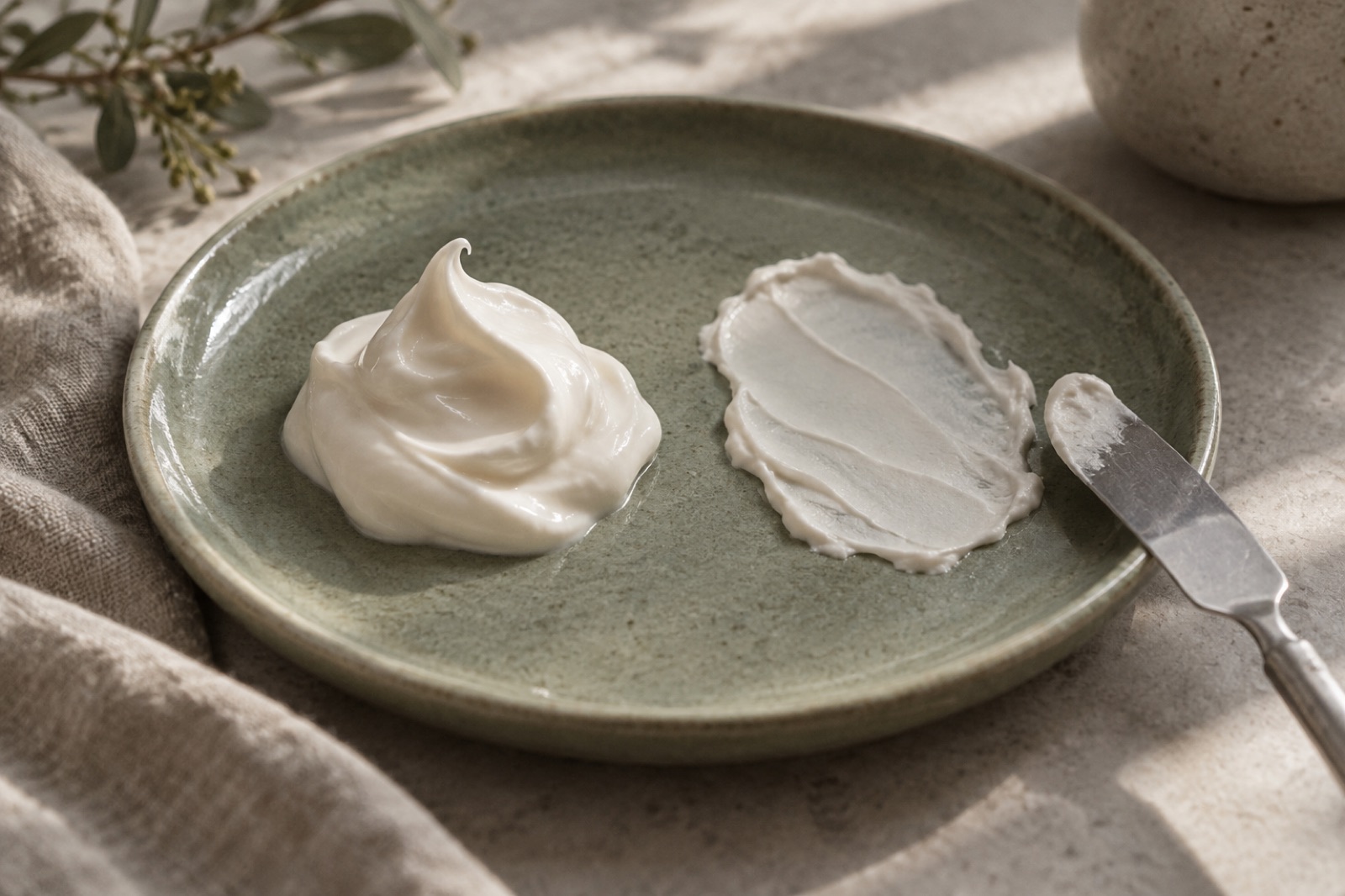
Whether one product is enough depends on the season and on any medicine you are using that day. The Korean Dermatological Association explains lotion as the step that puts water and nutrients back after you wash, and cream as the step with more oil and moisturizing agents that temporarily fills in a protective layer on the skin.
So a natural order is to start with one light texture in summer, then use your log to decide whether to add a layer of cream in winter or during weeks on medicine. The KDCA, Korea’s national public health agency, advises choosing products with less oil but still being sure to use a moisturizer made for acne-prone skin to protect the skin barrier. Whichever amount you choose, keep it steady for two weeks so you have something to compare.
How much moisturizer on long mask days in summer?
On days you wear a mask for hours, the covered skin can lose water even if it looks shiny, so use less if you like but do not skip moisturizer. In a 2023 randomized split-face trial, 21 women who wore a mask 6 or more hours a day for one week lost more surface hydration where the mask sat, and 15 minutes after taking it off, their oil levels were actually higher.
In the same trial, the side that got moisturizer three times a day ended up with about twice the hydration of the side left bare. Still, there was no visible difference in redness, dryness, or pores, and the product’s ingredients were not disclosed. On summer days when you keep a mask on for a long commute, shift, or class, apply a thin layer once in the morning, then check at lunch, when the mask comes off, whether your chin and cheeks feel tight before deciding on a second round.
What changes in a heated room in winter?
Indoor heat drops humidity, and within a few hours your facial skin readings can change, which gives you a reason to add a layer of cream. In a 2023 Korean study, 20 women spent 6 hours in a winter room at 23.05% humidity. On the side of the face without cream, pore scores rose 29.45% after 1 hour and 36.12% after 6 hours.
On the side with cream, pore, roughness, and wrinkle scores showed no significant change through 6 hours. The sample was small and the result came from a finished product that mixed several moisturizing ingredients, so it cannot be applied to every cream. On days you sit for hours in a heated office or library, switch your evening step to a cream or dab a little more only on dry spots in the afternoon, and mark those days separately in your log.
How should moisturizer change while you use acne medication?
Topical and oral acne medicines tend to dry skin faster than usual, so it is better not to cut back on moisturizing during those weeks. In a 2026 split-face trial of 40 Asian patients on acne medicine, the gain in hydration (p=0.001) and the feeling of dryness (p=0.021) differed by moisturizer type after 4 weeks, while the drop in lesion counts was similar on both sides.
The season matters too. A post hoc analysis split 1,614 people from phase 3 trials of a prescription retinoid lotion by season: in cold months, scaling, redness, and itching rose a little more between weeks 2 and 8, and the dropout rate was 3.4% versus 1.9% in warm months. If you are on medicine in winter, start the first few weeks with one step more moisturizer than usual, and follow your prescriber’s directions for the order and amount of the medicine.
Does moisturizing more often help?
There is no evidence that reapplying more often makes skin better, so matching the times your skin feels tight works better than chasing a number. The mask trial above used three applications a day, and while device-measured hydration went up, there was no visible difference.
The winter indoor study also only compared a side with cream to a side without it; it did not test different numbers of reapplications. Putting moisturizer on at all comes first, and adding more rounds is a later question. If a day with an extra round leaves you shinier by afternoon, drop that round next week.
Two-week moisturizer log by situation
| Situation | Starting texture and amount | When to apply | What to watch in week 1 | What to decide in week 2 |
|---|---|---|---|---|
| Summer, long mask days | Light lotion or gel, one thin layer | Morning, plus lunch if needed | Chin and cheek tightness after the mask comes off, afternoon shine | Keep or drop the lunchtime reapply |
| Winter, heated rooms | Lotion plus one layer of cream at night | Morning and night, spot reapply in the afternoon | How soon tightness starts after washing at night, flaking | Whether to extend cream to mornings |
| Weeks on topical or oral acne medicine | One step more than usual | In the order your medicine directions give | Whether stinging or flaking clusters where the medicine goes | Keep the amount, or ask your prescriber |
| Between seasons | Start from last season’s amount | Morning and night | Which comes first: tightness or shine | Whether to move to the next season’s amount |
Each evening, fill in just three boxes: tightness (none, a little, a lot), afternoon shine (none, T-zone, all over), and the number of new breakouts. That is enough to settle your amount after two weeks.
When is it worth seeing a dermatologist?
- If the skin where you apply your medicine keeps peeling and stinging even with more moisturizer, and it is hard to keep using the medicine, talk with the dermatologist who prescribed it.
- If itchy, red patches spread after you switch moisturizers, stop using it and have a dermatologist take a look.
- If new breakouts keep increasing after two weeks of adjusting amount and texture, book a dermatology visit.
The evidence in brief
- In a 2023 randomized split-face trial of 21 women who wore a mask 6 or more hours a day for a week (PMID 36428277), surface hydration on the moisturized side rose to about twice that of the bare side.
- In a 2023 study of 20 Korean women who spent 6 hours in a winter room at 23.05% humidity (PMID 37357654), pore scores on the side without cream rose 36.12%, while the side with cream showed no significant change.
- In a 2023 analysis that split 1,614 people from phase 3 trials of a prescription retinoid lotion by season (PMID 37720201), the dropout rate in cold months was 3.4%, higher than 1.9% in warm months.
Frequently asked questions
Is moisturizer alone enough for acne-prone skin?
It depends on the season. The Korean Dermatological Association describes lotion as the step that puts water and nutrients back after cleansing, and cream as the step with more oil and moisturizing agents that temporarily fills in a protective layer. On summer days under a mask, one light product may be enough; in heated winter rooms, use a two-week log to see whether you need an extra layer of cream.
Can you put on moisturizer too often?
There is no evidence that reapplying more often makes skin better. In a 2023 trial, 21 women who wore face masks applied moisturizer three times a day to one side of the face. Device-measured hydration went up, but there was no visible difference in redness, dryness, or pores. Reapply only on areas and at times that feel tight, and note any extra shine on the days you add a round.
Does skin get better if you stop using lotion?
The sources behind this article do not show that, and one points the other way. In a 2023 study, 20 Korean women spent six hours indoors in winter at about 23% humidity. On the side of the face without cream, pore and roughness scores rose, while the side with cream showed no significant change. Korea's national health agency (KDCA) also says to be sure to use a moisturizer made for acne-prone skin.
Sources
- Long-term face mask wearing and the skin barrier: split-face RCT of a moisturizer, 21 women, 2023 (PMID 36428277)A
- Six hours of low-humidity indoor winter air and a moisturizing cream: split-face comparison in Korean women, 2023 (PMID 37357654)A
- Comparing moisturizers during acne medication use: split-face RCT, 40 Asian patients, 4 weeks, 2026 (PMID 41891349)A
- Seasonal tolerability of a prescription retinoid lotion: post hoc analysis, 1,614 participants, 2023 (PMID 37720201)B
- Korea Disease Control and Prevention Agency (KDCA), National Health Information Portal — Acne (Korean)Institutional
- Korean Dermatological Association — Basic skincare products (Korean)Institutional
Videos and forum posts never count as evidence for a fact here. Full rules: Editorial policy
What to check when choosing a product for this routine
Check the criteria below before the product name. Each item can be found on the full ingredient list or in the product description.
| Item | What to look for | Why |
|---|---|---|
| Texture and amount guidance | Whether it is a cream, lotion, or gel, and whether the label gives a per-use amount | When the season turns, it helps you decide whether to use less of the same product or switch textures |
| Where moisturizing ingredients sit | Whether moisturizing ingredients such as glycerin or ceramides appear near the top of the ingredient list | On winter days when one layer has to carry you, it gives you a fact to compare products on |
| Fragrance listing | Whether fragrance (parfum) appears in the ingredient list | If stinging starts during a prescription course, you can cross one possible cause off the list |
| Size and period after opening | The mL amount and the period-after-opening symbol on the pack | How long one container lasts tells you whether your daily amount is about right |
Product from this site's operator · KW Cosmetic Content Team
Revive Therapy N.F CreamCosmetics do not replace the diagnosis or treatment of a skin condition.