Gel Cleanser, Evenings Only: 2-Week Amount & Lather Log
To try a gel cleanser, keep your morning foam the same for all 2 weeks, log 3 baseline days, then from day 4 switch only your evening wash and write down the amount, lather time and tightness.
What this note covers8 sections
- Gel cleanser: why keep your morning foam and switch only the evening wash?
- What unit do you use to log the amount for each cleanser type?
- How do you time how long it takes to work up a lather?
- Why rate tightness twice, right after rinsing and 20–30 minutes later?
- Gel cleanser evening-switch log for 2 weeks, side by side with your morning foam
- On day 14, what do you look at to choose one of three paths?
- When is it time to stop logging and ask a dermatologist?
- What do the studies behind this log actually show?
| Item | Detail | Basis |
|---|---|---|
| Slot you switch: the second cleanse | Guidance written for teens groups cleansing foam, which comes as a cream or gel, with second-step cleansers, and says to put it in your palm, work up plenty of lather and rinse it off with water | KDCA (Korea) · institution |
| When you rate: twice | In a study that measured 22 Korean women with normal and dry-to-oily skin for 180 minutes after washing with a single cleanser, hydration, sebum and transepidermal water loss were all below their pre-wash baseline at 20 minutes | 2016 PMID 26100540 · B |
| Fixed conditions: habits that vary by person | In a 19-question survey of 124 members of the general public (91 women, 33 men), answers on using a gentle cleanser, moisturizing after washing, washing after sweating and using warm water differed by sex, while washing frequency did not (p=0.098) | 2024 PMID 39822430 · B |
| Context: what peers wash with | In a cross-sectional survey of 190 university students in health programs, the products used most often without a prescription were facial cleansers (48.2%), creams and moisturizers (30.7%) and cleansing soap (21.1%), in that order | 2025 PMID 40248498 · B |
| Count and time: keep them matched | In an experiment that washed healthy volunteers’ inner forearms 5 or 11 times within 4 hours, 60 seconds each time, all three washing methods had mild, similar effects on barrier and inflammation markers | 2022 PMID 35357722 · B |
Gel cleanser: why keep your morning foam and switch only the evening wash?
When you try a gel cleanser, keep the foam you use in the morning for all 2 weeks and move just one wash, the evening one, to gel from day 4. If the morning column holds still, you can narrow a change in that same day’s evening column down to the new cleanser type.
Guidance written for teens on the National Health Information Portal of the Korea Disease Control and Prevention Agency (KDCA), Korea’s national public health agency, describes cleansing foam, which comes as a cream or gel, as a second-step cleanser. In other words, a foam you squeeze from a tube and a gel cleanser fill the same second-cleanse slot, so you leave your first cleanser and how many times a day you wash alone and change only that one slot. If you move to a pump foam or a bar soap instead, the slot you change is the same.
For the first 3 days, wash in the evening with your current foam too, and fill in exactly the same columns as in the morning. Those 3 days are the baseline you compare with the evening columns for days 4–14. If you’re a high school student who gets home from an evening study session at school and washes after 11 p.m., that late hour is your baseline evening. If you plan to start a new tube foam for the morning column, switch to it before day 1 and log your baseline with it.
Write your fixed conditions just once, in the top row of your log. In a 2024 survey of 124 members of the general public (PMID 39822430), answers on using a gentle cleanser, moisturizing after washing, washing after sweating and using warm water differed by sex, but washing frequency did not (p=0.098). It was a self-reported survey and doesn’t tell you which habit is right, so write down habits that differ from person to person, like water temperature, what you apply after washing and how many times a day you wash, just as they are now, and keep them the same for 2 weeks. If how many times a day to wash is your first question, fill in a 1-week face-washing log for finding how often to wash first.
What unit do you use to log the amount for each cleanser type?
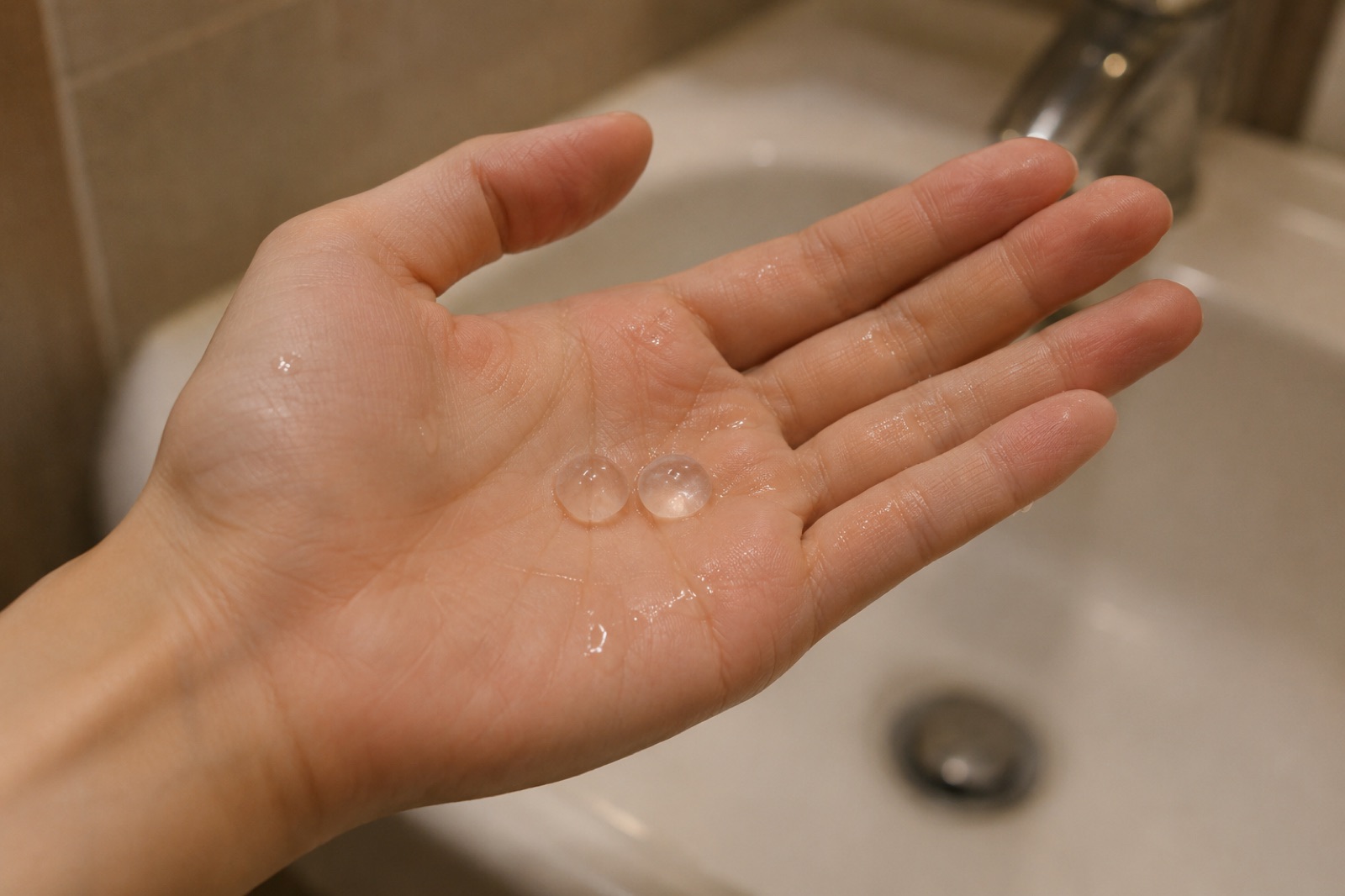
Log the amount in the unit you actually count when you dispense that type. For a gel cleanser that’s pea-sized drops, for a pump foam it’s pumps, for bar soap it’s rubs between wet hands, and for your morning tube foam it’s the length you squeeze out (cm).
| Column | Type | Unit you log | Example |
|---|---|---|---|
| Morning (fixed, days 1–14) | Tube foam | Length squeezed out | 1.5 cm |
| Evening (days 4–14) | Gel cleanser | Number of pea-sized drops | 2 pea-sized drops |
| Evening (days 4–14) | Pump foam | Number of pumps | 2 pumps |
| Evening (days 4–14) | Bar soap | Rubs between wet hands | 8 rubs |
Because the units differ, the table doesn’t compare whether 1.5 cm in the morning or 2 pea-sized drops in the evening is more. What you check is whether the amount stayed the same from day to day within one column, and you stick with the amount you set on the evening of day 4 through day 14. On a day you used more than usual, note it in the ‘what changed that day’ column, and because two cleansers mixed together can’t be logged in one unit, don’t mix them while you log.
The KDCA’s guidance for teens also cautions that washing too much can damage the skin barrier and its moisture function. That’s the reason you pin the amount to a number rather than “plenty,” and even on a day you don’t like the lather, you leave the amount where it is.
How do you time how long it takes to work up a lather?
Write down in seconds the time from when you put the cleanser on your hands or a foaming net until you feel the lather is ready to go on your face, and write “hand” or “net” next to it. You don’t score how much lather there is; you only keep the time it took and the tool.
Set how long you move the lather around your face the way you do it now, and write it in seconds in the fixed conditions in the top row. A 2022 experiment (PMID 35357722) washed healthy volunteers’ inner forearms 5 or 11 times within 4 hours and compared washing methods with each wash set to the same 60 seconds. It was a short experiment on the arm that ended within one day and didn’t look at washing over several consecutive days, so we don’t carry it over as a standard for how long to wash your face; still, the point that time has to be matched before you can compare anything else holds for a home log too.
On a rushed day, like when someone is waiting behind you at a shared sink, your seconds will be shorter, so write “rushed” in the ‘what changed that day’ column. After rinsing, rub your wet hands together once and mark Y or N for whether lather comes back, but keep the number of rinses as written in the top row. If you’re replacing your foam with a new one entirely, the lather and rinse columns for that are in how to use a foam cleanser and check it for 2 weeks after a switch.
Why rate tightness twice, right after rinsing and 20–30 minutes later?
Tightness right after rinsing and a little later may not be the same, so rating it only once shows you only half of that wash. Rate the second one 20–30 minutes after washing, as the way your skin feels after you’ve put on what you usually apply.
A 2016 study (PMID 26100540) measured hydration, sebum, transepidermal water loss and pH for 180 minutes after 22 Korean women with normal and dry-to-oily skin washed with a single cleanser. At 20 minutes after washing, hydration, sebum and transepidermal water loss were all below their pre-wash baseline, and the researchers offered their finding that each measure returned to baseline at a different time as a reference for setting how long skin should rest before it is measured. These were device readings, not the same thing as tightness you feel with your fingertips, and only one cleanser was used, so the 20–30 minute second time point is this guide’s editorial standard, set with this study as a reference.
The scale has three steps: 0 (no feeling at all), 1 (you notice it if you pay attention) and 2 (you keep feeling it even when you’re not paying attention). Rate stinging on the same scale, once, right after rinsing.

Gel cleanser evening-switch log for 2 weeks, side by side with your morning foam
| Date | Used in the evening | Amount (morning / evening) | Lather time · tool (morning / evening) | Lather on hands after rinsing Y/N (morning / evening) | Tightness right after rinsing 0–2 (morning / evening) | Tightness after 20–30 min 0–2 (morning / evening) | Stinging 0–2 (morning / evening) | What changed that day |
|---|---|---|---|---|---|---|---|---|
| Fixed conditions (once, before day 1) | Water temperature: · Rinses: · Seconds on face: | What you apply after washing: | Washes per day: | First cleanser: | Nothing new started | |||
| Day 1 (example) | Current foam | 1.5 cm / 1.5 cm | Hand 20 s / Hand 20 s | N / N | 1 / 1 | 0 / 0 | 0 / 0 | None |
| Day 2 | Current foam | / | / | / | / | / | / | |
| Day 3 | Current foam | / | / | / | / | / | / | |
| Days 1–3 baseline | — | — | Average seconds → | Number of Y | Average | Average | Average | |
| Day 4 (example) | Gel cleanser | 1.5 cm / 2 pea-sized drops | Hand 20 s / Hand 35 s | N / Y | 1 / 0 | 0 / 0 | 0 / 0 | Washed at 11 p.m. after evening study |
| Day 5 | New cleanser | / | / | / | / | / | / | |
| Day 6 | New cleanser | / | / | / | / | / | / | |
| Day 7 | New cleanser | / | / | / | / | / | / | |
| Day 8 | New cleanser | / | / | / | / | / | / | |
| Day 9 | New cleanser | / | / | / | / | / | / | |
| Day 10 | New cleanser | / | / | / | / | / | / | |
| Day 11 | New cleanser | / | / | / | / | / | / | |
| Day 12 | New cleanser | / | / | / | / | / | / | |
| Day 13 | New cleanser | / | / | / | / | / | / | |
| Day 14 | New cleanser | / | / | / | / | / | / | |
| Days 4–14 | — | — | Average seconds → | Number of Y | Average | Average | Average | |
| Day 14 decision | Pick one of ①, ② or ③ below |
The morning column uses the same foam for all 2 weeks, so if the morning column shifted too after day 4, look first in the ‘what changed that day’ column for something else going on that week (exams, late nights, a new sunscreen) before pinning it on the new cleanser. If you’re a college student sharing a sink with dorm roommates, writing the time you washed next to the columns makes crowded days easier to pick out.
On day 14, what do you look at to choose one of three paths?
Compare the averages in your evening columns for days 4–14 with the evening columns of your days 1–3 baseline, and check whether the morning column stayed the same over the same period. The three paths and the scale below are this guide’s editorial standard, not values set by research, and they are neither a score for how well a product works nor a normal range.
- Stop that day: If you rate stinging in the evening column a 2 even once, go back to your current foam from the next evening and put a stop mark on that row.
- Decision ① Log 2 more weeks the same way: If your average tightness at 20–30 minutes in the evening column is the same as or lower than the baseline and stinging stayed at 0–1, keep the amount and tool as they are and log 2 more weeks.
- Decision ② Change one thing and log 2 weeks: If tightness right after rinsing, or Y for lather on your hands, came up more often than in the baseline, pick only one change, using one unit less or switching the lathering tool between hand and net, and log 2 weeks again.
- Decision ③ Stop and see a doctor: If redness or itch lasted more than 2 days, or you saw even one of the signs in the section below, leave the remaining rows blank and bring this table to a medical appointment.
When you try again with bar soap or a pump foam instead of gel, start a fresh copy of the same table and log again from the days 1–3 baseline. For days when washing changes with the situation, like days you work out or wear makeup, continue with face washing by situation, from a water-only morning rinse to the evening after a workout.
When is it time to stop logging and ask a dermatologist?
- If stinging rated 2 lasts more than 2 days after you switch the evening column, or redness or itch doesn’t settle down, don’t fill in the remaining rows; see a dermatologist and bring your old cleanser, your new cleanser and this log.
- Guidance written for teens on the KDCA’s National Health Information Portal says that if unusual reactions like itching, pain, swelling or redness appear, you should stop using the product and visit a dermatologist (this line is written for teens, not for adults).
- If you get oozing or crusts, or swelling reaches the area around your eyes, don’t wait for day 14; get seen by a doctor right away.
- If you’re using a prescription medicine that you apply to your skin, check first with the clinic that prescribed it about when to switch your evening cleanser.
What do the studies behind this log actually show?
- In a 2016 study (PMID 26100540), 22 Korean women who washed with a single cleanser had hydration, sebum and transepidermal water loss all below their pre-wash baseline at 20 minutes, and the researchers presented their 180-minute measurements as a reference for setting the rest time before skin measurements.
- In a 2024 survey (PMID 39822430), 124 members of the general public (91 women, 33 men) showed differences by sex in using a gentle cleanser, moisturizing after washing, washing after sweating and using warm water, and no difference in washing frequency (p=0.098).
- In a 2025 cross-sectional survey (PMID 40248498), the products 190 university students in health programs used most often without a prescription were facial cleansers (48.2%), creams and moisturizers (30.7%) and cleansing soap (21.1%), in that order.
Frequently asked questions
I have oily skin and use a cleansing oil. Should I switch to a gel cleanser?
The sources for this guide don't compare cleansing oil and gel for oily skin, so we don't say which one is better. If you decide to try it, keep your mornings as they are, log a 1–3 day baseline, then move just one wash, the evening one, to gel and log through day 14. If in the evening you've been cleansing with oil first and then washing again with a foam, keep the oil step and swap only the foam for the gel, so the number of steps stays the same.
My foam cleanser barely lathers. What should I do?
We don't rate a small lather as bad or a big one as good. Instead, write in the same column how many seconds it took until the lather was ready to go on your face, and whether you made it with your hands or a foaming net. Whether to use more product or switch to a foaming net is a choice you make at day 14 decision ②: pick only one of the two and try it over the next 2 weeks.
I use a foaming net, but when I rub my hands after rinsing they still get sudsy. Am I not rinsing enough?
Nothing in our sources lets us conclude that lather coming back on your hands means you didn't rinse enough, or that it harms your skin. For the 2 weeks you log, keep rinsing the number of times you do now, write that number in the top row, and after rinsing rub your wet hands together and mark Y or N for whether lather appears. If you rinsed the same number of times but Y shows up more often only on the new evening cleanser, go to day 14 decision ② and use one unit less for 2 more weeks.
On no-makeup days I use only a gel cleanser, but on makeup days that doesn't feel clean enough. Can I wash with a foam cleanser and then use the gel cleanser?
This guide doesn't decide whether makeup days need one more cleansing step. For the 2 weeks you log, write 'makeup' in the 'what changed that day' column on days you wear it, keep the first cleanser you usually use, and put only the gel in the second-cleanse slot. If you use foam and gel back to back, that slot holds two products, and you can't tell which one that evening's entry is about.
Can you walk me through how to wash my face with bar soap?
If you switch the evening column to bar soap, wet your face and hands with water at the temperature in your fixed conditions, rub the soap between your wet hands to build lather on your hands, and put only that lather on your face. Write the number of rubs between your palms in the amount column, like '8 rubs,' and keep the number you set on day 4 the same through day 14. On a day you rub the bar straight on your face, there's no unit left to count, so note it separately in the 'what changed that day' column.
After a low-pH cleansing water, does my second cleanse have to be a low-pH product too? Right now I wash with bar soap.
Our sources have no evidence that your first and second cleansers need to match in pH, so we don't say they must. For the 2 weeks you log, keep the cleansing-water step as it is and change only the bar soap in your evening second-cleanse slot to the new cleanser. If you change the first and second steps at once, your table can't tell you which step is behind a change from day 4.
I have both a low-pH foam cleanser and a bar soap. Is it okay to alternate between them?
We found no data comparing alternating use. But if alternating days get mixed in, the foam rows and the soap rows tangle together and you can't compare them after 2 weeks. While you log, give each a set place, your current foam in the morning and the soap in the evening from day 4, and don't swap them.
Foam cleanser A barely lathers. Can I mix it with foam cleanser B?
We found no data checking whether mixing two foams is okay, so we don't say yes or no. A mixed amount can't be logged in a single unit like cm or pea-sized drops, so for the 2 weeks you log, don't mix them; use one at a time. If you keep the seconds it took in the column for the one that lathers poorly, you can see how the two foams differ without mixing them.
Is it too much to wash first with bar soap and then use a low-pH foam cleanser as a second cleanse?
Our sources have no data to decide whether that's too much or fine. Guidance for teens from the Korea Disease Control and Prevention Agency (KDCA) cautions that washing too much can strip away the sebum your skin needs, intercellular lipids and even natural moisturizing factors, damaging the skin barrier and its moisture function. Changing the number of steps is a change in itself, so within 2 weeks change only one thing: the number of steps or the cleanser.
My skin turned blotchy red and itchy after a low-pH cleanser. Can you recommend a different cleanser?
We don't pick a different cleanser for you. On a day blotchy redness and itching show up, stop that cleanser and put a stop mark on that day's row of your log. If itching or redness lasts more than 2 days, or swelling or pain comes with it, see a dermatologist and bring the cleanser you used and your log, rather than buying yet another new cleanser.
Sources
- Facial hydration, sebum, transepidermal water loss and pH measured for 180 minutes after washing with a cleanser, 22 Korean women, 2016 (PMID 26100540)B
- Adherence to a facial washing routine in the general public, survey of 124 people with 19 questions, 2024 (PMID 39822430)B
- Use of acne self-care methods among university students in health programs, cross-sectional study of 190 students, 2025 (PMID 40248498)B
- Washing frequency and epidermal barrier and inflammation markers, inner forearms washed 5 or 11 times within 4 hours, 2022 (PMID 35357722)B
- Korea Disease Control and Prevention Agency (KDCA) National Health Information Portal — Safe cosmetic use for teens (Korean)Institutional
Videos and forum posts never count as evidence for a fact here. Full rules: Editorial policy
What to check when choosing a product for this routine
Check the criteria below before the product name. Each item can be found on the full ingredient list or in the product description.
| Item | What to look for | Why |
|---|---|---|
| Lathering tool line | Whether the directions say to lather with your hands and also say whether a foaming net is okay | If you fix 'hand' or 'net' next to the morning lather time exactly as the directions word it, you can read it side by side with the new evening cleanser's seconds under the same conditions |
| Water temperature line | Whether it says lukewarm water both for wetting your face and for rinsing | Water temperature is a habit that varies from person to person, so you can copy that line into the fixed conditions in the top row of your log and leave it unchanged for 2 weeks |
| Wording for how much to use | Whether there's wording to gauge the amount beyond 'a suitable amount,' and if not, whether it comes in a tube so you can set the squeezed length in cm | Tying the morning amount to a single cm figure keeps that column's unit from mixing with the pea-sized drops or pumps in the evening column |
| Using it with other acid products | When the ingredient list includes acids, whether a line follows saying to cut back how much and how often you use it alongside other products that contain acids | You can write the rule 'no new exfoliating products during the 2 weeks of logging' ahead of time on the first line of the 'what changed that day' column |
| When to stop | Whether there's a line saying to stop if anything unusual appears, and a line saying to follow your healthcare provider and the medicine's instructions if you use prescription medicine | It points the same way as the stop mark in your log, so a day when stinging is rated 2 in the morning column can be stopped by the same standard |
Product from this site's operator · KW Cosmetic Content Team
Revive Therapy A.C CleanserThis cleanser has no test data or log like this guide's comparing it with gels, pump foams or soaps, and it's a tube foam, not a gel cleanser (SKIN9HARI makes no gel cleanser, pump foam or facial soap). It's a 150 ml mildly alkaline foam with salicylic acid, AHA and PHA, contains fragrance, and is irritation patch-tested (skin responses vary). Its product page says to wet with lukewarm water, lather by hand or with a foaming net without rubbing the net on your face, and skip the eye area and unhealed skin. For the tube foam kept in your morning column, the product we suggest is Revive Therapy A.C Cleanser.
Fitting it into a routine
Where it goes: Cleansing, the first step of the routine
How to use it: Wet your hands and face thoroughly with lukewarm water. Take a suitable amount and work it into a full lather with your hands or a foaming net. Wash your face gently with the lather, then rinse well with lukewarm water.
Check before you use it: Do not rub the foaming net directly on your face. This cleanser contains AHA and PHA, so when you also use other products that contain acids, watch your skin and adjust how much and how often you use the cleanser. Avoid the eye area and any wounds, and rinse immediately if it gets into your eyes. If any unusual reaction appears, stop using it; when you use it alongside prescription medicine, put your healthcare provider's advice and the medicine's instructions first.
Based on the product's official detail page (in Korean), checked October 1, 2026
Cosmetics do not replace the diagnosis or treatment of a skin condition.