Cheek Acne on Side-Sleeping, Chin-Resting Days: Less Time Pressed
On days your cheeks stay pressed for hours, write down in minutes how long you rested your chin, spent on calls and kept your cheeks covered, then cut back one thing at each of five moments.
What this note covers9 sections
- Who ends up with their cheeks pressed for hours a day?
- Can resting your chin on your hand while studying cause cheek acne?
- Is there a link between long phone calls and cheek acne?
- How do you log the time a mask or helmet covers your cheeks?
- What do you skip at your evening wash and at bedtime?
- I haven’t changed my skin care and wash the same way, but my cheek acne suddenly got worse a few days ago. What do I write down first?
- Daily order table: cutting the time your cheeks stay pressed
- When should you take your cheeks to a dermatologist?
- What this pressed-time order is based on
| Item | Detail | Basis |
|---|---|---|
| Situation: cheeks covered for 4 hours | After 20 Korean women with sensitive skin wore a KF94 mask for 4 hours, redness and transepidermal water loss measured on the cheek increased significantly. The study did not count pimples | 2022 PMID 35639816 · B |
| Situation: covered all day | In a survey of 230 healthcare workers, 192 (83.5%) had skin reactions, led by acne at 57.8%, dryness at 47.0% and redness at 45.7%. Because people answered for themselves in a cross-sectional survey, we don’t read it as a cause | 2022 PMID 35748134 · B |
| Timing: daytime | Pressure from sports helmets, tight clothes and backpacks is classed as something that doesn’t cause acne but can make it worse | NIAMS · Institution |
| Timing: commuting, exercise and evening | Roughly rubbing sweat away with a towel can irritate the skin and lead to breakouts, so the advice is to pat gently with a clean towel | AAD · Institution |
| Time frame: your log | Keep the five-moment order the same for 7 days, and log pressed time in minutes | Editorial choice |
Who ends up with their cheeks pressed for hours a day?
Days when your cheeks stay pressed for a long time usually overlap with things that are hard to skip, like studying, work and sleep. The five moments in this guide (after your morning wash, daytime, commuting and exercise, your evening wash and bedtime), the 7 days and logging in minutes were not set by research; they are editorial choices made so you can write things down the same way each day and compare.
A high school senior working through test-prep books at a library study desk late into the night can easily spend hours with one cheek resting on a palm. A call center agent fielding a rush of customer calls takes notes with a desk phone receiver or cell phone wedged between shoulder and cheek. A college student who always sleeps turned to one side has the same cheek against the pillowcase all night. Few people like these have ever counted, day by day, how long their cheeks are pressed.
Can resting your chin on your hand while studying cause cheek acne?
The evidence this guide checked has no study that measured chin resting on its own against cheek acne, so we can’t say it does. That’s why this guide handles it by writing the time down and cutting it back.
NIAMS (the U.S. National Institute of Arthritis and Musculoskeletal and Skin Diseases) classifies pressure from sports helmets, tight clothes and backpacks not as a starting point for acne but as a condition that may make acne you already have worse. Those three are the only things named on that list, so carrying the same explanation over to the hand under your chin is this guide’s own assumption. The National Health Information Portal of the Korea Disease Control and Prevention Agency (KDCA), Korea’s national public health agency, lists not touching your face for any reason as one of the things to keep doing while you manage acne.
If you’re a high school senior, stack two or so books under your test-prep book so your head doesn’t drop as far, and each time you finish a block of studying, jot down roughly how many minutes you rested your chin. If you still have to rest it, put a clean handkerchief between your palm and your face instead of your bare hand, and don’t rub the pressed spot with your hand.

Is there a link between long phone calls and cheek acne?
The evidence this guide checked has no study that directly compared time on the phone with cheek acne, so it’s hard to say whether there is a link or not. Still, the time your phone sits against your cheek is contact you can cut back today.
If you work at a call center, set your cell phone down on the desk and take calls through earbuds or on speaker, and use a headset instead of wedging the receiver against your shoulder. At the end of the day, copy the total call time from your phone’s call log screen so you don’t have to count it separately. Even if your cheek itches during a call, don’t scratch or rub it with your fingertips.

How do you log the time a mask or helmet covers your cheeks?
Before you swap out anything that covers your cheeks, like a mask or helmet straps, first write down how long you wore it. There is research on covered time, but none of it showed that covered time causes cheek acne.
In a 2022 study, after 20 Korean women with sensitive skin wore a KF94 mask (a Korean-standard filtering mask) for 4 hours, redness and transepidermal water loss on their cheeks increased significantly, but the study was small and didn’t count pimples, so we don’t read it as cause and effect. In a 2024 study that measured the faces of 83 volunteers with a skin analyzer, acne readings in people who had worn masks for a long time were higher than the device’s reference values, but there was no comparison group that didn’t wear masks, so the masks can’t be named as the cause. If you bike or ride a motorcycle to school or work, write your helmet time in the same box, and blot sweat by patting gently with a clean towel. When to change your mask and when to take it off for a short break are covered in the schedule for long mask-wearing days.
What do you skip at your evening wash and at bedtime?
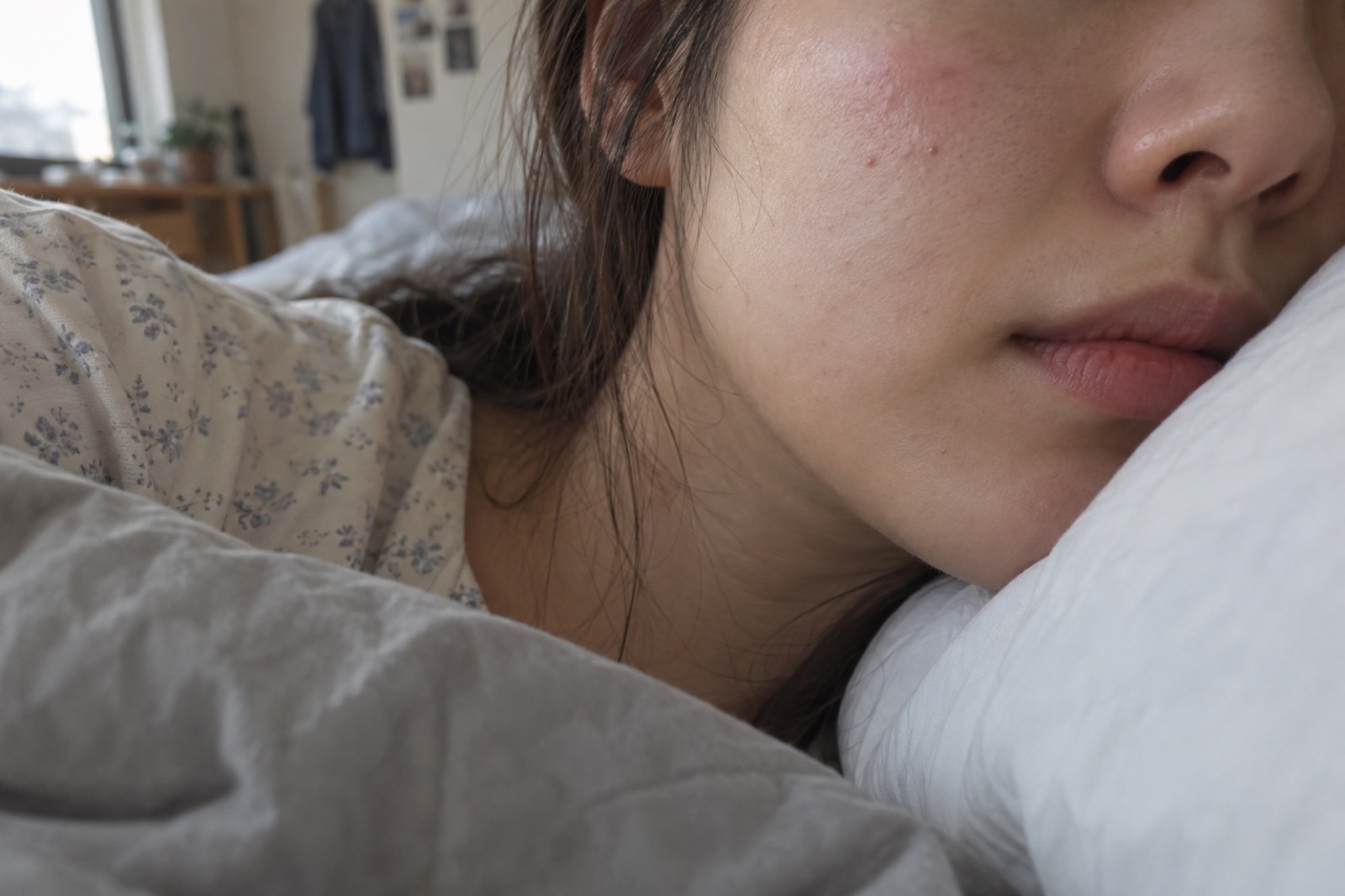
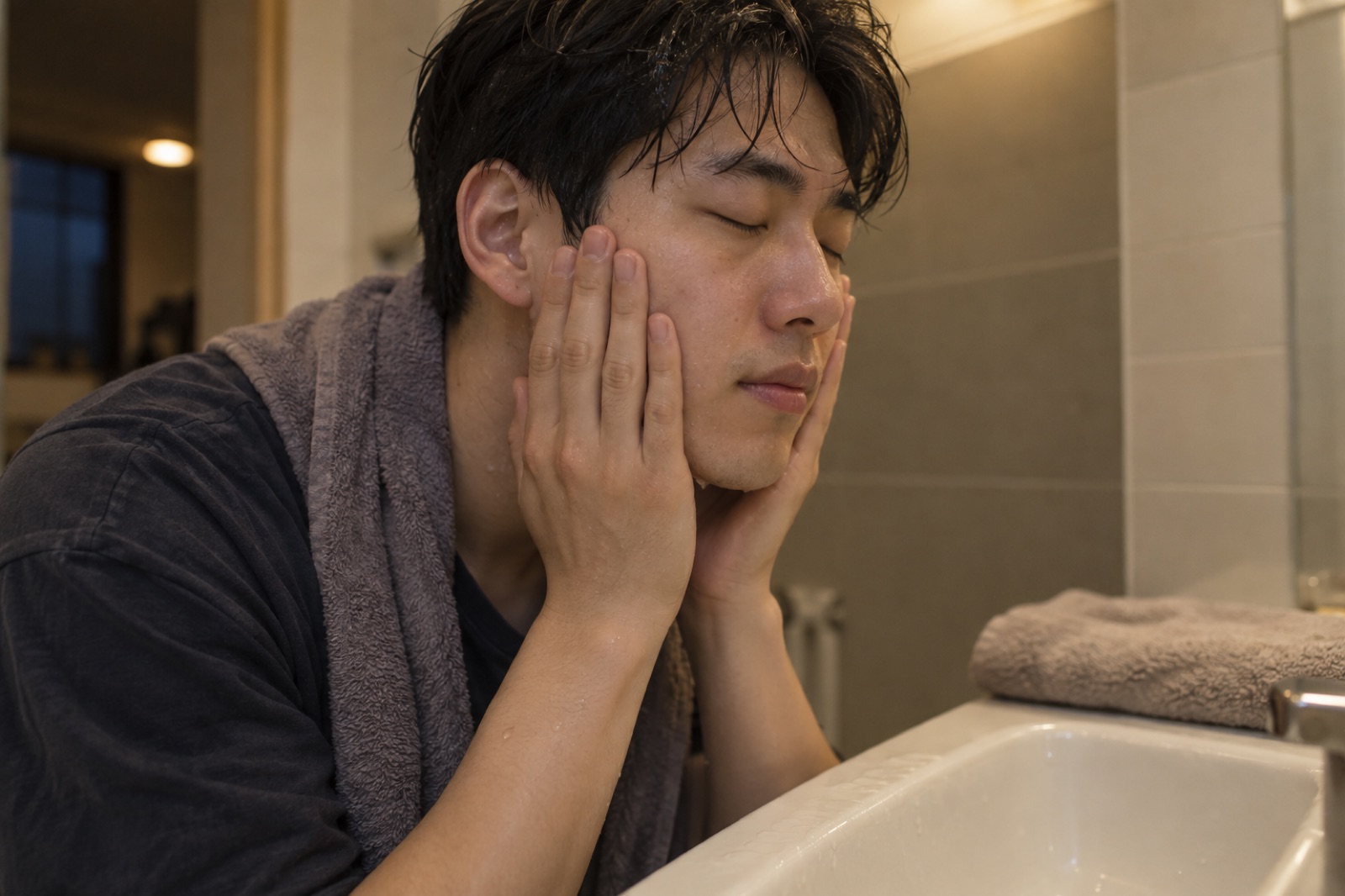
In the evening, not rubbing the cheeks that were pressed all day is close to the whole job. At bedtime, keep a clean side of the pillowcase against your cheek and write down how you slept.
The American Academy of Dermatology (AAD) says scrubbing skin that has acne can irritate it and make acne flare, and that after washing you should pat your skin dry with a clean towel. So rest the lather from your palms on your cheeks before you rinse, and only press the towel against your cheeks. If you’re a college student who sleeps on your side, rather than forcing yourself to change position, flip the pillowcase to use the clean side, and in the morning just write one line on whether you slept on your back or on your side.
I haven’t changed my skin care and wash the same way, but my cheek acne suddenly got worse a few days ago. What do I write down first?
If what you put on and how you wash haven’t changed, first write down whether the time your cheeks were pressed or covered changed over those few days. This isn’t a log for pinning down the cause; it’s a log for picking the one thing to cut back next.
Copy into the 7-day boxes below whether exam season started, whether it was a week when support calls piled up, whether you started a schedule that has you wearing a mask, and whether where you sleep changed. If you’re curious about days that overlap with your menstrual cycle, look at the luteal phase skin plan alongside this and log your cycle separately.
Daily order table: cutting the time your cheeks stay pressed
| Moment | What to do | What not to do | What to write down |
|---|---|---|---|
| After your morning wash | Spread just one thin layer of whatever goes on your cheeks | Put on a mask before it has fully dried | What you applied, what time you put on a mask |
| Daytime (studying, work, calls) | Cut back chin-resting time; if you rest your chin, put a handkerchief under it; take calls on speaker or with earbuds | Wedge the receiver between your shoulder and cheek; rub the pressed spot | Chin-resting time (min), call time (min) |
| Commuting and exercise | Time how long you wear helmet straps or a mask; blot sweat by patting | Wipe sweat away with the back of your hand or your sleeve | Covered time |
| Evening wash | Rest the lather from your palms on your cheeks, then rinse; press the towel | Rub your cheeks with your fingers or a towel | Whether your cheeks stung or looked red |
| Bedtime | Keep a clean side of the pillowcase against your cheek | Touch your cheeks while looking in the mirror before bed | Sleep position |
7-day contact-time log
| Day | Chin-resting time (min) | Calls or phone held to cheek (min) | Time covered by a mask, helmet, etc. | Sleep position | New spots on your cheeks |
|---|---|---|---|---|---|
| Day 1 | |||||
| Day 2 | |||||
| Day 3 | |||||
| Day 4 | |||||
| Day 5 | |||||
| Day 6 | |||||
| Day 7 |
The moments and boxes in the order table, the 7-day time frame and the minute units are all this guide’s editorial choices. Rough times are fine, but you need to measure the same way every day to compare heavy days with light days on day 7. After the 7 days, pick just the one box that ran longest and try cutting it back the following week.
When should you take your cheeks to a dermatologist?
- If red, painful acne spreads across your whole cheek or you can feel a deep lump, stop the order table and see a dermatologist.
- If new spots on your cheeks haven’t gone down, or have gone up, 7 days after you cut your pressed time, consider bringing your log to a dermatologist.
- If the spots where your cheek was pressed turn itchy and rough and spread, or the redness hasn’t faded for several days, it may not be acne, so have a dermatologist check it.
- If it swells and hurts more after you squeeze or scratch it, don’t wait; see a doctor.
What this pressed-time order is based on
- In a 2022 study (PMID 35639816) in which 20 Korean women with sensitive skin wore a KF94 mask for 4 hours, cheek redness and transepidermal water loss increased significantly, but the study was small and did not look at pimple counts.
- In a 2022 web survey of 230 healthcare workers (PMID 35748134), 192 (83.5%) reported mask-related skin reactions and acne was the most common at 57.8%, but because it was a self-reported cross-sectional survey, cause and effect was not confirmed.
- In a 2024 study (PMID 38528785) that measured 83 volunteers with a device, acne readings in people who had worn masks for a long time were higher than the reference values, but there was no comparison group that didn’t wear masks.
Frequently asked questions
Can resting your chin on your hand while studying cause acne on your cheeks?
The evidence this guide checked has no study that looked at chin resting on its own and cheek acne. NIAMS puts pressure on the skin, such as from sports helmets, tight clothes and backpacks, in the group of things that don't cause acne but may make it worse. So instead of drawing a conclusion, write down your chin-resting time in minutes and try cutting it back, and if you have to rest your chin, put a clean handkerchief under it instead of your bare hand.
I haven't changed my skin care and I wash the same way, but my cheek acne suddenly got worse a few days ago. What should I write down first?
If what you put on and how you wash haven't changed, start by writing down whether the time your cheeks were pressed or covered changed over those few days. Use the 7-day log to note whether exam season had you resting your chin for long stretches, whether calls piled up, whether you wore a mask or helmet for longer, and whether your sleep position changed. This log isn't a tool for pinning down the cause; it's something to help you pick the one thing to cut back next.
My cheeks seem to break out more on days I spend a long time on the phone. Is there a link?
The evidence this guide checked has no study that directly compared time on the phone with cheek acne, so it's hard to say whether there is a link or not. Still, the time your phone sits against your cheek is contact you can cut right away by using speaker or earbuds. Compare the new spots on your cheeks on heavy-call days and light-call days in your log.
About six pimples suddenly came up on my cheek and it's never been this bad, so I'm panicking. What do I do right now?
First, take your hands away and don't squeeze or pick at them. The National Health Information Portal of the Korea Disease Control and Prevention Agency (KDCA), Korea's national public health agency, also says not to touch your face for any reason. Start writing down from that day how long your cheeks are pressed and covered, but if they turn red and painful and grow larger or spread, see a dermatologist before you finish filling in the log.
What should I do if red, painful acne spreads across my whole cheek?
At that point, set this guide's order table aside and see a dermatologist first. Cutting down pressed time is not a reason to put off seeing a doctor. If you bring the log you've kept and the names of the skin care products you've been using to the appointment, it's easier to explain what's been going on.
Sources
- Four hours of mask wearing and sensitive skin, 20 Korean women, 2022 (PMID 35639816)B
- Prolonged mask wearing and skin reactions in healthcare workers, survey of 230, 2022 (PMID 35748134)B
- Long-term surgical mask wearing and facial skin parameters, 83 participants, 2024 (PMID 38528785)B
- NIAMS — Acne (Overview, reviewed July 2023)Institutional
- AAD — 10 skin care habits that can worsen acneInstitutional
- Korea Disease Control and Prevention Agency (KDCA) National Health Information Portal — Acne (Korean)Institutional
Videos and forum posts never count as evidence for a fact here. Full rules: Editorial policy
What to check when choosing a product for this routine
Check the criteria below before the product name. Each item can be found on the full ingredient list or in the product description.
| Item | What to look for | Why |
|---|---|---|
| Where in the routine it goes | Whether the label says where in your routine to apply it, such as after cleansing and before moisturizing | You can decide ahead of time whether to add it only in the one slot after your evening wash, out of this guide's five moments, or in the morning too, so your log doesn't get mixed up |
| Alcohol and fragrance on the label | Whether ethanol is listed with a number, and whether fragrance is included | If your log has days when a spot that was pressed for a long time turned red or stung, this is the first box to check it against |
| Notes to read before use | Whether there is a note to avoid the eye area and wounds, and a note to stop using it if anything unusual happens | On a day you have a spot scratched by a fingernail while resting your chin, you can decide from the notes first whether to leave that spot bare |
| How you apply it | Whether the directions say to pour it into your palm and press it in lightly until absorbed | This order keeps only a pressing motion on your cheeks in the evening, with no rubbing, so you can check whether the written directions match that motion |
Product from this site's operator · KW Cosmetic Content Team
Revive Therapy N.F TonerIn this guide's order, this product takes one of the five moments: the slot after your evening wash. Its product detail page says to use it after cleansing and before moisturizer, from your palm or a cotton pad, smoothed on or pressed in lightly with your palms, and to avoid the eye area and wounds. It contains ethanol 3.0%, fragrance and salicylic acid, so if a pressed spot has ever stung, read that note first; no test data looked at the cheeks or at use after pressing. For that one slot after the evening wash, pressed in with the palms, the product we suggest is Revive Therapy N.F Toner.
Fitting it into a routine
Where it goes: After cleansing, before your moisturizing products
How to use it: After cleansing, pour a suitable amount onto your palm or a cotton pad. Smooth it gently along the skin's texture, or press it in lightly with your palms until absorbed. Then follow with whichever moisturizing products your skin needs at the time.
Check before you use it: Contains ethanol 3.0%, fragrance and salicylic acid. When you use it together with other products that contain acids, watch how your skin reacts and adjust how often you use it, and avoid the eye area and any wounds. If red spots, swelling, itching or any other unusual reaction appears, stop using it and consult a dermatologist.
Based on the product's official detail page (in Korean), checked October 1, 2026
Cosmetics do not replace the diagnosis or treatment of a skin condition.