Calming Sheet Mask Stings? Peel It Off, Log It, Decide in 3 Uses
If a calming sheet mask stings, peel it off right then and rinse with lukewarm water. Then score stinging, heat and redness at five set times, and use three tries to decide whether to keep that mask.
What this note covers8 sections
- Should you peel off a calming sheet mask as soon as it stings?
- Why log the 1-minute and 5-minute marks separately?
- Why check again 1 hour later and the next morning?
- How do you log a day with broken skin or a flushed face?
- Within 3 uses, what tells you whether to keep the mask?
- Your sting log: reactions at five set times
- When is a sting worth a visit to a dermatologist?
- What is this sting log built on?
| Item | Detail | Basis |
|---|---|---|
| Timing: first 5 minutes after applying | In a test that put 10% lactic acid on the nasolabial folds and rated stinging at 30 seconds, 2.5 minutes and 5 minutes, the sooner stinging started, the lower the current perception threshold and the higher the transepidermal water loss | 2015 PMID 25198401 · A |
| Timing: the 1-minute box | In a test that measured stinging 1 minute after lactic acid went on the cheek, people who saw themselves as sensitive measured higher for stinging regardless of skin type (P<0.01) | 2020 PMID 32726552 · A |
| Timing: 1 hour after removal | Stinging and redness from leave-on cosmetic formulas faded within about 1 hour in some volunteers, and standard patch tests had not picked them up in advance | 2020 PMID 32279349 · A |
| Timing: the next morning | Allergic reactions can happen even after brief contact, and they usually show up hours to days after contact | AAD · Institution |
| Action: right after contact | If you come into contact with something that irritates your skin or sets off an allergy, the advice is to wash it off with lukewarm water right away | NHS · Institution |
Should you peel off a calming sheet mask as soon as it stings?
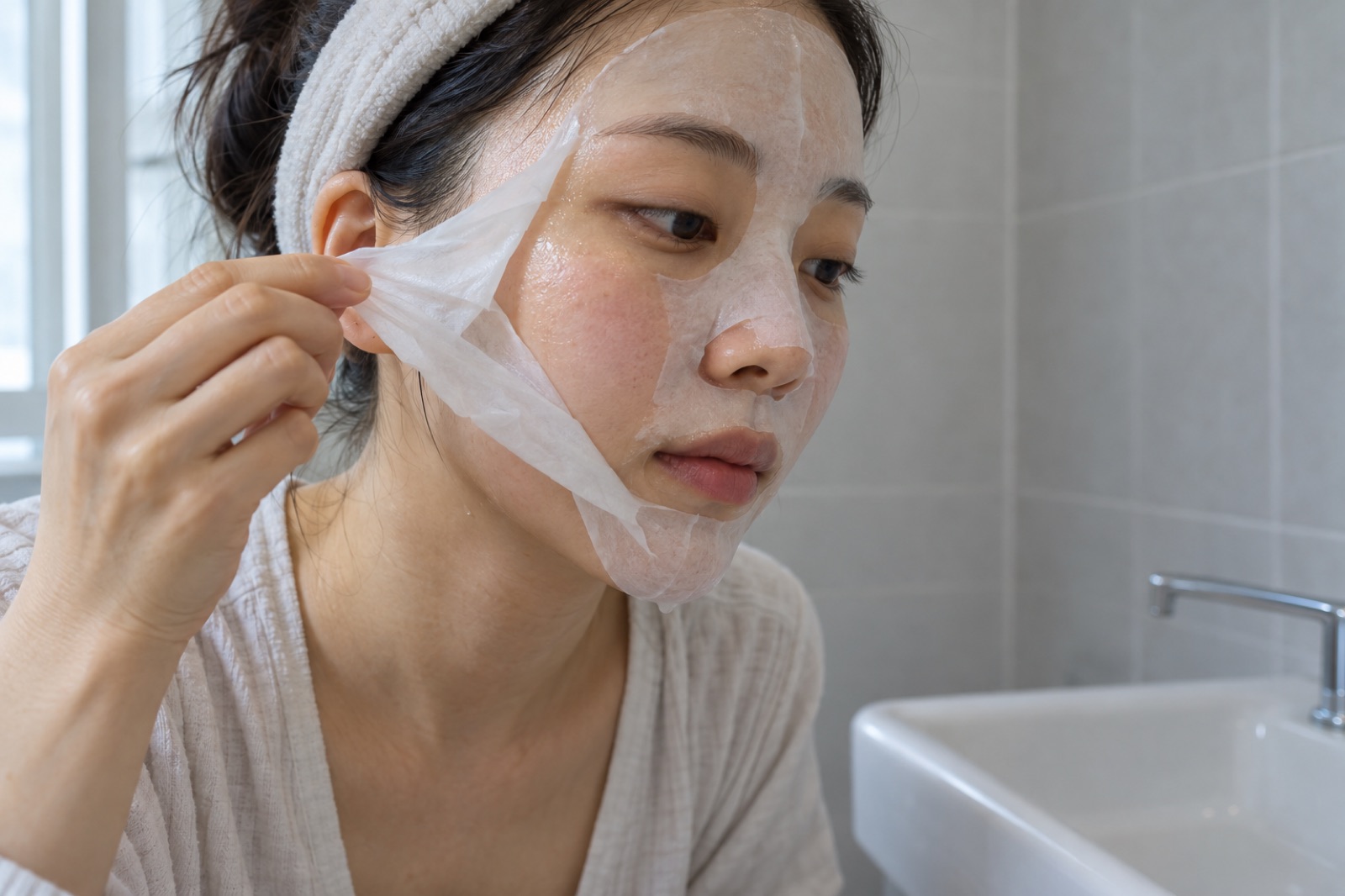
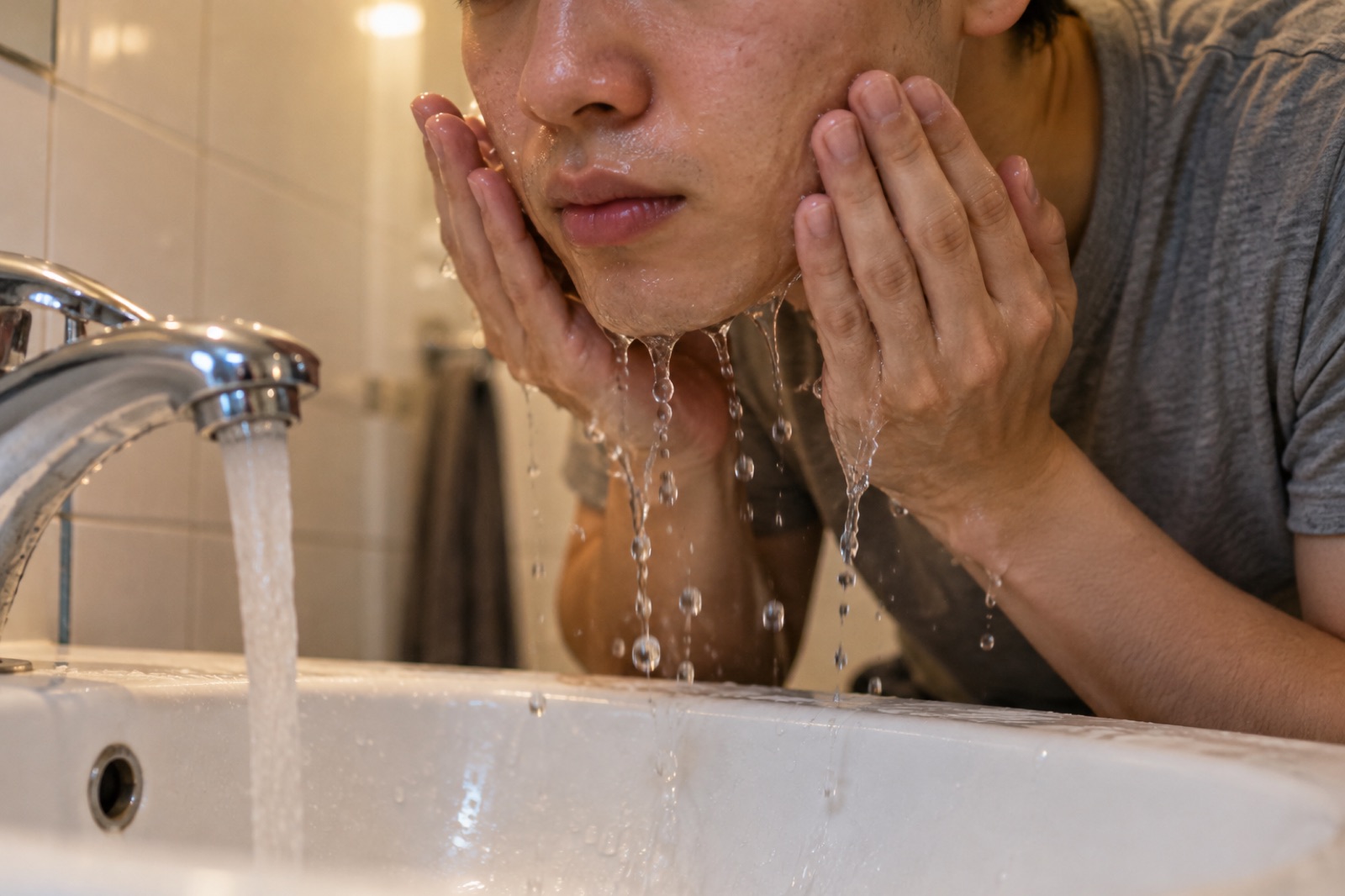
Yes. On a use where you feel stinging, take the sheet off right then instead of waiting out the time you planned. Once it’s off, rinse away the leftover essence with lukewarm water, apply only the one finishing step you already use, and then start that day’s log.
The UK’s National Health Service (NHS) advises washing with lukewarm water right away after contact with something that irritates your skin or sets off an allergy. Say you’re a college student who put on a mask the evening you got home from soccer: the moment it prickles, peel the sheet off, splash water on to rinse, and only press the towel to your face. This rinse is a step just for days when there was a reaction.
Why log the 1-minute and 5-minute marks separately?
Because when the stinging started is worth writing down on its own. If you keep the uses where it started early apart from the uses where it started late, then when you compare 3 uses you can see whether the same mask is setting off a reaction sooner each time.
A 2015 test put 50 μL of 10% lactic acid on both nasolabial folds (the lines running from the nose to the corners of the mouth) and rated stinging at 30 seconds, 2.5 minutes and 5 minutes. The sooner a person’s stinging started, the lower their current perception threshold and the higher their transepidermal water loss. In a 2020 cheek lactic acid test, whether people saw themselves as sensitive tracked more clearly with stinging at 1 minute than the skin type difference did (45.6% vs. 27.9%, P=0.058). Both are results with test-grade lactic acid, so this guide doesn’t carry them over to sheet masks. It uses them only as the reason people who usually feel sensitive should start logging at the 1-minute box.
Why check again 1 hour later and the next morning?
Because stinging and redness can fade quickly, or can instead show up a day later. Keeping the two times apart stops “briefly, while it was on” and “new, a day later” from landing in the same box.
In a 2020 study of cosmetic formulas, some volunteers had stinging and redness show up during real use and fade within about 1 hour, and standard patch tests had not revealed it ahead of time. The American Academy of Dermatology (AAD) explains that allergic reactions usually appear hours to days after contact. So even a high school student who puts on a mask at 11 p.m. during finals week fills in the 1-hour box before bed and the last box before school. A trial run on the inner arm first is laid out separately in the 7-day order for testing on your inner arm before moving to your face.
How do you log a day with broken skin or a flushed face?
Either way, write that day’s condition on one line at the top of your log before you start. On a day with broken skin, keep the sheet off that spot or skip that use; on a day your face is flushed, write down the heat before applying as its own line.
The evidence this guide drew on has no study of covering a spot that burst and bled with a sheet. First check whether the cautions on the package mention wounds, and mark that use “broken skin” so you don’t compare it with the other uses. An office worker whose cheeks feel hot after a full day under the air conditioning should also write down “heat before applying,” so you can tell where the heat in the 1-minute box came from.
Within 3 uses, what tells you whether to keep the mask?
Put the tables from up to 3 uses of the same mask side by side, and stop that mask if even one of the decision rules below applies. These rules are not a standard set by research; they are an editorial call this guide made to keep the log easy to read.
One use makes it hard to separate that day’s skin condition from the mask’s effect, and stretching it out means going through the reaction again and again, so the cutoff is 3 uses. Getting past 3 uses doesn’t mean the mask is fine for everyone. Taken together, the patch test evidence shows that a negative result doesn’t guarantee safety either, and some reactions show up late. Separately, in a 2021 lanolin study, 12 people with a positive patch test applied a lanolin cream to normal skin for 4 weeks with no reaction. That means a test result and what happens when you actually use something may not match, so this guide goes by the log you keep with the mask you’re actually using. This decision table is not a diagnosis. If reactions keep coming back, the cause is something to look for at a doctor’s appointment.
Your sting log: reactions at five set times
Above the table, write on one line the use number (1, 2 or 3), the product name and opened date, the situation that day (after a workout, late night during finals, an air-conditioned office and so on), and whether there is broken skin. Score each box 0 (nothing felt), 1 (felt if you pay attention), 2 (keeps bothering you) or 3 (you want it off now).
| Time | Stinging (0–3) | Heat (0–3) | Redness (0–3) | Action |
|---|---|---|---|---|
| 1 minute after applying | Left on / Took off | |||
| 5 minutes after applying | Left on / Took off | |||
| When taken off (at ___ min) | Rinsed / Didn’t rinse | |||
| 1 hour after removal | Finishing step only / Note anything else you applied | |||
| Next morning | New tiny bumps or itching: yes / no |

| Decision | Condition (editorial call) | Next step |
|---|---|---|
| Stop after use 1 | Stinging started within 5 minutes, and redness lasted more than 1 hour after removal | No second use of that mask |
| Stop within 3 uses | In 2 or more of the 3 uses, any box at 2 or higher | Stop that mask and keep the table |
| Stop that mask and log it | New redness, itching or tiny bumps the next morning, even once | Skip the next use, and keep the table and a photo of the package together |
| See a doctor no matter the count | Swelling, or a rash with itching | Stop that day and go to a dermatologist |
| OK to keep going | Every box 1 or lower in all 3 uses, and 0 the next morning | Keep going, logging the same way |
When is a sting worth a visit to a dermatologist?
- If the area where the mask sat swells, or a rash with itching appears, stop that day no matter which use it is and see a dermatologist.
- If redness, itching or tiny bumps keep going after you stop that mask, or a second use turns up a new reaction the next morning, take the tables and package photo you kept to a dermatologist, even if you haven’t finished the 3-use table.
- If similar reactions keep coming back even after you switch masks, have a dermatologist check the cause, as the AAD advises. The Korean Dermatological Association, a professional society in Korea, describes reactions caused by irritation as something that can happen in almost everyone once the irritation reaches a certain concentration or more. Reacting to a mask doesn’t on its own tell you whether it was irritation or allergy, so don’t try to sort that out at home; talk it over at your appointment. To get ready for the visit, see the log to fill in before a dermatology visit.
What is this sting log built on?
- In a 2020 cheek lactic acid test (PMID 32726552), the share showing objective stinging at 1 minute was 45.6% for Fitzpatrick skin types 1–3 and 27.9% for types 4–6, a borderline difference (P=0.058), and people who saw themselves as sensitive measured higher for stinging in every skin type (P<0.01).
- In a 2020 study of cosmetic formulas (PMID 32279349), stinging and redness in some volunteers showed up during real use and faded within about 1 hour, and standard patch tests did not predict them.
- In a 2021 lanolin study (PMID 32844454), 12 people with a positive patch test applied a lanolin cream to normal skin for 4 weeks with no reaction, showing that a test result and the result of actually applying something may not match.
Frequently asked questions
Should you take off a sheet mask right away if it stings?
On the use where you feel stinging, don't wait it out; take it off right then. Once it's off, rinse with lukewarm water, then write down when the stinging started and how many minutes in you took the mask off. Don't decide from a single time whether to give up that mask for good; use the 3-use rules. But if stinging started within 5 minutes on the very first use and redness was still there more than 1 hour after you took it off, stop that same day.
I got itchy tiny bumps the day after a sheet mask. Is the mask the cause?
You can't settle that at home. The American Academy of Dermatology (AAD) explains that an allergic reaction usually shows up hours to days after contact with a substance, so you can't rule the mask out just because you were fine the day you used it. Stop that mask, write the itching and any new tiny bumps in the next-morning box, and also note whether you started any other new product that same week. If it keeps going after you stop, or comes back when you use the mask again, see a dermatologist.
Can you put a calming sheet mask over a popped spot that's bleeding?
The evidence this guide drew on has no study of sheet masks placed over open skin. First check whether the cautions on the package say anything about wounds, then either skip the mask that day or keep the sheet off that spot, and write "broken skin" on your log so that day doesn't get mixed in with the others. If the bleeding doesn't stop easily, or the spot swells and hurts, see a dermatologist.
Should you rinse your face right away if a calming sheet mask stings?
On a day it stings, rinsing fits the guidance. The UK's National Health Service (NHS) advises washing with lukewarm water right away after contact with something that irritates the skin or sets off an allergy. Splash the water on with your palms and only press the towel to your face. Whether to wash after taking off a mask on days it doesn't sting is outside what this guide covers.
If stinging starts within 5 minutes of putting it on, should you take it off that day?
This guide says yes, take it off that day. In a 2015 test that put 10% lactic acid on the nasolabial folds and rated stinging at 30 seconds, 2.5 minutes and 5 minutes, people whose stinging started sooner had a lower current perception threshold, a measure of nerve sensitivity, and higher transepidermal water loss. Because the study used test-grade lactic acid, its results can't be carried over to sheet masks, so the rule of taking it off within 5 minutes is an editorial call.
Can you put a calming sheet mask on right after a workout while your face is still hot?
The evidence this guide drew on has no study of putting a sheet mask on a face flushed from exercise. Rinse off the sweat with lukewarm water first and wait until your face has cooled down and dried before you put the mask on. That day, add a "heat before applying" line above the table so you can compare whether the heat in the 1-minute box came from the mask or from the workout.
My face broke out after a calming sheet mask. Can I just wait a few days and see?
Rather than keep using it while you wait, stop that mask and fill in only the morning box each day. There is no evidence that it's fine to keep going because your skin is adjusting. The AAD explains that finding the cause can take time and that the longer a rash goes on, the longer it can take to get better even after the cause is found, so if it keeps going or spreads after you stop, see a dermatologist.
How do you show your sheet mask reaction log at a dermatology appointment?
Gather the product name and opened date, a photo of the side of the package that shows the full ingredient list, your table of scores by time for each use, and one photo from when the redness was strongest. Bring the table just as you wrote it, without rewriting it, so it's clear when the scores went up. If you changed a cleanser or cream during the same period, write its name at the bottom too.
Sources
- Stinging from 10% lactic acid on the nasolabial folds, current perception threshold and transepidermal water loss, 2015 (PMID 25198401)A
- Short occlusive patch test protocol for immediate-type stinging and redness from cosmetic formulas, 2020 (PMID 32279349)A
- 1-minute stinging from 10% lactic acid on the cheek, compared across Fitzpatrick skin types, 2020 (PMID 32726552)A
- Lanolin patch test in 12 positive reactors and 14 controls, 4-week repeated open application test, 2021 (PMID 32844454)A
- AAD — Contact dermatitis: OverviewInstitutional
- NHS — Contact dermatitisInstitutional
- Korean Dermatological Association (Korea) — Contact dermatitis (Korean)Institutional
Videos and forum posts never count as evidence for a fact here. Full rules: Editorial policy
What to check when choosing a product for this routine
Check the criteria below before the product name. Each item can be found on the full ingredient list or in the product description.
| Item | What to look for | Why |
|---|---|---|
| Stop-use wording for unusual reactions | Whether the container or product detail page says to stop using it and talk to a dermatologist if red spots, swelling or itching appear | On a night the mask stung, the cream you finished with can be marked in the next-morning box against the same wording |
| Ingredient list and expiry date on the latest packaging | Whether it tells you to check the full ingredient list and expiry date on the container before use | It gives you a rule for splitting the product-name and opened-date boxes at the top of your log into one line for the mask and one for the finishing cream |
| Ethanol (alcohol) listing | Whether ethanol appears on the full ingredient list | On a day the heat box reached 2, it takes one variable off the list you weigh at the finishing step |
| What a fragrance-free label is based on | Whether fragrance is absent from the full ingredient list, and whether "no added fragrance" is stated based on that list | On a use where the 1-hour-after score climbed again, it helps you decide whether to look first at the mask essence or the finishing cream |
Product from this site's operator · KW Cosmetic Content Team
Revive Therapy N.F CreamThis cream has no test data on days a mask stung or right after a sheet mask comes off, and the lactic acid sting tests and patch test studies cited here did not look at it either. It is a 50 ml cream with ceramides and hyaluronic acid and no added fragrance going by the full ingredient list; its detail page says to apply it as the last step after ampoule and to stop and talk to a dermatologist if red spots, swelling or itching appear. For an evening finish after a lukewarm rinse, keeping only the steps you already use, the product we suggest is Revive Therapy N.F Cream.
Fitting it into a routine
Where it goes: After ampoule, the last step of the routine
How to use it: After toner and ampoule, take a suitable amount and spread it gently from the center of the face outward. On areas where dryness bothers you, layer a small amount once more to finish.
Check before you use it: If red spots, swelling, itching or any other unusual reaction appears during or after use, stop using it and consult a dermatologist. Avoid using it on areas with wounds, and check the full ingredient list and expiry date on the latest packaging first.
Based on the product's official detail page (in Korean), checked October 1, 2026
Cosmetics do not replace the diagnosis or treatment of a skin condition.