Skincare Routine Order: Where to Slot a New Product, How Long to Wait
Put a new product in the step that does the same job, add only one at a time, and leave everything else unchanged for at least two weeks so late reactions have time to show.
What this note covers8 sections
- Where does a new product fit in your current order?
- Does barrier cream go on before or after lotion?
- What do you drop or add first when the seasons change?
- How long does a new routine take to make a difference?
- Does the order change if you use a prescription?
- Week-by-week log for a new product
- When should a dermatologist check your skin?
- Evidence at a glance
| Topic | Detail | Basis |
|---|---|---|
| Spacing between products | If a reaction is suspected, stop everything, use just one cleanser and one moisturizer, and once symptoms settle, add products back one at a time at 1–2 week intervals while you watch | Korean Dermatological Association · Korean society |
| Late reactions | In a repeated-application test of 19 people already sensitized to a fragrance ingredient, 4 of the 12 who reacted (33%) did so only after day 7, and none reacted after day 14 | 1996 PMID 8879928 · B |
| First checkpoint | In 291 people with mild to moderate acne, the group that added a cream to prescription medicine already showed a difference in overall rating at week 4 (p=0.007), and 61.7% improved by at least one grade at week 8 | 2024 PMID 39430644 · A |
| Longer view | In a 90-day trial of 299 adult women with mild acne, tolerability was rated “good” or better in 97% of the group that added skincare and used their medicine every other day, versus 84% of the group using only a standard moisturizer | 2017 PMID 28573779 · A |
| What each step does | Cleansers lift oil and sweat, toner adds water after washing, lotion tops up water and nutrients, and cream temporarily fills in a protective layer | Korean Dermatological Association · Korean society |
Where does a new product fit in your current order?
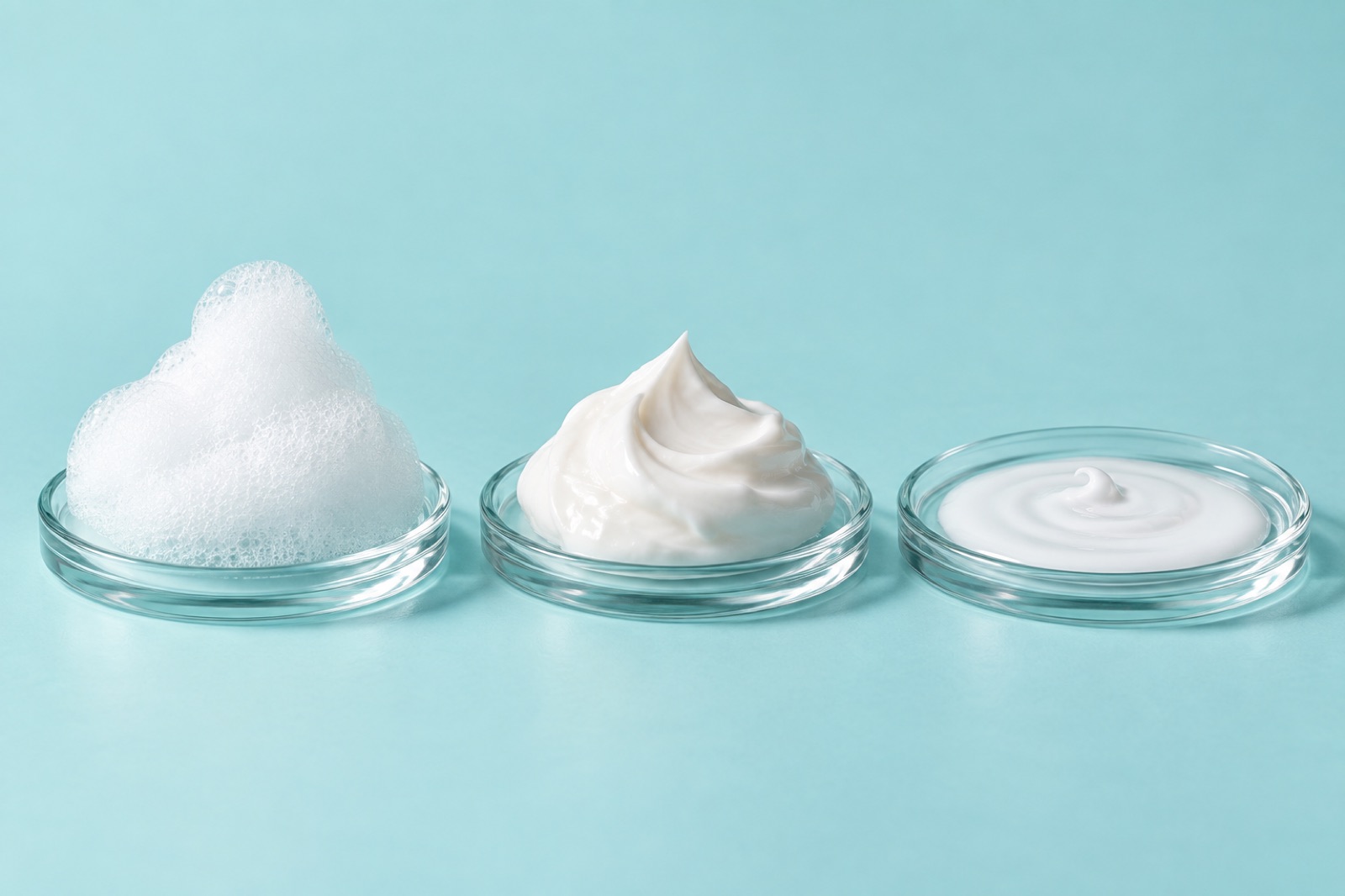
A new product goes into the step that does the same job, whatever it is called. The Korean Dermatological Association, a Korean professional society, sorts the steps this way: cleansers remove oil and sweat, toner puts water back after washing, lotion tops up water and nutrients, and cream, with more oil and moisturizing agents, temporarily fills in a protective layer.
For example, an ampoule or serum often sits after toner and before lotion, and a new cream takes the place of your old cream. If two products would do the same job, take one out before putting the other in, so your notes do not blur together. Whatever you add, keep the basic frame of cleanser, moisturizer, and sunscreen as it is. If you use a prescription medicine, your prescriber’s directions decide where it goes.
Does barrier cream go on before or after lotion?
If you decide by what the texture does rather than by marketing names, cream follows lotion in most cases. As the Korean Dermatological Association puts it, lotion sits between toner and cream, and cream carries more oil and moisturizing agents, so it goes last to fill in a protective layer.
More important than the order is not starting both products on the same day. If you switch lotion and cream together and a breakout shows up, you cannot tell which one is behind it. If you already have a lotion you use, keep it, bring in only the new cream, watch for two weeks, and then decide whether to change the lotion.
What do you drop or add first when the seasons change?
Between seasons, change one thing at a time and wait 1–2 weeks before moving on to the next product. When a cosmetic reaction is suspected, the Korean Dermatological Association suggests keeping only one cleanser and one moisturizer and adding the rest back one by one at 1–2 week intervals, and that same spacing makes causes easier to tell apart when you shift seasons.
Late reactions are another reason for the gap. In a 1996 study of 19 people already reactive to a fragrance ingredient, 4 of the 12 who tested positive after repeated application (33%) reacted only after day 7, and no one had a new reaction after day 14. These were people with an existing allergy, so the result does not apply to everyone, but it is a reason not to open the next product just because the first week was quiet.
How long does a new routine take to make a difference?
Plan on 4 weeks for the first change and 8 weeks for a decision, which matches how the studies were set up. In a trial of 291 people with mild to moderate acne in Indonesia, the group that added a cream to prescription medicine already differed in overall rating at week 4 (p=0.007), and at week 8, 61.7% had improved by at least one grade, compared with 47.9% of the medicine-only group.
That said, the drop in lesion counts did not differ significantly among the three groups, and these were results with prescription medicine in the mix. A 2017 trial of 299 adult women in Spain and Poland followed people for 90 days, and tolerability was better in the group that added skincare. If you changed only the order of your cosmetics, comparing photos in the same light once at week 4 and once at week 8 is the most practical plan.
Does the order change if you use a prescription?
If you use a prescription medicine, the new product’s spot has to be set again around the medicine’s directions. In a 2012 split-face trial, about 83–86% of people using tretinoin cream had irritation on both sides of the face, but the side that also got an SPF 30 moisturizing lotion was generally milder.
A 2026 consensus from six South African dermatologists also split dermocosmetics into three roles: on their own for mild acne, as an add-on to prescription care, and for the maintenance stage. If you want to add a new serum or exfoliating product while on medicine, check the order and spacing with your prescriber before you start it.
Week-by-week log for a new product
| Week | What to do | What to write down |
|---|---|---|
| Week 0 | Keep your current order for 1 week | Number of morning and evening steps, tightness and shine, new breakouts |
| Week 1 | One new product in the step with the same job, once in the evening | Where it went (after toner, in place of cream, etc.), stinging |
| Week 2 | Leave everything else alone, watch for late reactions | Dates when itching or redness appeared |
| Weeks 3–4 | If no reaction, add a morning use or a bit more product | A photo in the same light at week 4 |
| Weeks 5–8 | Keep it steady | A photo at week 8, decide whether to keep it |
| Next product | Start only after the week 8 decision | Begin again from a fresh week 0 log |
If you need to change several products between seasons, start with the moisturizing step and push exfoliating or active-ingredient products to later.
When should a dermatologist check your skin?
- If redness or itching does not settle 1–2 weeks after you stop the new product, have a dermatologist take a look.
- If stinging gets worse after you add a new product while on a prescription, talk with the dermatologist who prescribed it.
- If new breakouts keep increasing after 8 weeks on the same order, or you get swollen, painful breakouts, book a dermatology visit.
Evidence at a glance
- In a 2024 randomized trial comparing 291 people with mild to moderate acne over 8 weeks (PMID 39430644), the group that added a cream to prescription medicine showed a difference in overall rating at week 4 (p=0.007), and 61.7% improved by at least one grade at week 8.
- In a 2017 randomized trial comparing 299 adult women with mild acne over 90 days (PMID 28573779), tolerability was rated “good” or better in 97% of the group that added skincare and used their medicine every other day, versus 84% of the group using only a standard moisturizer.
- In a 1996 repeated-application test of 19 people sensitized to a fragrance ingredient (PMID 8879928), 4 of the 12 who reacted (33%) showed their reaction after day 7.
Frequently asked questions
What should you change in your skincare routine when the seasons change?
Change one step at a time instead of everything at once. When a cosmetic reaction is suspected, the Korean Dermatological Association suggests going down to one cleanser and one moisturizer, then adding products back one by one at 1–2 week intervals. Using the same spacing when you switch seasons makes it easier to pin down a cause. Moving from summer into fall, try adding a cream first rather than dropping your lighter texture.
Does barrier cream go on before or after lotion?
Go by what the texture does, not the name on the label. The Korean Dermatological Association describes lotion as the step after toner that tops up water and nutrients, and cream as the step with more oil and moisturizing agents that fills in a protective layer. So cream usually goes on after lotion. The bigger rule is not to start both new products at the same time.
How long should you try a new skincare routine before judging it?
Studies that combined prescription medicine with skincare usually looked at results over 4 to 8 weeks, and some ran as long as 90 days. In one trial of 291 people with mild to moderate acne, a difference in overall rating already showed at week 4 and was checked again at week 8. Even if you changed only cosmetics, keep the same order for at least 4 weeks so you have a fair comparison.
Sources
- Adding a skincare regimen for adult women using adapalene/benzoyl peroxide: RCT, 299 women, 90 days, 2017 (PMID 28573779)A
- Tolerability of tretinoin cream with an SPF 30 moisturizing lotion: split-face RCT, 2012 (PMID 23135655)A
- Using dermocosmetics in acne care: South African expert consensus, 2026 (PMID 41689191)A
- A dermocosmetic cream combined with adapalene: RCT, 291 participants, 8 weeks, 2024 (PMID 39430644)A
- Use test and patch test in isoeugenol contact allergy, 19 participants, 1996 (PMID 8879928)B
- Korean Dermatological Association — Basic skincare products (Korean)Institutional
- Korean Dermatological Association — Cosmetics overview and adverse reactions (Korean)Institutional
- Korea Disease Control and Prevention Agency (KDCA), National Health Information Portal — Acne (Korean)Institutional
Videos and forum posts never count as evidence for a fact here. Full rules: Editorial policy