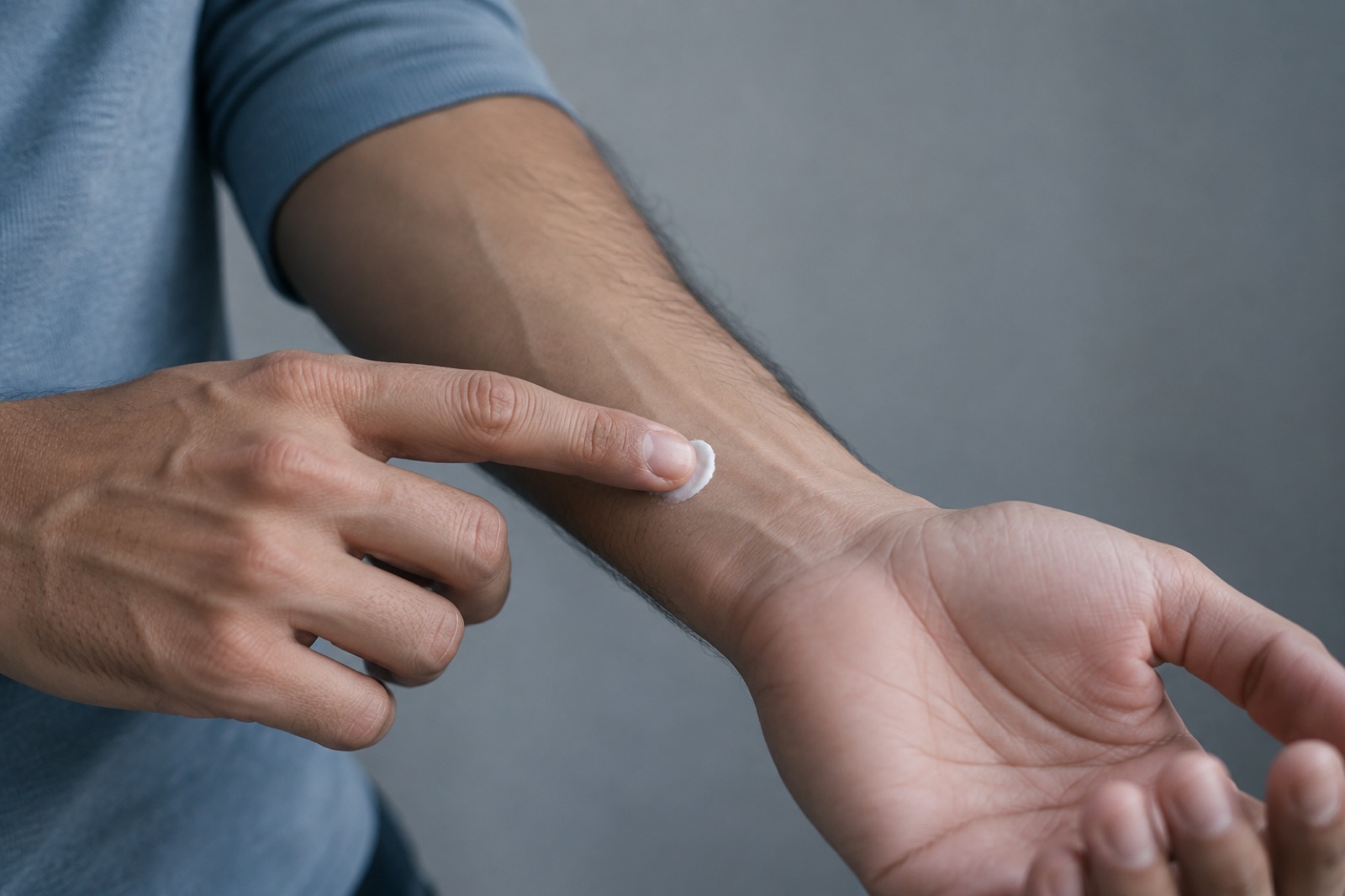
Niacinamide Benefits: 2% to 20%, Half-Face 2-Week Log
Most of what's known about niacinamide benefits comes from studies of 2–5% products, so when you switch to a 10–20% serum, start it on one half of your face and log it side by side with your old serum.

What this note covers9 sections
- Niacinamide benefits: what do you decide first when moving to a higher percentage?
- Why put the new serum on only half your face in the first week?
- In week 2, when do you widen it to your whole face?
- Your 2-week half-face log for a higher-percentage switch
- On what day do you go back to your old percentage?
- Why skip sheet masks and mixed-in concentrates during the 2-week switch?
- After 2 weeks, how do you compare the two sides’ boxes?
- When is it time to take your log to a dermatologist?
- The evidence behind this switch log
| Situation | What you do in these 2 weeks | Basis |
|---|---|---|
| The day you buy a 10%, 15% or 20% serum after months on a 2–5% product | Only swap your old product for the new one in the serum step, and keep every other step, through to the final cream, the same | Editorial choice |
| Wondering whether a higher percentage is better | No study has compared 2%, 4%, 5% and 10% head to head on healthy skin; the only evidence comparing concentrations is one patient study and one grade-B report | Editorial evidence review · evidence gap |
| Hesitating to switch because your skin is sensitive | The irritation figures reported come from patient studies in psoriasis, alongside calcipotriol, which doctors prescribe, and in actinic keratosis; how often healthy people get irritation applying 10–20% at home isn’t in the evidence | 2013 PMID 24520552 · 2025 PMID 39587989 · A |
| Planning to try it on your inner arm first | There’s no evidence that a result on your arm predicts how your face will react, so log it on half your face, side by side with your old product | Editorial evidence review · evidence gap |
| After stinging starts while using 20% | Go back to your old percentage and log 2 more weeks to see whether any reaction lasts into the morning | Editorial choice |
Niacinamide benefits: what do you decide first when moving to a higher percentage?
Most of the human studies behind known niacinamide benefits had a few dozen people apply 2–5% products for 4 to 12 weeks, and no study has compared 10% or 20% head to head with a lower percentage on healthy skin. So the first thing to decide when you go higher isn’t the result you expect but a rule: in the serum step, you only swap your old product for the new one.
Say an office worker who has used a 5% serum for three months buys a 20% serum. Instead of layering the new serum on top of the old one, take the old one out of that step and put the new one in. Leave your cleanser, toner and the cream you apply last untouched, in both type and amount, for 2 weeks. If you bring in another new product, lay on a sheet mask or mix in a concentrate during the same 2 weeks, you won’t be able to tell what caused a change in your boxes.
Don’t rework the order you apply things in during these 2 weeks, either; keep the serum in the spot it already had. Neither claim, that a higher percentage works better or that it stings more, can be made from this guide’s evidence, so use these 2 weeks only to log how differently your skin reacts to the two products.
Why put the new serum on only half your face in the first week?
In the first week, once in the evening, apply the new serum to only the left or right side of your face and keep applying your old serum to the other side. Putting the two products side by side on the same night, under the same conditions, is what lets you compare the two sides’ boxes the next morning.
Write the amount as drops or pumps, not as how many times you applied. For a dropper bottle, write the number of drops; for a pump bottle, the number of presses, and make the amount the same on both sides. Once in the evening is this guide’s choice to keep it from mixing with your morning steps, not a frequency set by research.
This half-face log isn’t a test that predicts a reaction ahead of time. The evidence we reviewed has nothing showing that a self-test on your inner arm, or a test that repeats applications on your arm over several days, predicts how your face will react, and how often people in the general population newly become sensitive to niacinamide isn’t known either. So read the half-face log only as a record comparing your old product and the new one side by side on the same face.
The irritation figures that have been reported also all come from patient studies. In a 2013 combination study in 65 patients with psoriasis (PMID 24520552), calcipotriol, a medicine doctors prescribe, and 4% niacinamide were applied together to lesions on one side for 12 weeks; mild redness and itching occurred in 4.6%, moderate burning and sensitivity to light in 3.0%, and no one stopped because of them. In a 2025 patient study of 26 people with actinic keratosis (95 lesions, PMID 39587989), the group that got a 1% gel twice a day for 12 weeks had burning in 2.4% and redness in 9.5%. Both studies used 4% and 1% products on skin with a disease, so how often healthy people get irritation applying a 10–20% serum at home isn’t in this guide’s evidence.

In week 2, when do you widen it to your whole face?
If, during the seven nights of week 1, neither side had a reaction that lasted into the next morning, apply the new serum to your whole face from week 2, still once in the evening. If the new-serum side had even one day with a box that lasted into the morning, don’t widen it; keep the half-face method for another week.
This guide’s first week has a different purpose from starting on one area of the face and gradually widening where you apply. The first week is for comparing two products on the same face, and the second week is for trying the new serum alone once that comparison is done. Don’t put your old serum away in week 2; keep it for the day you might need to go back.
Your 2-week half-face log for a higher-percentage switch
The boxes in this table and the 2-week length weren’t set by research; they’re a frame this guide set so you can read the new-serum side and the old-serum side on the same night under the same conditions. Split each box into “new / old,” and score stinging, itching and dryness as 0 none · 1 there but gone by morning · 2 still there in the morning.
| Day | Amount applied (drops · pumps) new / old | Stinging 0–2 new / old | Itching 0–2 new / old | Dryness 0–2 new / old | Redness next morning new / old | Overlapped that day |
|---|---|---|---|---|---|---|
| Before you start | New-serum side: left · right / old product’s percentage | — | — | — | Morning before applying | Cream and toner names on one line |
| Day 1 | e.g. 2 drops / 2 drops | |||||
| Day 2 | ||||||
| Day 3 | ||||||
| Day 4 | ||||||
| Day 5 | ||||||
| Day 6 | ||||||
| Day 7 | ||||||
| Day 8 (whole face from today) | Whole-face amount | |||||
| Days 9–14 | Keep going in the same boxes | On a day you go back, the date and “switched back” | ||||
| After 2 weeks | Compare the two sides’ boxes | Number of days with a 2 | Number of days marked “still there” |
In the “overlapped that day” box, write in one word anything that day that could make your skin swing on its own: the week before your period, late nights at work stretching past two days, a day you worked out and stayed sweaty for a long time, a day you wore a face mask all day, or a day spent in an office with the heat turned up high.

On what day do you go back to your old percentage?
If stinging or redness that lasts into the morning is logged on the new-serum side two days in a row, stop the new serum and switch your whole face back to the product with your old percentage. On a day the area you applied it to swells, or itching spreads beyond it, don’t wait two days; stop that same day.
After you go back, don’t try the serum that caused the reaction again by using less of it or applying it every other day. This guide’s evidence has nothing supporting the idea of pushing through reactions that last into the morning as “a period while your skin gets used to it,” and research hasn’t set a standard for telling whether stinging is a sign of skin damage or a reaction that passes. That’s because most studies of stinging were done with prescription medicines, procedures or people with skin conditions, so there’s no standard to carry straight over to everyday cosmetics.
Keep using the same table during the 2 weeks after you go back to your old percentage. If the morning boxes stay empty in those 2 weeks, stick with your decision to go back; if reactions continue with your old product too, check the conditions for seeing a doctor below first.
Why skip sheet masks and mixed-in concentrates during the 2-week switch?
Laying a sheet mask over the serum changes the conditions you applied it under, and mixing a concentrate into a cream leaves you not knowing the actual concentration reaching your face or how the mixture keeps, so you can’t read your log boxes. That doesn’t mean covering or mixing is harmful; it’s that this guide’s evidence has no study of applying under those conditions, and these 2 weeks need conditions kept to one variable.
If you want a mask on a weekend evening, put it off until the 2 weeks are over. If you already used one, write “mask” in that day’s “overlapped that day” box, and after 2 weeks read that line separately. This guide doesn’t cover how to mix concentrate or powder products; use each product following the directions on its label.
After 2 weeks, how do you compare the two sides’ boxes?
Put the new-serum side’s and old side’s boxes from week 1 next to each other by area, like the cheeks, jawline and around the eyes, and look only at which side more often had stinging, itching, dryness and morning redness that stayed. What this comparison tells you is how differently your skin reacted to the two products, not a verdict on whether the new serum works better or worse.
For example, if only the new-serum side’s dryness box had a 1 for three days and nothing lasted into the morning, write that fact on one line under the table. Star the days that overlapped with the week before your period or back-to-back late nights, on both sides, and don’t read them mixed in with the other days. What you compare against isn’t other people’s reviews but the old-serum side’s boxes on the same face.

When is it time to take your log to a dermatologist?
- If red spots, swelling or itching appear where you applied it, stop the serum and get it checked by a doctor for care or advice.
- If stinging or redness keeps newly appearing for more than 2 weeks after you’ve gone back to your old percentage, consider taking your log to a dermatologist.
- If tiny bumps or pimples get painful and hard or you see pus, see a doctor rather than continuing to log.
- If you’re using a prescribed medication, ask the prescriber first before raising your serum’s percentage.
The evidence behind this switch log
- In a 2013 half-body comparison trial in 65 patients with psoriasis (PMID 24520552), the side that got 4% niacinamide added to calcipotriol, a medicine doctors prescribe, for 12 weeks had adverse reactions of mild redness and itching in 4.6% and moderate burning and photosensitivity in 3.0%, with no one stopping. It’s a patient, combination study, so we don’t carry it over to high-percentage serums on healthy skin.
- In a 2025 randomized trial in 26 patients with actinic keratosis (95 lesions, PMID 39587989), the group that got 1% niacinamide gel for 12 weeks had burning in 2.4% and redness in 9.5%. How often healthy people get irritation applying a 10–20% serum, and any study comparing 2%, 5% and 10% head to head, aren’t in this guide’s evidence.
- A 2025 consumer newsletter from Korea’s Ministry of Food and Drug Safety (MFDS) advises checking the directions, precautions and expiration date on the container or packaging before using a cosmetic, not applying it to damaged skin or mucous membranes, and seeing a specialist for care or advice if side effects such as red spots or swelling appear.
Frequently asked questions
Can I switch to a 15% niacinamide serum if I have sensitive skin?
This guide's evidence has no study of 15% niacinamide on sensitive skin, so it can't say whether switching is fine or not. If you decide to switch, for the first week apply the 15% serum once in the evening to only half your face, keep your old product on the other side, and write the same number of drops for both sides. Before you start, write your rule at the top of the log: 'If a reaction lasts into the morning on the new-serum side two days in a row, I go back to my old percentage.'
My 20% niacinamide serum caused irritation. Can I lower the percentage and use it again?
Don't retest the 20% serum that caused the reaction by just using less of it or using it less often; go back to a product with the percentage you'd used for months without problems. This guide's evidence also has nothing showing that a lower percentage makes things fine, so after you go back, use the same log for 2 weeks to check that no reaction lasts into the morning. If red spots, swelling or itching appeared, stop everything and see a dermatologist.
Can I put a sheet mask on after niacinamide serum?
This guide's evidence has no study of a sheet mask laid over the serum, so it can't say whether that's good or bad. But during the 2 weeks you change the percentage, conditions need to stay at one variable so you can read the new-serum and old-serum boxes, so put masks off until the 2 weeks are over. If you already used one, write 'mask' in that day's 'overlapped that day' box and read it separately.
Is it OK to mix a niacinamide concentrate into my moisturizer?
This guide's evidence has no study that tested a cream with concentrate mixed in. Once you mix, you can't know the actual concentration reaching your face or how the mixture holds up in storage, so you can't write down in your log what you applied and how much. This guide doesn't cover how to mix; use each product separately, following the directions on its own label.
Tiny bumps increased after I moved to a higher percentage. Is the ingredient to blame?
You can't pin it on niacinamide from an article alone. Check in your log whether the tiny bumps increased only on the new-serum side or on both sides, and whether the 'overlapped that day' box shows things like the week before your period, late nights at work or a new sunscreen; together they tell you which side to look at first. If the bumps get painful and hard or you see pus, or they keep increasing for more than 2 weeks, see a dermatologist.
I'm buying a 20% niacinamide serum for the first time. Since it's high strength, can I put it on my whole face from day one?
No study has compared starting 20% on the whole face with starting on half the face, so there's no basis for saying which is right. This guide's order is to apply 20% to only half your face in the first week and keep your old product on the other side. Logging both sides next to each other leaves you the boxes to tell whether a reaction came from the new serum or from something else that week.
My oily skin flushes easily. Will a 20% niacinamide serum make the redness worse?
This guide's evidence has no study of people whose faces redden easily using a 20% serum, so it can't answer ahead of time. The redness figures that have been reported come from 4% and 1% products in patient studies, one in psoriasis alongside a medicine doctors prescribe and one in actinic keratosis, so we don't carry them over to 20% on healthy skin. If you decide to use it, split the next-morning redness box into the new-serum side and the old side, and if red spots or swelling appear, stop and see a doctor.
My new niacinamide serum is a different color from the reviews and product page. Can I still use it on switch day?
Why the serum you received looks different can't be judged from an article, so until the seller or manufacturer confirms it's the same product in normal condition, don't start the half-face log with that bottle; keep using your old serum. If you start after getting that confirmation, write the date you received it, the color you saw and the expiration date on the container on one line in the 'before you start' row of your log. Store it the way the label says, and if the color changes again during the 2 weeks, note it in that day's 'overlapped that day' box and ask again.
Sources
- Double-blind half-body comparison of calcipotriol with 4% niacinamide, 65 patients with mild to moderate psoriasis, 12 weeks, 2013 (PMID 24520552)A
- Randomized comparison of 1% niacinamide gel and 5% fluorouracil cream, 26 patients with actinic keratosis (95 lesions), 2025 (PMID 39587989)A
- Ministry of Food and Drug Safety (Korea), Busan Regional Office — Consumer newsletter: precautions when using cosmetics (Korean, 2025-05-30)Institutional
Videos and forum posts never count as evidence for a fact here. Full rules: Editorial policy
What to check when choosing a product for this routine
Check the criteria below before the product name. Each item can be found on the full ingredient list or in the product description.
| Item | What to look for | Why |
|---|---|---|
| A container that gives the same amount | Whether one squeeze of the tube or one press of the pump gives about the same amount from day to day | If the cream amount wobbles during the 2 weeks you change only the serum, you can't compare the new-serum side and the old-serum side under the same conditions |
| How many more ingredients to watch | How many ingredients in the full ingredient list, besides the serum you're switching, you'd need to watch separately for reactions | The fewer lines you'd suspect after the serum on a day the boxes change, the easier it is to read the 2-week log as one variable |
| A fragrance line | Whether fragrance appears in the full ingredient list, and whether you copied that above your log on day one | On a night the stinging or itching box goes up to 1, you already have one item to check first on the cream side |
| Use near broken spots | Whether the product page or the back of the container says not to apply it to broken or damaged skin | On a day a stinging spot shows up on the new-serum side, you've already decided whether to keep putting cream on that spot |
| Stop-and-ask wording | Whether it says to stop and talk to a dermatologist if red spots, swelling or itching appear during use | On a day you hit your switch-back rule, you can match the cream's directions to decide whether to stop only the serum or the cream too |
Product from this site's operator · KW Cosmetic Content Team
Revive Therapy N.F CreamWhen you swap only the serum for 2 weeks, one fixed last moisturizing step lets you compare both sides. This 50 mL cream contains 4 ceramides and 5 types of hyaluronic acid, has no added fragrance by its full ingredient list, and has completed a low-irritation skin patch test. Niacinamide is in its ingredient list, but the amount isn't disclosed, and no test data covers use with a high-percentage serum. Its product page says to apply it last, after ampoule, and to avoid broken skin. To hold that last step with the same amount on both sides for 2 weeks, the product we suggest is Revive Therapy N.F Cream.
Fitting it into a routine
Where it goes: After ampoule, the last step of the routine
How to use it: After toner and ampoule, take a suitable amount and spread it gently from the center of the face outward. On areas where dryness bothers you, layer a small amount once more to finish.
Check before you use it: If red spots, swelling, itching or any other unusual reaction appears during or after use, stop using it and consult a dermatologist. Avoid using it on areas with wounds, and check the full ingredient list and expiry date on the latest packaging first.
Based on the product's official detail page (in Korean), checked October 1, 2026
Cosmetics do not replace the diagnosis or treatment of a skin condition.