How to Remove Sebum from Your Face? Track Your Shine for 2 Weeks First
Before you try to clear sebum from your face, spend 2 weeks noting when and where you get shiny, then time your washing, blotting papers, and moisturizer to match.

What this note covers8 sections
- What causes excess sebum on your face?
- How do you log when and where you get shiny?
- Why does white stuff come out of my pores when I squeeze them?
- Does squeezing out sebum make your pores bigger?
- On day 15, how do you adjust washing, blotting, and moisturizer?
- Two-week shine log
- When should a dermatologist take a look?
- Research behind this log
| Point | Detail | Basis |
|---|---|---|
| How long to log | This article logs for 2 weeks and adjusts on day 15. In a trial of a toner applied to the skin, the difference in nose oiliness also became significant only from week 3 | 2019 PMID 30964238 · A |
| Different amounts by zone | In the same 21 people, the drop in oiliness after 28 days differed by zone: 13.10% on the forehead and 21.43% on the nose | 2019 PMID 30964238 · A |
| Hot days | Oil output rises 10% for every 1°C (1.8°F) rise in body temperature, so there is more in summer | Korea Disease Control and Prevention Agency (KDCA) · Korean agency |
| How often to blot | Lightly, about once or twice a day, is best; removing too much oil can increase water loss | KDCA · Korean agency |
| Squeezing by hand | Do not squeeze or scratch with dirty hands, and a bad squeeze can leave pitted scars | KDCA, Seoul National University Hospital · Korean institutions |
What causes excess sebum on your face?
Sebum is made continuously by oil glands attached to hair follicles and rises up through the pores, so even if you wipe it off or push it out, your face gets shiny again a few hours later. Seoul National University Hospital, a university hospital in Korea, explains that male hormones rise in puberty and oil glands become more active, and the KDCA, Korea’s national public health agency, says oil output rises 10% for every 1°C rise in body temperature, so there is more in summer.
That is why the same person’s shine differs between a day in an air-conditioned office, a day walking to and from school in the blazing sun, and a day in a face mask from morning to night. The Korean Dermatological Association also cites research suggesting that oil gland size and activity are set by genetics, so rather than trying to change the amount you were born with, a realistic starting point is knowing when during the day it goes up.

How do you log when and where you get shiny?
Check the mirror four times (right after your morning wash, around lunch, at 3–4 p.m., and right after you get home) and score shine on your forehead, nose, cheeks, and chin as 0, 1, or 2. Just as the 2019 toner trial measured oiliness changes separately on the forehead and nose of the same 21 people, the amount of shine and how fast it changes differ from zone to zone.
Next to the scores, add one line about the day’s conditions: things that change daily, such as temperature, hours in a face mask, whether you exercised, when you fell asleep the night before, and your menstrual cycle. After 2 weeks, overlapping boxes will stand out, like “nose only, 2 at 3 p.m. on weekdays” or “forehead 2 on workout days,” and those boxes are what you adjust.
Why does white stuff come out of my pores when I squeeze them?
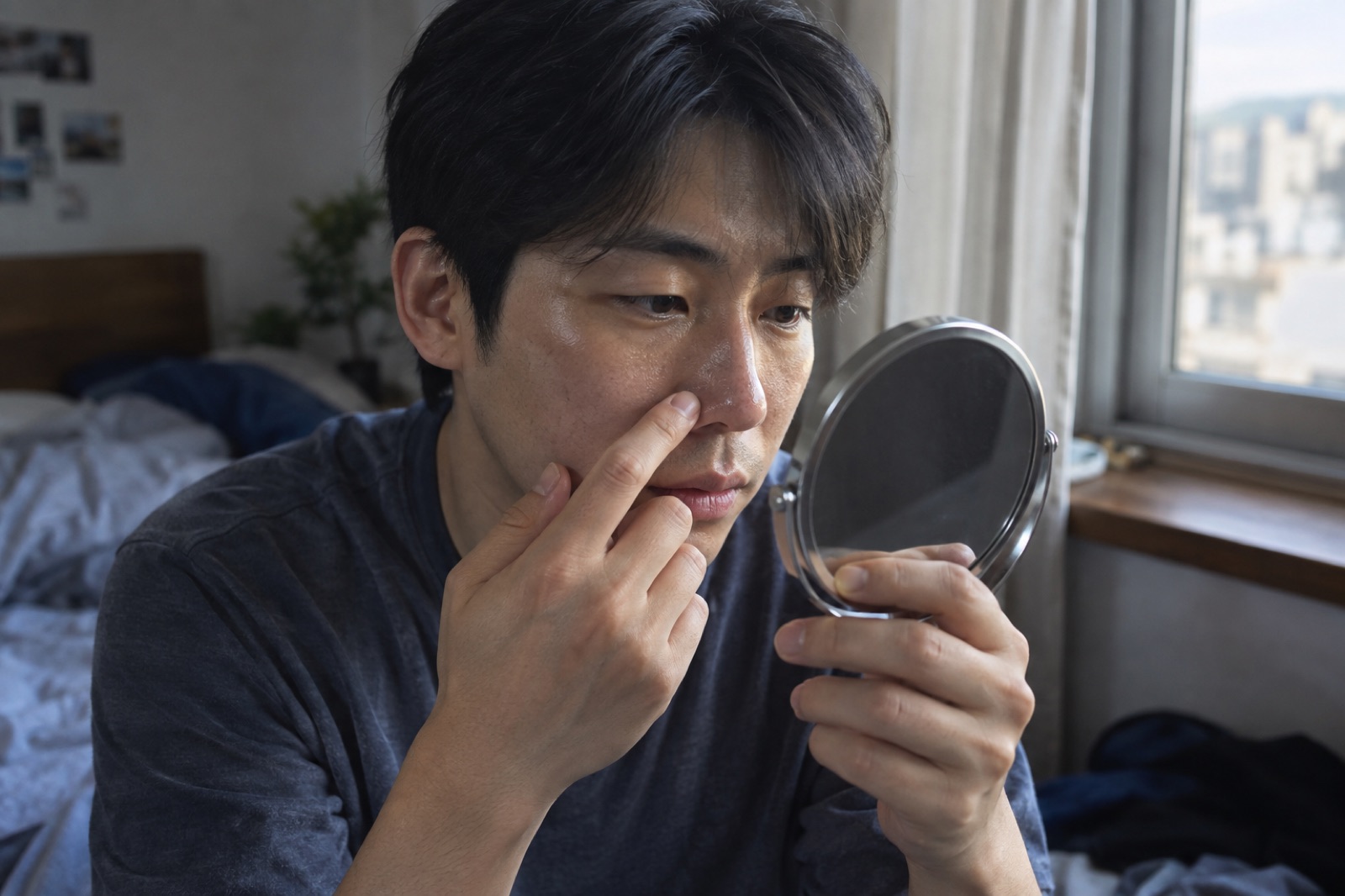
The white plug that comes out when you press on a pore is often comedone contents, dead skin and oil that pooled and hardened inside the follicle. The Korean Dermatological Association explains that when a plug of dead skin blocks the follicle opening, trapped oil swells the follicle into a comedone, and closed comedones, whose openings are shut, look like small skin-colored or white bumps.
The contents are also the reason not to press out white spots just because you can see them. In a 1992 study that analyzed 108 open comedones from 18 people with acne, substances that trigger inflammation (IL-1 alpha activity) were found in 76%. If fingertip pressure pushes these contents out through the follicle wall, they can turn into a red pimple, so during your logging period, just note where the white spots are and keep your hands off.
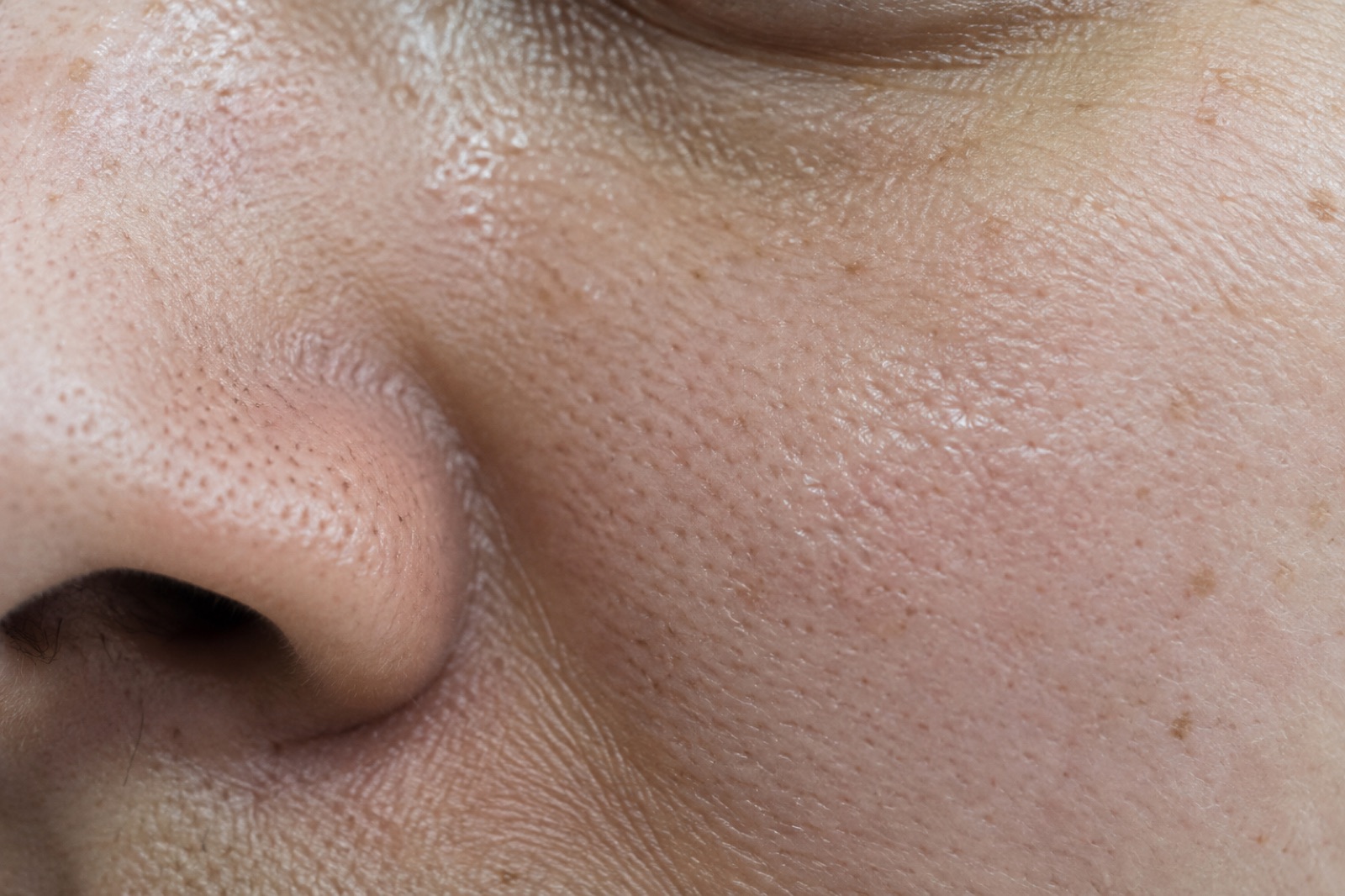
Does squeezing out sebum make your pores bigger?
The sources behind this article include no study that directly measured whether squeezing changes pore size, but a link with scarring has been reported. In a 2025 survey of 225 acne patients in Thailand, 61.33% had scars, and squeezing or picking was named as a factor that raises the risk of scarring.
Seoul National University Hospital explains that if a bad squeeze bursts oil into the deeper skin, it can leave raised or pitted scars. Pitted marks are harder to undo than pores that look large, so if your goal is less shine, leave squeezing out of this logging plan.
On day 15, how do you adjust washing, blotting, and moisturizer?
Look at the times and zones where 2s pile up, and adjust one thing at a time: keep washing to twice a day but shift when you do it, blot only at those times, and use less moisturizer on the shiny zones. The KDCA advises blotting lightly about once or twice a day, noting that removing too much oil can increase water loss and may even lead to more oil.
For example, if most of your 2s are “nose at 3 p.m.,” press blotting paper on your nose only at that time; if “forehead right after getting home” clusters on workout days, add a post-workout wash time to your log. If your cheeks score 0 but feel tight, log moisturizer amounts separately for your shiny T-zone and your cheeks. Skip masks you leave on for a long time. In a 2024 trial of three sheet masks worn for 5 to 40 minutes, oil went up with every mask and was more noticeable after 40 minutes, and 57.14% of 28 people had dryness.
Two-week shine log
| Date | Right after morning wash | Around lunch | 3–4 p.m. | Right after getting home | One-line conditions |
|---|---|---|---|---|---|
| Day 1 (Mon) | Forehead 0 · Nose 0 · Cheeks 0 · Chin 0 | Forehead 1 · Nose 1 | Nose 2 | Forehead 1 · Nose 2 | 26°C (79°F), mask 3 hours |
| Day 2 (Tue) | |||||
| … | |||||
| Day 14 (Sun) | |||||
| Day 15 wrap-up | Time with the most 2s: | Zone with the most 2s: | Overlapping conditions: | One thing to change: |
If there were days in those 2 weeks when you squeezed or picked, mark those boxes and check whether a red pimple showed up in the same spot the next day.
When should a dermatologist take a look?
- If red, painful pimples or pus-filled spots keep coming back where you get shiny, see a dermatologist.
- If spots you squeezed or picked start leaving dents or dark marks, talk with a dermatologist.
- If your nose and cheeks are shiny and also flush easily with burning that keeps going, get checked by a doctor to see whether it is a different condition.
- If flaking and itching keep coming back around your eyebrows or beside your nose along with the shine, have a dermatologist take a look.
Research behind this log
- In a 2019 split-face trial of 21 people with oily skin (PMID 30964238), the drop in oiliness after 28 days differed by zone, 13.10% on the forehead and 21.43% on the nose, and the nose difference became significant from week 3.
- A 1992 study that analyzed 108 open comedones from 18 people with acne (PMID 1534342) found inflammatory substances (IL-1 alpha activity) in 76%.
- A 2025 survey of 225 acne patients in Thailand (PMID 39601200) found a scar prevalence of 61.33%, with squeezing and picking as risk factors.
Frequently asked questions
What causes excess sebum on your face?
Sebum is made continuously by oil glands attached to hair follicles and rises up through the pores, and the amount differs by person and by conditions. Seoul National University Hospital explains that male hormones rise in puberty and oil glands become more active, and Korea's national health agency (KDCA) says oil output rises 10% for every 1°C rise in body temperature, so there is more in summer. The Korean Dermatological Association also cites research suggesting that oil gland size and activity are set by genetics.
Why does white stuff come out of my pores when I squeeze them?
The white plug that comes out when you squeeze is usually comedone contents: dead skin and oil that pooled and hardened inside the follicle. The Korean Dermatological Association explains that when a plug of dead skin blocks the follicle opening, trapped oil swells the follicle into a comedone, and those with a closed opening look white. Research has also found inflammatory substances in comedone contents, so it is safer not to press out white spots just because you can see them.
Does squeezing out sebum make your pores bigger?
The sources behind this article include no study that directly measured whether squeezing changes pore size. What has been reported is a link with scarring. In a survey of 225 acne patients in Thailand, 61.33% had scars, and squeezing or picking was named as a risk factor for scarring. Seoul National University Hospital also explains that if a bad squeeze bursts oil into the deeper skin, it can leave pitted scars.
Sources
- Forehead and nose oiliness with a 6% guava extract toner: 28-day split-face trial, 21 people with oily skin, 2019 (PMID 30964238)A
- Inflammatory interleukin-1 alpha in 108 open comedones from 18 acne patients, 1992 (PMID 1534342)B
- Risk factors for acne scarring in 225 patients in Thailand, 2025 (PMID 39601200)B
- Skin responses by sheet mask type and wear time, 2024 (PMID 38951050)A
- Korea Disease Control and Prevention Agency (KDCA), National Health Information Portal — Acne (Korean)Institutional
- Korean Dermatological Association — Acne vulgaris (Korean)Institutional
- Seoul National University Hospital, N Medical Information — Acne (Korean)Institutional
Videos and forum posts never count as evidence for a fact here. Full rules: Editorial policy