Centella Ampoule on Spots vs. Your Full Face: A 3-Week Log
Log a centella ampoule in three stages: week one, evenings only on 2–3 spots; week two, evenings on your full face only if the directions describe that use; week three, decide whether to add mornings.

What this note covers7 sections
- Centella ampoule: why only on spots, and only at night, in week one?
- What do you write down 10 minutes after applying, and the next morning?
- When is it OK to widen to your full face in week two?
- In week three, how do you decide on mornings and whether to keep going?
- A 3-week centella ampoule log, from spots to the full face
- When should a dermatologist see your skin before the 3 weeks are up?
- Which studies this 3-week log draws on
| Item | Detail | Basis |
|---|---|---|
| The first few minutes | Capsaicin was applied to the folds beside the nose of 31 women with sensitive skin, and burning intensity was recorded right after and at 1, 2, 5, 10 and 15 minutes (a comparison of finished products, not an ampoule test) | 2016 PMID 26805418 · A |
| A 3-week length | 33 people with sensitive skin applied a cream or balm twice a day for 21 days and were assessed on days 1, 8 and 22 (an open-label trial with no control group) | 2023 PMID 36214607 · B |
| Stinging and tightness as boxes | Unpleasant sensations such as stinging, burning and tightness were scored as a combined total after 28 days of use (a specific finished product, white women) | 2024 PMID 39291708 · A |
| A next-morning box | Allergic reactions show up a few hours to a few days after contact with the cause, which makes the cause hard to find | American Academy of Dermatology (AAD) · institution |
| Places to leave out | Advises against using cosmetics on mucous membranes or damaged skin | Korea’s MFDS, 2025 · institution |
Centella ampoule: why only on spots, and only at night, in week one?
In week one, apply it in the evening only, on 2–3 spots that need it, and leave your morning routine as it is. Keeping the area small and the use to once a day means whatever shows up in the next morning’s boxes can be matched to this one ampoule.
If you can’t decide between using it only on spots or all over your face, set just one ground rule: for these 3 weeks, the ampoule is the only new thing you bring in. Pick spots you can find again every time, like beside the edge of a nostril, just off the tip of your chin or one side of your forehead, and keep the number of drops you set on day one. Korea’s Ministry of Food and Drug Safety (MFDS) advises against using cosmetics on mucous membranes or damaged skin, so leave scratched or peeled spots and the rims of your eyes and lips out of the ‘where applied’ box from the start.
What do you write down 10 minutes after applying, and the next morning?
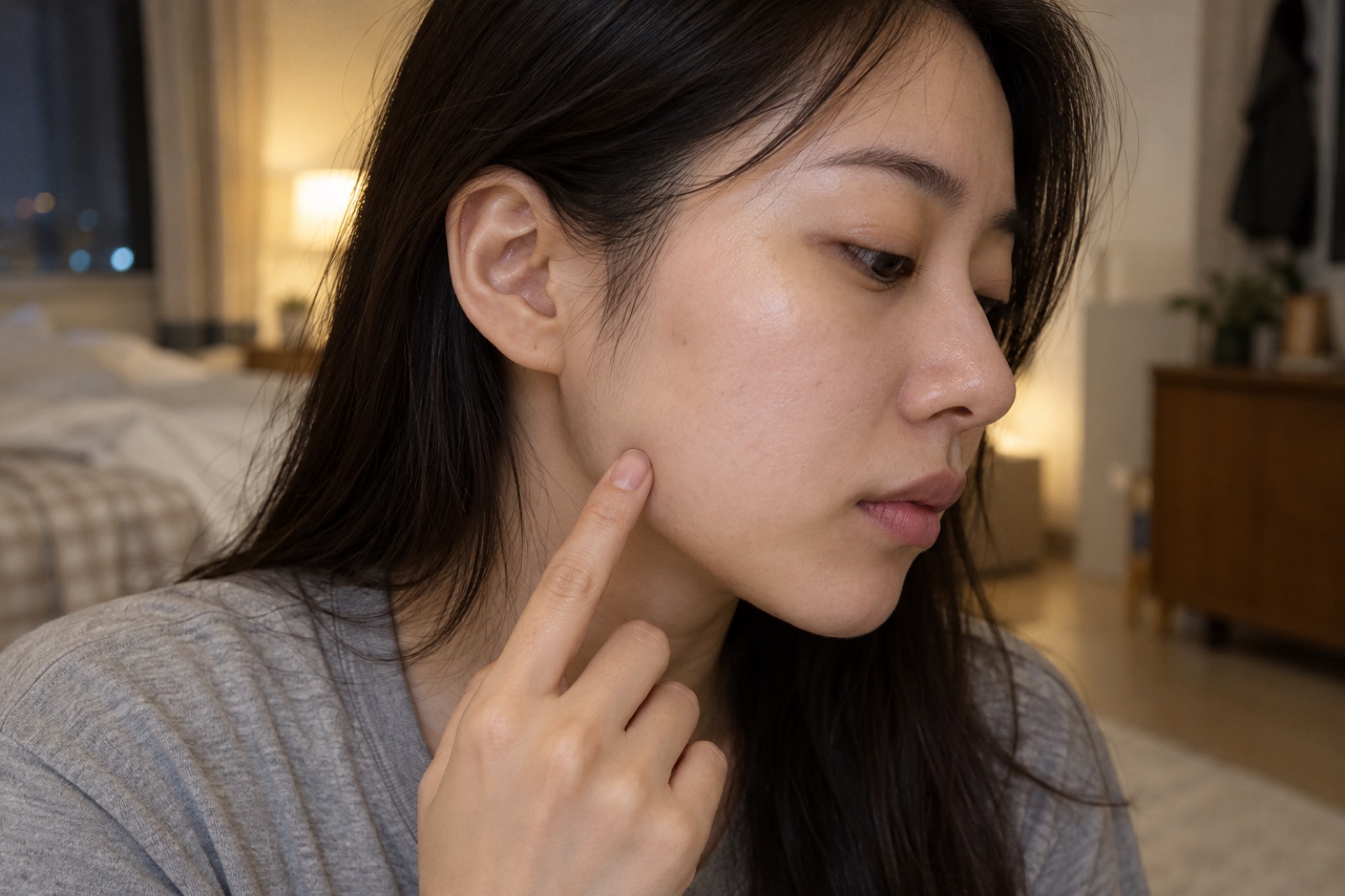
Write down stinging on a 0–3 scale once within 10 minutes of applying, and redness and tightness once the next morning before you wash your face. Stinging that comes right away and reactions that show up later appear at different times, so they get two separate boxes.
In the stinging box, 0 means you feel nothing, 1 means a tingle that fades within a minute, 2 means a burning feeling that lingers for a few minutes, and 3 means it’s still there after 10 minutes. In a 2016 trial, capsaicin was applied to the folds beside the nose of 31 women with sensitive skin, and burning intensity was measured right after and at 1, 2, 5, 10 and 15 minutes. The two finished products’ scores differed significantly only at 1 and 2 minutes, and peak intensity and duration showed no significant difference. Because that model triggered burning on purpose, don’t carry it over to how an ampoule feels; it’s borrowed only as a reason to log at set times.
The reason for a separate next-morning box comes from the American Academy of Dermatology (AAD). It explains that the body takes time to react after contact with the cause, so an allergic rash appears a few hours to a few days later, which makes the cause hard to find. Under the same lighting each time, write down redness (yes or no) and tightness (0–2) on the spot you applied it to and the skin around it.
When is it OK to widen to your full face in week two?
Widen the evening area only if week one’s seven lines have no 3 for stinging and no morning redness, and the product’s directions describe using it on the whole face. If the wording only mentions the areas that need it, stay with spots in week two as well and keep filling in the same boxes.
On the day you widen, write down how many drops it took to cover your whole face, and split the next morning’s box into the week-one spots and everywhere else, such as your cheeks and forehead. Keep the other steps after the ampoule exactly as they were in week one. In the evidence this guide drew on, there’s no study of stinging when several products are layered.
In week three, how do you decide on mornings and whether to keep going?
In week three, decide whether to apply it in the morning too, and at the end of the week pick one of four: keep going, spots only, stop or see a doctor. If the boxes from the first two weeks stayed low, add mornings; if stinging of 2 or higher lasted more than three days, scale the area back one step.
If you’d rather use a different product in the morning and a cica product at night, leave the morning box blank and continue with evenings only. Here’s how the decision breaks down.
- Keep going: stinging stayed at 0–1 with no morning redness for all three weeks
- Spots only: redness or tightness showed up in the morning box only after you widened to the full face — go back to the week-one spots
- Stop: the day stinging reaches 3, or when only flaking and tightness remain on that spot after close to a month of use
- See a doctor: redness or burning continues even after you stop (see the conditions below)
Three weeks isn’t a period set by research; it’s a length chosen so the log can be read. In the 2023 trial, 33 people with sensitive skin applied a cream or balm twice a day for 21 days and were assessed on days 1, 8 and 22, but it was an open-label trial that looked only at before and after in one group, with no control group. The 2024 trial also scored stinging, burning and tightness as a combined total after 28 days of use, but that’s the result for a specific finished product. No centella study has yet compared changes in redness or stinging in sensitive skin against a placebo, either, so this guide doesn’t say what the ampoule does for you; it covers only the log of the days you applied it.

A 3-week centella ampoule log, from spots to the full face
The order below wasn’t compared in research; it’s a standard this guide set so you can log 3 weeks under the same conditions.
| Week and time | Where applied | Drops | Stinging 10 min after (0–3) | Next-morning redness and tightness | Notes |
|---|---|---|---|---|---|
| Week 1 evening | 2–3 spots that need it (named, like “beside the left nostril”) | The number set on day one | Redness yes/no / tightness 0–2 | First ingredient, in one word | |
| Week 2 evening | Full face only if the directions describe full-face use; otherwise the week-1 spots | The increased number on the day you widen | Week-1 spots and everywhere else, separately | Date you widened | |
| Week 3 evening | Same as week 2 | Same as week 2 | Minutes you waited before the next step | ||
| Week 3 morning | Decide whether to add (blank if you use another product in the morning) | No more than the evening number | Check again that evening | Date you added mornings | |
| End of week 3 | Keep going / spots only / stop / see a doctor | — | — | — | Date you stopped and days since |
Days when your face tends to swing anyway, like the days around your expected period, a week of late nights at work or exam week, go in the notes box first. If a box jumps on one of those days, look at that circumstance before you look at the ampoule.
When should a dermatologist see your skin before the 3 weeks are up?
- If the spot you applied it to swells, or blisters or oozing appear, don’t finish the 3 weeks; stop the ampoule and see a dermatologist.
- If itching keeps you up at night, or redness or burning lasts more than 2 weeks even after you stop, have a dermatologist check it.
- The British Association of Dermatologists (BAD) explains that an allergic reaction comes back every time you touch the cause again. Don’t reapply an ampoule you’ve stopped without getting it checked, and if redness keeps returning in the same spot, talk to a dermatologist about finding the cause.
- The Korean Dermatological Association, a Korean professional society, describes patch testing as placing antigens at adjusted concentrations on the skin, removing them after 48 hours and reading the result at least 30 minutes after removal. Bringing your 3-week log and the ampoule container to the appointment makes the conversation easier.
Which studies this 3-week log draws on
- A 2016 trial (PMID 26805418) applied 40 ppm capsaicin beside the nose of 31 women with sensitive skin and recorded burning intensity right after and at 1, 2, 5, 10 and 15 minutes; the scores of the two finished products differed significantly only at the 1- and 2-minute marks.
- A 2023 open-label trial (PMID 36214607) had 33 people with sensitive skin apply a cream or balm twice a day for 21 days, with assessments on days 1, 8 and 22; there was no control group.
- A 2024 trial (PMID 39291708) recorded unpleasant sensations such as stinging, burning and tightness in women with sensitive skin as a combined total after 28 days of use; it’s the result for a specific finished product.
Frequently asked questions
Should I wait for a spot ampoule to dry before the next step?
If the product's directions give a waiting time, follow that wording first. The evidence this guide drew on has no study that sets how many minutes to leave before the next step, and research on stinging when several products are layered is missing too. So write the minutes you waited in the notes box, and leave the same amount of time for all 3 weeks so you can compare one date with another.
Can I use different cica products in the morning and at night?
Before any yes-or-no answer, settle how you'll log it. Keep separate morning and evening boxes, and for 3 weeks change only one side while leaving the other as you've been using it. If you change your morning and evening products in the same week, you can't tell which one the next morning's redness came from.
I've used a spot product for a month and the area just gets dry. What should I do?
That's the point to choose 'spots only' or 'stop' in the week-three decision box. If flaking or tightness remains where you applied it, use one drop fewer and log for another week; if it's still the same, stop and note the date. If redness or burning lasts more than 2 weeks even after you stop, see a dermatologist.
Can I use a cica ampoule around my eyes?
If the directions don't mention using it around the eyes, leave the eye area out of the 'where applied' box when you start. Korea's Ministry of Food and Drug Safety (MFDS) advises against using cosmetics on mucous membranes, so leave the rims of your eyes and lips out of the same box. If it gets in your eye and stinging or redness keeps going, rinse it out with water and see an eye doctor or a dermatologist.
After I stop an ampoule, how many days should I wait before seeing a doctor?
No study sets how many days to wait after stopping. But if swelling, blisters or oozing appear, or itching keeps you up at night, don't count days; see a doctor right away. If redness or burning lasts more than 2 weeks, have a dermatologist check it too. Keep filling in the date you stopped and the morning boxes after it, and it's easier to explain how things went at your appointment.
How many drops of ampoule should I use at a time?
If the directions give a number of drops, that number is your standard. In week one, when you use it on spots, start from that number and use the same number on the same spots for all 3 weeks; log the increased number separately only on days you widen to the full face. If you change the drop count from day to day, you can't tell whether the 10-minute stinging box reflects the amount or the ampoule.
Do you use a spot essence morning and night, or only at night?
If the product's directions name a time of day, follow that wording; if they don't, this guide has you apply it in the evening only for the first two weeks. Applying it at night and checking redness and tightness the next morning before you wash your face puts the overnight change into one box. Adding mornings is decided in week three, if the boxes from the first two weeks stayed low.
Can I put a product I've been using on spots all over my face?
Widen only if the directions describe a way to use it on the whole face. If the wording says to use it only on the areas that need it, keep the area the same, and decide separately after the 3 weeks are over whether you need another step for the whole face. On the day you widen, first check that week one's boxes had no 3 for stinging and no morning redness.
Sources
- Two cosmetics compared for capsaicin-induced burning in 31 women with sensitive skin, 2016 (PMID 26805418)A
- 21-day open-label trial of a 4-t-butylcyclohexanol cream and balm in 33 people with sensitive skin, 2023 (PMID 36214607)B
- Sensitive skin triggers and a 28-day trial of a dermocosmetic cream, 2024 (PMID 39291708)A
- American Academy of Dermatology — Contact dermatitis: CausesInstitutional
- British Association of Dermatologists — Contact dermatitis (revised June 2025)Institutional
- Korea's Ministry of Food and Drug Safety (Busan regional office) consumer newsletter — Are acne cosmetics a treatment? (May 30, 2025) (Korean)Institutional
- Korean Dermatological Association — Contact dermatitis (Korean)Institutional
Videos and forum posts never count as evidence for a fact here. Full rules: Editorial policy
What to check when choosing a product for this routine
Check the criteria below before the product name. Each item can be found on the full ingredient list or in the product description.
| Item | What to look for | Why |
|---|---|---|
| Spot and full-face directions | Whether the directions cover only use on the areas that need it, or also give a separate way to apply it unmixed to the whole face | In week two, you can decide from the wording, in your 'where applied' box, whether to widen the area or keep it as it is |
| First name on the ingredient list | The name of the ingredient listed first in the full ingredient list | Copying it into the notes box as one word gives you a line to read alongside the stinging box 10 minutes after applying |
| Dropper-style container | Whether it comes out one drop at a time so you can count, or you pour it into your hand and guess the amount | When you widen from spots to the full face, you can log the added amount in the drops box in the same unit |
| Fragrance components on the label | Whether fragrance component names (such as linalool or limonene) are listed separately at the end of the ingredient list | Noting them in the memo column gives you one more condition to compare, alongside the first-listed ingredient, on a day the skin stings |
Product from this site's operator · KW Cosmetic Content Team
Centella Rescue Spot AmpouleThere's no test data from a 3-week log of widening use from spots to the full face. This 15 ml spot ampoule is built on alcohol-extracted Centella asiatica extract, and its ethanol may sting for a moment; the product page gives only spot care (1–2 drops where needed) and tip care (mixed into a toner or ampoule), not full-face use of the ampoule alone. It's a cosmetic that completed low-irritation testing, not a medicine, and the page asks sensitive skin to try a small amount on a hidden area first. For the week-one evening boxes, counting drops on just 2–3 spots, the product we suggest is Centella Rescue Spot Ampoule.
Fitting it into a routine
Where it goes: After cleansing, on the areas that need it, or mixed into your toner or ampoule
How to use it: Spot care: after cleansing, put 1–2 drops directly on the area that needs it, or spread them lightly with a fingertip. Tip care: mix 3–4 drops into the toner or ampoule you normally use.
Check before you use it: It contains ethanol, so it may sting for a moment when applied to troubled skin. If your skin is sensitive, test a small amount on an inconspicuous area before use. This product is a cosmetic, not a medicine.
Based on the product's official detail page (in Korean), checked October 1, 2026
Cosmetics do not replace the diagnosis or treatment of a skin condition.