Hyperpigmentation: Is It Fading? A Sunscreen and Monthly Photo Log
Hyperpigmentation changes over months, not days. Reapply sunscreen through the day and compare photos taken under the same conditions once a month to see whether the color is really getting lighter.

What this note covers7 sections
- When can you start judging whether a mark is fading?
- How much sunscreen should you use, and how many times a day?
- Why do marks last for months after you squeeze a pimple?
- With marks and new pimples at the same time, where should your routine focus?
- Monthly photo and sunscreen log
- When does a dermatologist need to see the marks?
- Where these facts come from
| Item | Detail | Basis |
|---|---|---|
| How much to apply | SPF is measured using 2 mg per cm². Most people apply only 1/4 to 1/3 of that, so protection drops to about 1/4 | Korean Dermatological Association, sunscreens · society |
| How often to reapply | Apply 20 to 30 minutes before outdoor activity and reapply every 2 to 3 hours. The association suggests about SPF 15 for daily life and SPF 30 or higher outdoors | Korean Dermatological Association, sunscreens · society |
| When to judge | Melasma takes at least 2 months to show a response and needs 6 months or more | Korean Dermatological Association, melasma · society |
| How often to compare | A trial of two groups with dark marks after acne (60 and 63 people) got different results at 12 and 24 weeks | 2024 PMID 38685118 · A |
| Habits to log | Too much sun and squeezing or scratching were named as risk factors | 2021 PMID 34880967 · B |
When can you start judging whether a mark is fading?
Don’t judge after a week or two. Wait at least two months and compare photos taken a month apart. The Korean Dermatological Association says melasma takes at least 2 months to show a response and needs a care period of 6 months or more.
The conclusion can even flip depending on when you look. In a 2024 randomized trial that split patients aged 13 to 35 with dark marks after acne into two groups (60 and 63 people) and followed them for 24 weeks, the overall severity score differed clearly between groups at 12 weeks but was similar by 24 weeks. That’s why this guide’s log has columns at 1, 2, 3 and 6 months.
How much sunscreen should you use, and how many times a day?
More than you think, and on days you’re outside for a long time, reapply every 2 to 3 hours. According to the Korean Dermatological Association, SPF is measured by applying 2 mg per cm² (about 30 ml, or roughly 1 ounce, for the whole body), but people actually apply only 1/4 to 1/3 of that, so they get only about 1/4 of the protection.
A 10-minute walk to school and a half-day weekend outing are different conditions. In Korea, the association suggests about SPF 15 for everyday life and SPF 30 or higher for outdoor activities, and its melasma guidance calls SPF 30 or higher desirable. On days with a lot of sun time — a lunchtime walk, a desk by the window, driving — marking how many times you reapplied makes it easier to match against next month’s photo.

Why do marks last for months after you squeeze a pimple?
Squeezing or scratching has been reported to increase dark marks after acne, and once color is left behind, it fades on a timescale of months. In a 2021 observational study that pooled data from acne patients, 80% or more had dark marks after acne, and risk factors were being female, darker skin tone, severe acne, too much sun, and squeezing or scratching.
That study included many people with darker skin types, so its rates can’t be applied the same way to everyone. Still, if you log the days you touched your face and the days you spent a long time in the sun separately, you can see which one lines up with the spots that darkened in your photos.

With marks and new pimples at the same time, where should your routine focus?
Focus on sticking to three things every day — cleanser, moisturizer and sunscreen — and get new pimples managed separately by a dermatologist. In the 24-week trial above, both the group that used a prescription topical medicine and the group that didn’t used these three skin care steps throughout, and participants said the skin care helped reduce irritation and keep them on track.
A 2021 study that used sunscreen together with a moisturizing cream also reported less UV-induced redness and pigment change (the number of participants isn’t given in the abstract). In a 2026 trial, 20 people with darker skin types applied a finished sunscreen for 20 days, and on day 8 the pigmentation score where it was applied was about 30% to 53% lower than on untouched skin. Both studies tested finished formulas, so neither result can be credited to any single ingredient.
Monthly photo and sunscreen log
| Point in time | Photo conditions | Days with sunscreen / days reapplied | Days with a hat or umbrella | Days you squeezed or picked | New pimples | Mark color vs. baseline |
|---|---|---|---|---|---|---|
| Start date | e.g., 9 a.m., living room window, arm’s length | — | — | — | ___ | Baseline photo |
| 1 month | Same as start | ___ / ___ days | ___ days | ___ days | ___ | Darker / similar / lighter |
| 2 months | Same as start | ___ / ___ days | ___ days | ___ days | ___ | Darker / similar / lighter |
| 3 months | Same as start | ___ / ___ days | ___ days | ___ days | ___ | Darker / similar / lighter |
| 6 months | Same as start | ___ / ___ days | ___ days | ___ days | ___ | Mark whether you need a visit |
Take photos of your bare face with phone filters and retouching turned off. If you had a week with a lot of sun — a summer vacation, a school field day, a hike — leave a note next to that month.
When does a dermatologist need to see the marks?
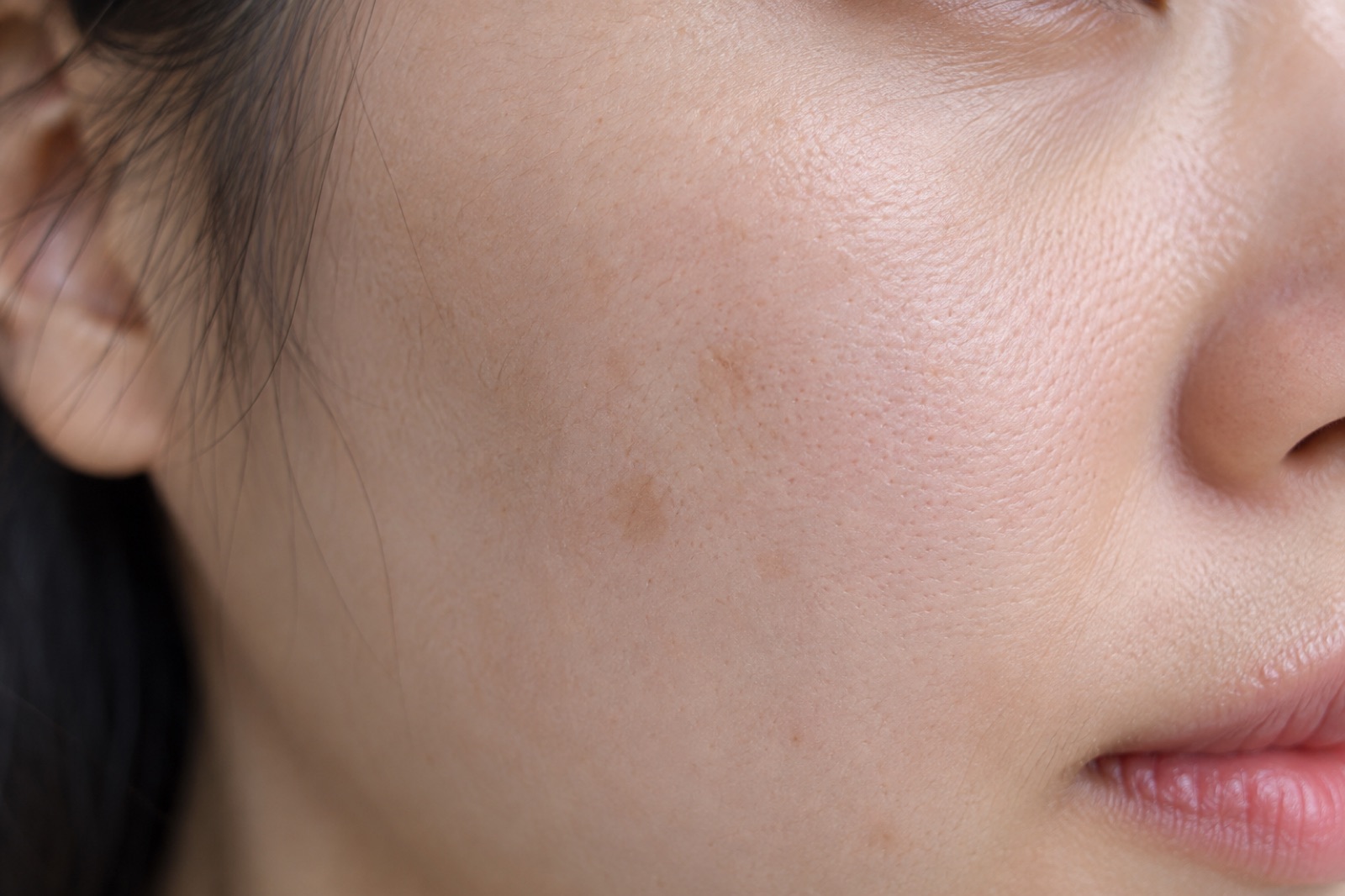
- If your same-conditions photos show the color unchanged or darker after 6 months, bring your log to a dermatologist.
- If a mark spreads and gets bigger, or looks like a spot with an uneven shape or border, have a dermatologist check it.
- If new pimples keep coming up and leaving a mark each time, it’s better to get the acne itself managed by a dermatologist first.
- If wide patches across both cheeks darkened during a pregnancy or while taking birth control pills, it may be melasma, so consider an appointment.
Where these facts come from
- According to the Korean Dermatological Association’s sunscreen guidance, SPF is measured at 2 mg per cm², but people actually use 1/4 to 1/3 of that, so apply sunscreen generously and reapply every 2 to 3 hours.
- A 2024 phase 4 trial (PMID 38685118) followed two groups with dark marks after acne (60 and 63 people) for 24 weeks; both used a cleanser, moisturizer and sunscreen, and the difference in overall severity score was clear only at 12 weeks.
- In a 2026 randomized trial of 20 people with darker skin types (PMID 41240206), the pigmentation score on day 8 was about 30% to 53% lower where sunscreen was applied than where it wasn’t.
Frequently asked questions
Why does hyperpigmentation form around the mouth, and how does it fade?
The sources behind this guide include no study looking only at the area around the mouth. A 2021 analysis of patients with dark marks after acne named too much sun, squeezing or scratching, and facial location as risk factors, so start by logging habits of touching around your mouth and the hours you go without reapplying sunscreen. If it's a wide, symmetrical brown patch, it may be melasma, so it's worth having a dermatologist check.
Why do marks last for months after I pop a pimple, and is that darkening temporary?
Squeezing or scratching has been reported as a risk factor for dark marks after acne. In its melasma guidance, the Korean Dermatological Association notes it takes at least 2 months to see a response and 6 months or more of care, so marks that leave color behind are also best judged in months. Don't write it off because it hasn't faded in a few weeks; compare monthly photos.
If I have dark marks and new pimples at the same time, what should my routine focus on?
Center it on three things every day: a gentle cleanser, a moisturizer and sunscreen. In a trial that followed two groups of patients with dark marks after acne (60 and 63 people) for 24 weeks, both groups used these three skin care steps as their base. If new pimples keep appearing, getting them managed separately by a dermatologist is the way to end up with fewer marks.
Sources
- Korean Dermatological Association — Sunscreens (Korean)Institutional
- Korean Dermatological Association — Melasma (Korean)Institutional
- 24-week phase 4 trial of a prescription topical plus skin care in post-acne hyperpigmentation, 60 and 63 patients, 2024 (PMID 38685118)A
- Risk factors for post-acne hyperpigmentation, 2021 (PMID 34880967)B
- Niacinamide-containing sunscreen and post-inflammatory hyperpigmentation, randomized trial in 20 people, 2026 (PMID 41240206)A
- Ceramide-containing sunscreen with moisturizing cream and UV-induced skin changes, 2021 (PMID 33852258)A
Videos and forum posts never count as evidence for a fact here. Full rules: Editorial policy