Butt Acne That Hurts to Sit On: Clothes, Chairs and a 3-Day Log
If butt acne hurts when you sit, spend the first 3 days without squeezing it, break your sitting time into shorter stretches, and write down its size and pain each evening so you can decide on day 3.

What this note covers7 sections
- A sore bump came up and it hurts to sit. What do you decide on day 1?
- If you have to sit through a long bus ride or classes, how do you split up the time?
- What do you write down on day 2, and how?
- What if it’s the same or bigger on day 3?
- Your 3-day order for butt acne that hurts when you sit
- When is it time for a dermatologist to take a look?
- The sources behind this guide, briefly
| Item | Detail | Basis |
|---|---|---|
| Situation: a day of long sitting | In an experiment that put body weight on the sacral area (the base of the spine) and heels of 8 healthy men for 2.5 hours, redness (the erythema index) rose only under the loaded condition. It was not a study of acne or of bumps on the buttocks | 2021 PMID 33939289 · A |
| Timing: the first 3 days | Splitting it into day 1 for clothes, sitting time and chairs, day 2 for notes and day 3 for a decision is this guide’s editorial standard | Editorial standard |
| Times you touch it: 0 | Korea’s national public health agency explains that scratching or squeezing it yourself makes scars more likely | KDCA “Acne” (Korean) · Institution |
| Time frame: if it burst and became a wound | Advises going to a hospital or clinic right away if you see redness, swelling or pus, or if a wound hasn’t closed up after a week or more | KDCA “Wound care and scars” (Korean) · Institution |
| What to log | Size (vs. a coin), three pain boxes (still, sitting, pressed), warmth, red rim | Editorial standard |
A sore bump came up and it hurts to sit. What do you decide on day 1?
On day 1, settle on one rule, that you won’t squeeze it, and spend the rest of the day choosing three things: your clothes, how long you sit and what you sit on. Whether it’s acne or something else isn’t something to decide at home; if needed, that gets decided at a doctor’s visit.
For clothes, choose loose cotton pants or a skirt that doesn’t cling to your buttocks. This borrows the direction of the American Academy of Dermatology (AAD), which, in its guidance on hair follicle problems, suggests loose clothing instead of tight clothes when it’s hot and humid. Once in the morning, compare the size with a coin and write it on the first line. If it throbs even when you’re still, go no further than ice, which the AAD suggests in place of squeezing for deep, painful acne (from its guidance on facial acne).
If you have to sit through a long bus ride or classes, how do you split up the time?
This guide’s rule is to keep each stretch of sitting short, and each time you break it, to stand up and take the pressure off the spot. On a long-distance bus that’s the rest stop, at school it’s the break between classes, and at the office it’s the gap between meetings.
This order draws on a weight-bearing experiment. In a 2021 crossover experiment, researchers put body weight on the sacral area and heels of 8 healthy men (average age 27.5) for 2.5 hours; the erythema index, which measures redness, rose only under the loaded condition, and IL-1α, a marker of inflammation, also tended to rise with loading. The sample was small and the study didn’t look at acne, so read it only as “skin that’s pressed for a long time can turn red.” If tomorrow holds something you can’t skip, like a school fitness test, write down the size the night before, and on the day itself focus only on breaking up your sitting time.

What do you write down on day 2, and how?
Each evening, fill in four columns, size, pain, warmth and rim, using the same method as on day 1. Compare the size with a dime, a nickel or a quarter, and split pain into whether it hurts even when you’re still, only when you sit, or only when you press on it.
For warmth, rest the back of your hand on it briefly and note only whether it feels warmer than the skin around it. When the AAD describes follicle infections, it mentions a red rim around the bump, so noting whether the rim has spread since the day before gives you something useful to show at a visit. This column is for watching change, not for naming what it is. Your buttocks are hard to see on your own, so take one phone photo each day in the same mirror under the same light.

What if it’s the same or bigger on day 3?
Compare it using the same method as on day 1. If it’s the same size or bigger, or the pain has moved into the “even when still” box, see a dermatologist and bring your 3-day notes. If it’s shrinking, keep breaking up your sitting time and wearing loose clothes.
If it bursts on its own during these 3 days, think of that spot as a wound and leave it alone. The National Health Information Portal of the Korea Disease Control and Prevention Agency (KDCA), Korea’s national public health agency, lists wounds that look infected, with redness, swelling or pus, and wounds that haven’t closed up after a week or more as reasons to go to a hospital or clinic right away. That guidance wasn’t written about bumps on the buttocks, but this guide uses it as the standard for watching a spot after it bursts.
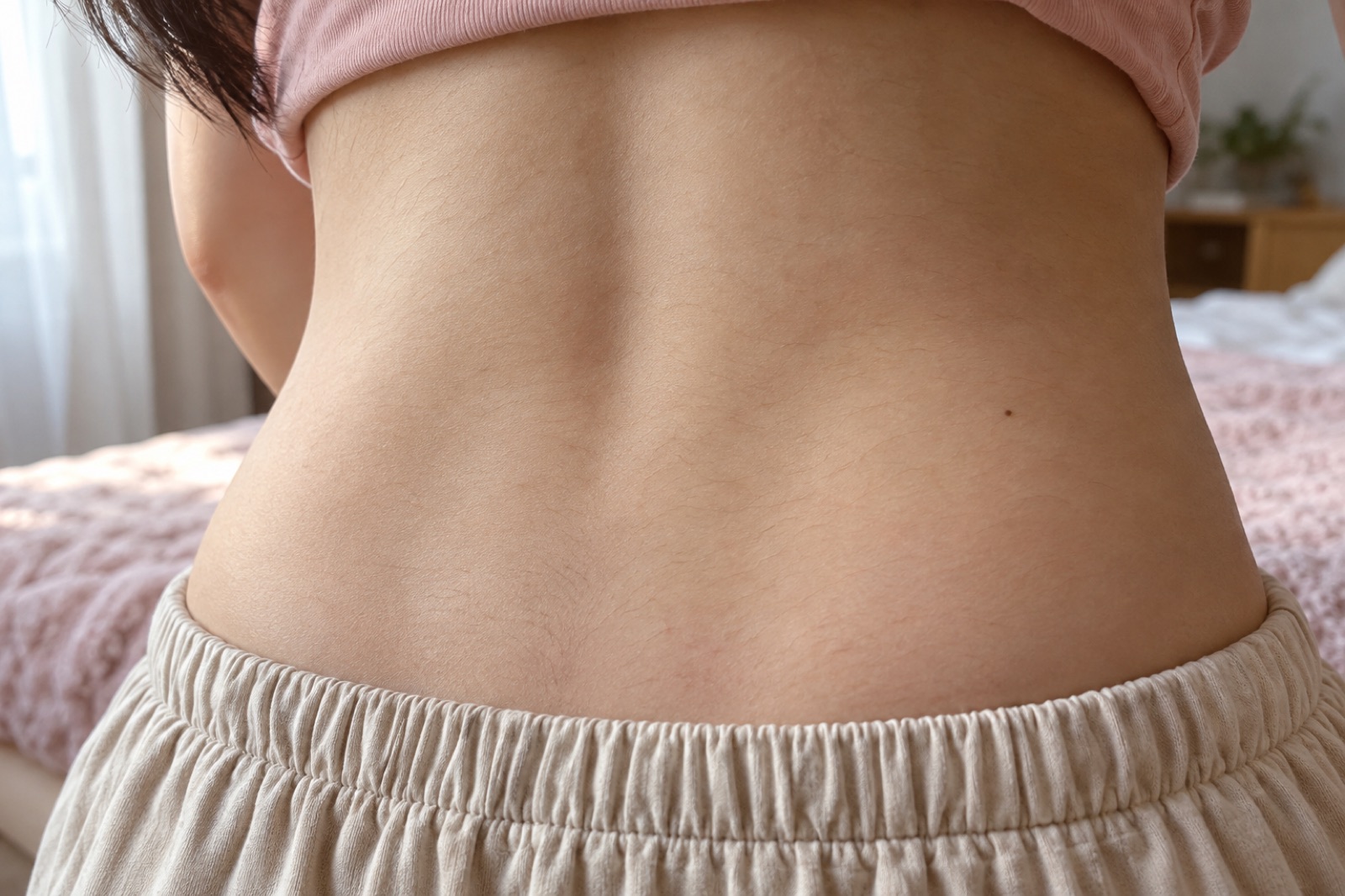
Your 3-day order for butt acne that hurts when you sit
| Time of day | Day 1 | Day 2 | Day 3 |
|---|---|---|---|
| Morning | Decide not to squeeze · loose cotton pants or a skirt · size vs. a coin on the first line | Keep the same clothing rule · only check whether it burst overnight | Line up the day 1 and day 2 rows; compare size and pain |
| Daytime | Split classes, meetings and bus rides at breaks or rest stops, and stand up | Less weight on the sore side · don’t cross your legs | Same or bigger: book a visit |
| Evening | One line: the chair you sat on longest and when it hurt | Four-column notes (size, three pain boxes, warmth, rim) · photo under the same light | Shrinking: keep the same order · otherwise gather your notes and photos |
| Date | Size (coin) | Pain (still / sitting / pressed) | Warmth | Red rim | Chair you sat on that day |
|---|---|---|---|---|---|
| Day 1 ( / ) | |||||
| Day 2 ( / ) | |||||
| Day 3 ( / ) |
When is it time for a dermatologist to take a look?
- If it gets noticeably bigger or fills up yellow within a day, don’t wait out the 3 days; see a dermatologist.
- If it throbs even when you’re still and not sitting, or it’s hot enough to feel with the back of your hand and the red rim is spreading, consider seeing a doctor.
- If it’s the same or bigger on day 3, bring your order table and photos and have a dermatologist check it.
- If a spot that burst on its own shows redness, swelling or pus, or you run a fever, don’t wait; see a doctor.
The sources behind this guide, briefly
- A 2021 crossover experiment (PMID 33939289) put body weight on the sacral area and heels of 8 healthy men for 2.5 hours, and the erythema index rose only under the loaded condition (none of the studies here looked directly at butt acne).
- The KDCA page on wound care and scars (posted in 2021, updated in 2026) advises going to a hospital or clinic right away for wounds with redness, swelling or pus, or ones that haven’t closed up after a week or more.
- The American Academy of Dermatology (AAD) advises against squeezing deep, painful acne at home and says to have a dermatologist look at any bump that won’t go away or that you’re unsure about.
Frequently asked questions
My butt pimple got bigger and turned yellow in a day, and I have to sit for hours tomorrow. What should I do?
Tonight, compare its size with a coin and write it down. Tomorrow, wear loose pants and stand up at every break to take the pressure off the spot. Let go of the idea of squeezing it to make it smaller; the National Health Information Portal of the Korea Disease Control and Prevention Agency (KDCA) explains that scratching or squeezing it yourself makes scars more likely. If it changed this much in one day, don't wait out the 3 days; see a dermatologist once your schedule is over.
A pimple on my butt hurts to touch and is still red and swollen on day 5. What should I do?
You're already past the first 3 days, so count the watch-at-home stage as over and see a dermatologist with the size and pain notes you've kept. If you scratched it and the skin came off, also check for the signs the KDCA's page on wound care and scars lists, such as redness, swelling and pus. If you see those signs, don't wait; go to a clinic right away.
How do I handle sitting on a bus with a painful pimple deep under the skin of my butt?
Break each stretch of sitting at rest stops or bus stops, and stand up whenever you can to take the pressure off the sore spot. While you're seated, shift your weight a little toward the side that doesn't hurt. This order draws on a 2021 experiment in 8 healthy men in which 2.5 hours of weight-bearing raised skin redness, but that study didn't look at butt acne itself.
Does a cushion or a different way of sitting help when butt acne hurts?
The sources behind this guide include no study comparing which cushion or position works better. As its editorial standard, this guide lays one thin cotton cushion on a hard wooden chair or vinyl seat, keeps your legs uncrossed, and has you sit so less weight falls on the sore side. If you note in the evening column of the order table which chair hurt more, you'll see what to change.
What if butt acne still hasn't gone away after a month?
That's far past the first-3-days mark, so don't keep watching it; see a dermatologist. The American Academy of Dermatology (AAD) advises having a dermatologist look at an acne-like bump that won't go away or that you're unsure about. Whether what's on your buttocks is acne or something else gets settled at a visit, not at home.
What should I do if a pimple on my butt hurts even when I'm lying down or sitting still?
Pain when you're still is one of the conditions in the order table for not waiting the full 3 days. On a day you'd mark the 'still' box among the three pain columns, don't fill in the remaining days; see a dermatologist with your notes and photos up to that day. Adding a line about which lying position hurt also makes it easier to explain at the visit.
A pimple near my butt crack hurts every time I move. Can I just wait 3 days?
You can watch it while noting the movements that hurt, such as standing up, walking or bending at the waist, but if it grows within a day or gets hot enough to feel with the back of your hand, don't wait 3 days; see a dermatologist. The sources behind this guide give no standard for sorting anything by how much it hurts to move, so make the call on changes in size, warmth and the red rim. In the meantime, keep breaking up your sitting time and wearing loose clothes.
I got pimples on both sides of my butt after wearing a pad for long shifts at work. What should I write down over 3 days?
Below the evening column of the order table, note how long you wore the pad, how many times you changed it and how many times you scratched. If it's hard to step away at work, use your trips to change the pad as the points where you break up your sitting. The sources behind this guide don't cover any link between wearing pads and bumps on the buttocks, so don't settle on that as the cause; if it's the same or bigger on day 3, see a dermatologist with your notes.
Sources
- Effects of loading and prophylactic dressings on the sacral and heel skin: An exploratory cross-over trial, 8 healthy men, 2021 (PMID 33939289)A
- AAD — Pimple popping: Why only a dermatologist should do itInstitutional
- AAD — FolliculitisInstitutional
- Korea Disease Control and Prevention Agency (KDCA) National Health Information Portal — Wound care and scar prevention (Korean)Institutional
- Korea Disease Control and Prevention Agency (KDCA) National Health Information Portal — Acne (Korean)Institutional
Videos and forum posts never count as evidence for a fact here. Full rules: Editorial policy
What to check when choosing a product for this routine
Check the criteria below before the product name. Each item can be found on the full ingredient list or in the product description.
| Item | What to look for | Why |
|---|---|---|
| Listed step of use | Whether the container or product page says where it goes in your routine, such as after toner and ampoule | In the evening column of the order table, you can give your face routine its own line so it doesn't get mixed up with your notes on the sore spot below |
| Note on broken skin | Whether the caution notes say not to use it where the skin is wounded | If the bump bursts on its own on day 3, you've already set the rule that nothing goes on that spot |
| Stop-use note for reactions | Whether it says to stop and talk to a dermatologist if red spots, swelling or itching show up while you use it | You end up logging a reaction on your face and a red rim on your buttock in separate columns |
| Ingredient list and expiry check | Whether a line says to check the full ingredient list and expiry date on the latest packaging first | If you open a new container during these 3 days, you can write the opening date next to the order table |
Product from this site's operator · KW Cosmetic Content Team
Revive Therapy N.F CreamThis guide's 3-day order table and the weight-bearing experiment are about sitting time, clothes and chairs, and they have nothing to do with this cream. The facts: a 50 mL face cream with 4 ceramides and 5 types of hyaluronic acid, no added fragrance per its ingredient list, and a completed low-irritation patch test. There's no data on the buttocks or body, or on bumps that hurt when you sit, and its product page places it last in the routine, after ampoule, away from wounds. For finishing your evening face routine while you leave the sore spot alone, the product we suggest is Revive Therapy N.F Cream.
Fitting it into a routine
Where it goes: After ampoule, the last step of the routine
How to use it: After toner and ampoule, take a suitable amount and spread it gently from the center of the face outward. On areas where dryness bothers you, layer a small amount once more to finish.
Check before you use it: If red spots, swelling, itching or any other unusual reaction appears during or after use, stop using it and consult a dermatologist. Avoid using it on areas with wounds, and check the full ingredient list and expiry date on the latest packaging first.
Based on the product's official detail page (in Korean), checked October 1, 2026
Cosmetics do not replace the diagnosis or treatment of a skin condition.