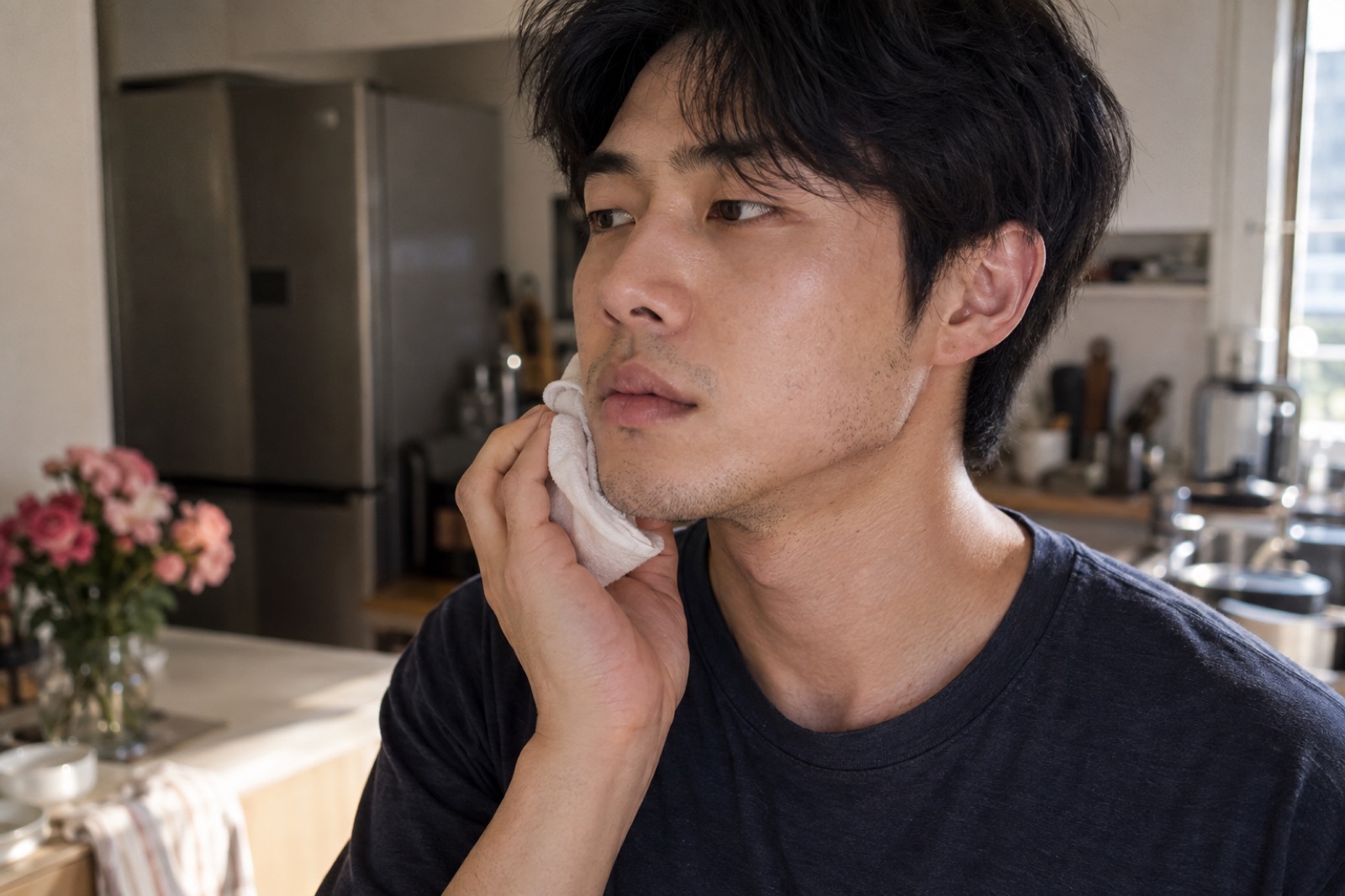
Pimples on Back of Neck: A 2-Week Haircut, Ponytail, Collar Log
For pimples on the back of your neck, log haircuts, tied-up hair, collar rubbing and pillow changes by date, and start by finding the conditions that overlap with new bumps.
What this note covers7 sections
- Pimples on the back of your neck after a haircut: what should you write down?
- Do bumps line up with days you tie your hair up or wear a hood?
- How do you log pillows and shampoo?
- What is different if it is an inflamed follicle or seborrheic dermatitis?
- 2-week nape log
- When is it time to have a doctor look at your neck?
- What this article is based on
| Log item | What to write | Why this column exists · Basis |
|---|---|---|
| Haircut days | The date your nape was trimmed with clippers or a razor, and whether it bled | In a case-control study of acne keloidalis nuchae, bleeding during haircuts and very close shaves came out as risk factors · B (2020) |
| Hours with hair tied up | How long the end of a ponytail or bun touched your neck, and whether you exercised that day | Boils form more easily when pressure, friction and sweat weaken the skin’s defenses · KDCA (Korea) |
| Collars and hoods | Hours a stiff collar, hood or scarf touched your neck | Friction, mechanical irritation and heavy sweating are named as things that can worsen acne · Korean Dermatological Association |
| Pillow and shampoo | Days you changed your pillowcase, days you switched shampoo or conditioner | Hairdressers had a 1.7 times higher risk of contact allergy to the shampoo surfactant CAPB (work exposure) · A (2022) |
| Scales and itching | Whether redness and scales reach your scalp and behind your ears | Red skin with yellowish scales on the scalp, face and upper trunk signals a scaly condition different from acne · KDCA (Korea) |
Pimples on the back of your neck after a haircut: what should you write down?
Start with the haircut date, the tool, how short your nape was cut and whether it bled. The back of the neck is where clippers and razors pass most often, so this column alone can show whether bumps cluster a few days after a haircut.
A 2020 case-control study in Togo compared 101 people with acne keloidalis nuchae, a firm bump condition at the nape, with 202 controls; bleeding during haircuts was linked to risk with an odds ratio of 13.9 when occasional and 22.1 when habitual. In the same study, very close shaves had an odds ratio of 4.9. Because the study looked at Black patients, you can’t apply it directly to everyone, but it is reason enough to log haircut dates and whether there was bleeding. The acne guide from the Korea Disease Control and Prevention Agency (KDCA) advises softening hair with soap and warm water before shaving and using a sharp blade without nicking pimples.
Do bumps line up with days you tie your hair up or wear a hood?
Log, day by day, how long the end of your tied-up hair, a hood or a stiff shirt collar touched your neck, and match it to where the bumps are. The nape gets pressure, friction and sweat all at once, so marking days when all three overlap makes comparison easier.
The KDCA National Health Information Portal explains that boils form more easily when the skin’s defenses are damaged by pressure or friction, heavy sweating, or shaving. Just write your own situation as it is: a student who leaves a ponytail in after gym class, an office worker who turns up a puffer jacket collar over a turtleneck all winter, or someone who ties their hair up to run on a treadmill.

How do you log pillows and shampoo?
Write the days you changed your pillowcase and the days you switched shampoo, conditioner or hair serum on the same calendar. If you change both in the same week, you can’t tell which one mattered, so leave at least 1 week between them.
A 2022 review of 70 papers on hair product ingredients found that hairdressers had a 1.7 times higher risk than non-hairdressers of developing a contact allergy to cocamidopropyl betaine (CAPB), a surfactant common in shampoos. That is work exposure from handling shampoo many times a day, so it doesn’t carry over directly to everyday users. Still, if your nape turned itchy and red over a wide area after starting a new shampoo, a contact reaction is worth thinking of before a pimple.
What is different if it is an inflamed follicle or seborrheic dermatitis?
If redness and yellowish scales reach your scalp or behind your ears, suspect a scaly scalp condition first; if a bump fills with pus around a single hair, or swells large and hurts, suspect follicle inflammation first. If hard bumps line up along the haircut area and keep firming, it may be a separate condition such as acne keloidalis nuchae, and a visit comes before a log.
The KDCA describes seborrheic dermatitis as redness with dry or greasy yellow scales on oily areas, and cautions that peeling scales off hard can make the inflammation worse. For boils, it says trying to squeeze one before it softens can make it worse. A 2025 systematic review of 16 surgical studies of acne keloidalis nuchae (99 patients) also reported a recurrence rate of 19.19%, so these bumps are not something to handle at home.
2-week nape log
| Date | Haircut or shave | Hours hair tied up | Collar or hood | Pillow or shampoo change | New bumps: number and shape |
|---|---|---|---|---|---|
| Day 1 (Mon) | Clipper trim, no bleeding | 2 hours (gym class) | School uniform shirt collar | — | 0 |
| Day 3 (Wed) | — | 6 hours (late shift) | Hoodie | Changed pillowcase | 2, small red bumps |
| Day 7 (Sun) | — | None | None | Started a new shampoo | 1 |
| Day 10 (Wed) | Razor along the neckline, slight bleeding | 1 hour | Turtleneck | — | 3, pus centered on a hair |
| Day 14 (Sun) | — | None | None | — | 2-week total and location comparison |
Every three days, take a photo of your nape in the same light. After 2 weeks, summarize the conditions on days bumps clustered and the day before in one line each, change only the one that overlapped most, and watch another 2 weeks.
When is it time to have a doctor look at your neck?
- If hard bumps gather and firm up along the haircut area, or stand out like a keloid, have a dermatologist check them.
- If a bump swells large and turns soft with pus, a red streak spreads out from it, or you get a fever, don’t squeeze it; get medical care right away.
- If red scales and itching spread across your scalp and behind your ears, seeing a doctor is the accurate way to tell whether it is seborrheic dermatitis.
- If new bumps keep appearing after 4 weeks of changing conditions one at a time, consider seeing a dermatologist.
What this article is based on
- A 2020 case-control study in Togo (101 patients, 202 controls) linked acne keloidalis nuchae to bleeding during haircuts (odds ratio 13.9 to 22.1) and very close shaves (odds ratio 4.9).
- A 2022 review of 70 papers on hair product ingredients found hairdressers had 1.7 times the risk of contact allergy to CAPB compared with non-hairdressers.
- The KDCA National Health Information Portal says boils form more easily when pressure, friction, sweat or shaving damage the skin’s defenses.
Frequently asked questions
Are tiny bumps along my neck hairline from a scalp condition or from my shampoo?
Location alone can't tell you. If red skin with yellowish scales reaches your scalp and behind your ears, ask a dermatologist about seborrheic dermatitis; if it got itchy and spread red after a new shampoo, think of a contact reaction first. Logging shampoo-change days and whether there are scales in the same table makes it easier to explain at a visit.
If I get acne on the back of my neck and my back, do I care for them the same way?
The basics of easing sweat and friction are the same, but the back of the neck adds haircuts, hair and collars. The Korean Dermatological Association explains that acne starts on the face and can also appear on the neck, back and chest, so log both areas side by side in one table and see whether they rise on the same days.
Do pimples along the hairline behind my ears have the same cause?
Behind the ears, glasses arms, mask loops and earbuds touch more, so the conditions may differ from your nape. Korea's KDCA explains that red, scaly patches on the scalp can spread toward the ears, so start by logging separately whether there are scales and itching behind your ears.
Why have pimple-like bumps kept showing up on my neck hairline for months?
If it has gone on for months, conditions that repeat every week, like your haircut schedule, tied-up hair or collars, may be overlapping. Use a 2-week log to narrow them down, but if hard bumps keep firming up or filling with pus again and again, see a dermatologist before relying on a log.
Sources
- Risk factors for acne keloidalis nuchae in Black patients, case-control study, 2020 (PMID 32081453)B
- Surgical outcomes of acne keloidalis nuchae, systematic review, 2025 (PMID 40117706)A
- Skin toxicity of hair cosmetic ingredients, with a focus on hairdressers, review, 2022 (PMID 35805241)A
- Korea Disease Control and Prevention Agency (KDCA) National Health Information Portal — Seborrheic dermatitis (Korean)Institutional
- Korea Disease Control and Prevention Agency (KDCA) National Health Information Portal — Cellulitis and boils (Korean)Institutional
- Korea Disease Control and Prevention Agency (KDCA) National Health Information Portal — Acne (Korean)Institutional
- Korean Dermatological Association — Acne vulgaris (Korean)Institutional
Videos and forum posts never count as evidence for a fact here. Full rules: Editorial policy
What to check when choosing a product for this routine
Check the criteria below before the product name. Each item can be found on the full ingredient list or in the product description.
| Item | What to look for | Why |
|---|---|---|
| Fragrance | Check whether fragrance appears on the full ingredient list | Like the day a new shampoo started, days when scented products overlap can be picked out in the same log |
| Where it's meant for | Whether the product page describes it as a face wash, and whether it says anything separate about the nape | You can decide ahead whether a day the lather reaches your nape gets logged as its own condition, like the pillow-and-shampoo column |
| Note on use with acid-containing products | Whether it says to adjust how much and how often you use it alongside other acid-containing products | For the next 2 weeks when you change just one thing, you can count up front how many products overlap |
| Wound note | Whether it says to avoid the eye area and any wounds | On a day a razor drew a little blood along your neckline, you can note in advance whether to leave that spot out |
Product from this site's operator · KW Cosmetic Content Team
Revive Therapy A.C CleanserThe nape log changes one neck-touching condition at a time, so a cleanser isn't meant to slip in as a new one. The label lists a 150 ml mildly alkaline foam with salicylic acid, AHA, PHA and fragrance, with a low-irritation patch test completed. It's made for washing the face; there's no data on the nape, hairline or scalp, and it has no tie to the sources above. The product page puts it first in the routine and says to keep it off the eye area and wounds. For the face-washing step you log apart from haircuts and collars, the product we suggest is Revive Therapy A.C Cleanser.
Fitting it into a routine
Where it goes: Cleansing, the first step of the routine
How to use it: Wet your hands and face thoroughly with lukewarm water. Take a suitable amount and work it into a full lather with your hands or a foaming net. Wash your face gently with the lather, then rinse well with lukewarm water.
Check before you use it: Do not rub the foaming net directly on your face. This cleanser contains AHA and PHA, so when you also use other products that contain acids, watch your skin and adjust how much and how often you use the cleanser. Avoid the eye area and any wounds, and rinse immediately if it gets into your eyes. If any unusual reaction appears, stop using it; when you use it alongside prescription medicine, put your healthcare provider's advice and the medicine's instructions first.
Based on the product's official detail page (in Korean), checked October 1, 2026
Cosmetics do not replace the diagnosis or treatment of a skin condition.