Jawline Acne Causes: A 2-Week Log for Period, Shave and Mask Days
Jawline acne causes are hard to pin on one thing, so log your cycle day, shaving, mask hours and chin resting for 2 weeks, then start with the days where conditions overlap.
What this note covers10 sections
- What do you look at first for jawline acne causes?
- How do you log your cycle and chin breakouts on a calendar?
- Does your jawline flare after you shave?
- How do you note masks and resting your chin on your hand?
- Breaking out on your chin without makeup: what else should you look at?
- What do you watch when a hard, painful bump keeps coming back on your chin?
- Your 2-week chin log calendar
- Once the 2 weeks are logged, how do you read them?
- When is it time to have a doctor check your jawline?
- What this article is based on
| What to log | Why the chin gets its own line | Basis |
|---|---|---|
| Jawline follicles | In 15 adult women with jawline acne, lower-jaw follicles were larger than those on the same women’s forehead, and more of them had a thickened border (76%), a hyperkeratinized border (72%) or visible inflammation (23%) than on the forehead | Confocal microscopy study · B (2018) |
| Around your period | Acne that first appears in adulthood may center on the lower jaw, and acne that has lasted since puberty usually gets worse around menstruation | Korean Dermatological Association · Institution |
| Shave days | Soften hair with soap and warm water, then shave with a sharp blade without nicking pimples | KDCA (Korea) · Institution |
| Chin oil | Comparing 47 people with moderate acne and 40 controls, women with acne had lower polyunsaturated fatty acids in chin-area sebum | Observational study · B (2022) |
| Other body signs | Among 24,435 self-reports in the US, 31.8% had moderate or worse acne, and it was more common in people with polycystic ovary syndrome | Cohort · B (2025) |
What do you look at first for jawline acne causes?
Jawline acne causes are hard to pin on one thing, so write your cycle, shaving, masks and chin-resting habit on the same calendar for 2 weeks and start with the days where they overlap. The Korean Dermatological Association describes the lower jaw as a place where acne that first appears in adulthood may show up, so it is quicker to lay out the candidate causes all at once.
Following the order below, fill in one column each for your cycle, shave days, masks and chin resting, and any other condition that repeats.
How do you log your cycle and chin breakouts on a calendar?
Mark the first day of your period as day 1, and write each new chin bump in that day’s box with a count and which side it is on. If you start so the 2 weeks straddle your expected period, you can compare before and after in one go.
The Korean Dermatological Association splits adult acne into a persistent type and a late-onset type. The persistent type, which carries on from puberty, usually gets worse around menstruation, while the late-onset type, which first appears in adulthood, may center on the lower jaw. A 2025 systematic review that pooled 20 papers on adult female acne listed high androgen levels, family history and a high-glycemic-index diet as related factors, and the share of adult acne patients with a family history was 59.8% to 60% or more, depending on the study. That is why one line on the first page noting whether anyone in your family had acne as an adult can help at an appointment. Skincare adjustments for the stretch before your period continue in acne before period: adjusting skincare from ovulation to day 1.
Does your jawline flare after you shave?
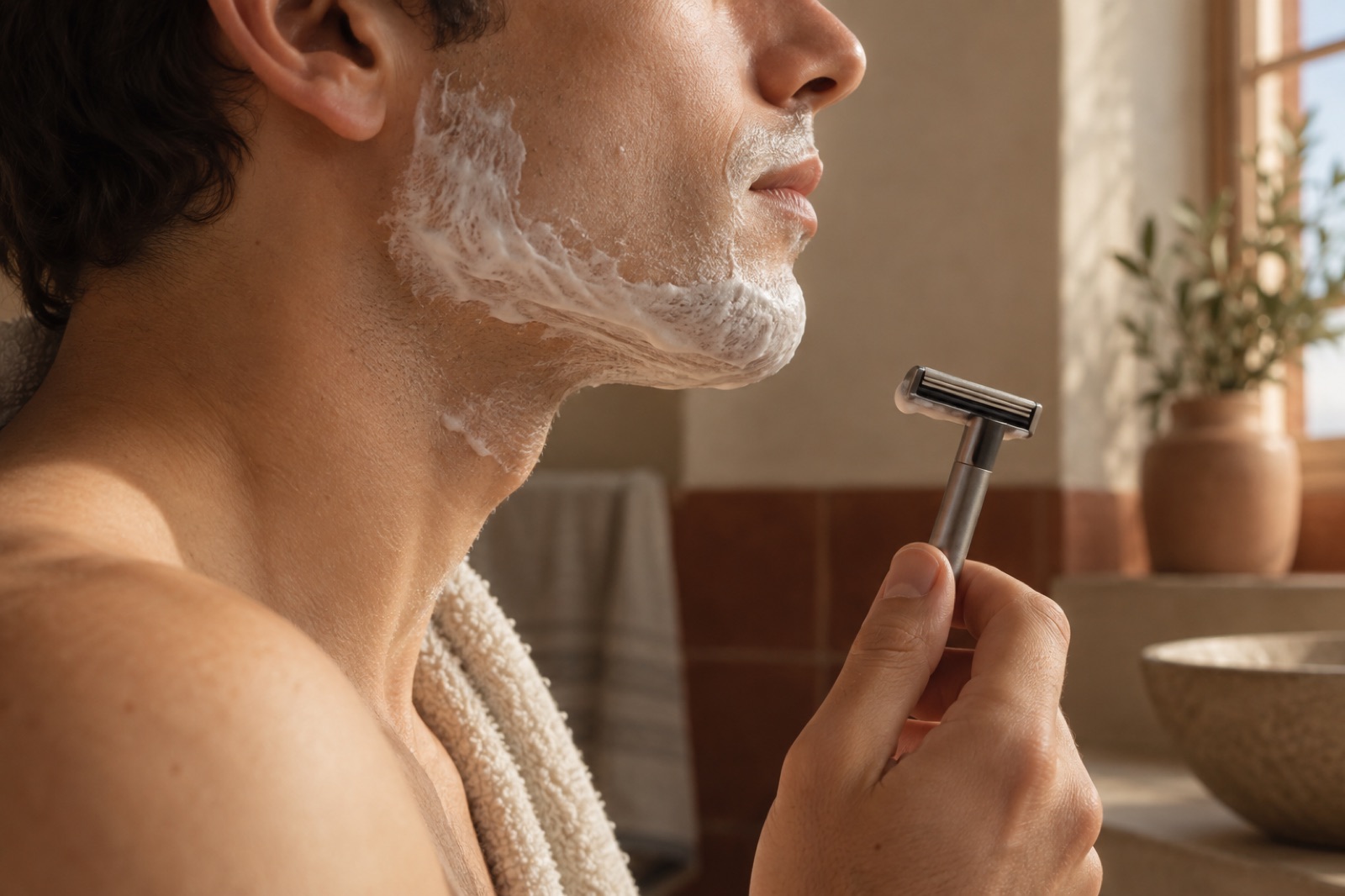
Write down shave days, the tool (electric or blade razor) and whether you used shaving cream, then watch for new bumps in the 1 to 3 days after. A red pus bump centered on a single hair may lean more toward shaving irritation than acne, so note the shape too.
The acne guide from the Korea Disease Control and Prevention Agency (KDCA) advises that when you use a safety razor, you first soften your beard with soap and warm water and then apply shaving cream, and that you shave gently with a sharp blade only when needed, avoiding pimples. Logging rushed dry shaves before work separately from shaves after an evening shower may reveal a difference. A routine for shave days is laid out in male acne on shave days and workout days.
How do you note masks and resting your chin on your hand?
Log mask time in hours, and for chin resting just mark whether it happened in the morning, afternoon or night. Trying to record too much detail makes the 2 weeks hard to finish, so short marks last longer.
The Korean Dermatological Association names friction or mechanical irritation, stress and heavy sweating as factors that can trigger or worsen acne. In a 2018 confocal microscopy study that looked closely at jawline follicles (15 people per group), lower-jaw follicles were larger than on the same women’s forehead, and more of them had a hyperkeratinized border or visible inflammation. That is the reason to flag days when something rests on your chin for a long time, like a student leaning on a desk to study during finals week or a store worker in a mask all shift. For a timetable on long mask days, see maskne on long mask days: a swap, break and moisturizer schedule.

Breaking out on your chin without makeup: what else should you look at?
Even if you use no cosmetics, hormone shifts, shaving, hands, phones and masks all gather on the chin, so don’t narrow the cause to one thing. Adding weeks with short sleep and deadlines, and any newly started medicine, to the same calendar makes overlaps visible.
The Korean Dermatological Association lists hormones, cosmetic use, medications and chronic stress together as causes of adult acne, and notes that about 40% of adult acne patients report psychological stress. A 2022 study that analyzed facial sebum from 47 people with moderate acne and 40 controls found lower polyunsaturated fatty acids in the chin-area sebum of women with acne. That is an observation that the composition of chin-area oil may differ, not a sign that food or products can change it.
What do you watch when a hard, painful bump keeps coming back on your chin?
Don’t squeeze it; log its size, pain and duration by date, and if any sign below is present, see a doctor before logging further. The Korean Dermatological Association lists pus bumps, nodules and pseudocysts as the deep lesions of acne, and explains that when several deep nodules join up, they can form a tunnel that is tender to the touch.
The chin is a place where bumps easily return to the same spot, so “that spot again” is an important thing to log. In the 2018 observational study, jawline follicles were often larger and thicker at the border than those on the same person’s forehead, but how that difference connects to recurrence has not yet been worked out. So writing the location in the same words each time, like “left jawline, 1 cm toward the ear,” lets you tell a repeat in the same spot from a new spot.
| What to log | How to log it | When to see a doctor first |
|---|---|---|
| Size | Tiny bump, red bump or deep lump | A deep lump lasts more than 2 weeks |
| Pain | Hurts without touching, 0–3 | 2 or higher for several days |
| Same spot | Location in the same words | Returns to the same spot for more than 3 months |
| Warmth, spreading | Yes / no | Swollen and warm, or redness spreading |
Your 2-week chin log calendar
| Day | Cycle day (1 = period starts) | Shave | Mask (hours) | Chin resting | Sleep (hours) | New bumps (left/right, size) |
|---|---|---|---|---|---|---|
| Day 1 | Day 18 | Blade razor | 2 | Afternoon | 7 | None |
| Day 3 | Day 20 | — | 8 (store shift) | Morning, afternoon | 6 | Left 1, tiny bump |
| Day 6 | Day 23 | Electric razor | 3 | Night | 5 (deadline) | Left 2, red bump |
| Day 9 | Day 26 | — | 1 | — | 7 | Right 1, deep and painful |
| Day 12 | Day 1 (period starts) | Blade razor | 2 | — | 7 | None |
| Day 14 | Day 3 | — | 2 | Afternoon | 7 | Totals and summary of overlapping conditions |
If you don’t shave, leave the shave column blank, and if the cycle column doesn’t apply to you, use it for high-stress days instead. When the 2 weeks end, gather the conditions from one and two days before each new bump, change only the one that showed up most often, and track the next 2 weeks on the same calendar.

Once the 2 weeks are logged, how do you read them?
Gather the boxes from one and two days before each new bump, and for the next 2 weeks change only the single condition that overlapped most often. If you change several at once, the next calendar can’t tell you what made the difference.
| Overlapping condition | The one thing to change for the next 2 weeks | What to look at on the next calendar |
|---|---|---|
| The week before your period starts | Add no new products or peels that week | Whether bumps cluster at the same time in a second cycle |
| The day after shaving | Soften the beard before shaving, change the blade | Number of bumps the day after shaving |
| Days with more than 6 mask hours | Swap your mask at lunch | Compare days with the same hours |
| Chin resting, phone calls | Just mark it in the afternoon and cut back consciously | Number of marks and number of bumps |
| No overlapping condition | Recheck sleep, deadline weeks and newly started medicine | Take the calendar as it is to your appointment |
If two rounds of 2 weeks show no overlapping condition, or bumps keep appearing in the same spot even after a change, having it checked at an appointment is quicker than looking further for causes in your daily life.
When is it time to have a doctor check your jawline?
- If a hard, painful lump deep in your chin comes back every cycle, see a dermatologist.
- If your periods are irregular, or you also notice more facial or body hair or hair thinning on your scalp, have a dermatologist or a gynecologist check your hormone levels.
- If pus bumps in the shaving area keep appearing even after you change how you shave, talk to a dermatologist.
- If chin bumps increased after you started a new medicine, don’t stop taking it on your own; talk to the doctor who prescribed it.
What this article is based on
- A 2018 confocal microscopy study (adult women with acne, 15 per group) found that of 569 lower-jaw follicles, 76% had a thickened border, 72% a hyperkeratinized border and 23% visible inflammation, more than on the same women’s forehead.
- A 2025 US digital cohort study (24,435 self-reports) found a 31.8% prevalence of moderate or worse acne, and acne was more common in people with polycystic ovary syndrome.
- The Korean Dermatological Association explains that late-onset acne, which first appears in adulthood, may center on the lower jaw, and that persistent acne carrying on from puberty usually gets worse around menstruation.
Frequently asked questions
What should I write on a calendar when chin breakouts come back every cycle?
Mark the first day of your period as day 1, then note the number of new bumps, left or right side, and size (tiny bump, red bump, deep lump). The Korean Dermatological Association says acne that has lasted since puberty usually gets worse around menstruation, so two or more cycles show how many days before it clusters.
Why do I keep breaking out on my chin when I don't wear makeup?
Even without cosmetics, your chin collects many changing conditions: hormone shifts, shaving, hands and phones, masks. The Korean Dermatological Association lists hormones, cosmetics, medications and chronic stress together as causes of adult acne, so it helps to find overlapping days with a 2-week log before narrowing it to one thing.
I have a big bump on my chin. Is it a pimple?
Size alone can't tell you. A pus bump centered on a single hair may come from shaving irritation or follicle inflammation, a red swelling that turns soft may be a boil, and a deep, firm, painful one may be nodular acne. Don't squeeze it; if it keeps growing or you get a fever, have a dermatologist check it.
Do masks and pillowcases really affect chin acne?
The evidence behind this article has no study that puts a number on how much. The Korean Dermatological Association lists friction and mechanical irritation as things that can worsen acne, so a practical step is to log mask hours and pillowcase-change days on the same calendar and see whether they overlap.
Sources
- Confocal microscopy of hair follicles in adult female acne, 2018 (PMID 29369333)B
- Facial sebum and red blood cell fatty acids in moderate acne, 2022 (PMID 35800343)B
- Signs of androgen excess across life stages in a US digital cohort, 2025 (PMID 39388314)B
- Systematic review of the causes of adult female acne, 2025 (PMID 40309637)A
- Korean Dermatological Association — Adult acne (Korean)Institutional
- Korean Dermatological Association — Acne vulgaris (Korean)Institutional
- Korea Disease Control and Prevention Agency (KDCA) National Health Information Portal — Acne (Korean)Institutional
Videos and forum posts never count as evidence for a fact here. Full rules: Editorial policy
What to check when choosing a product for this routine
Check the criteria below before the product name. Each item can be found on the full ingredient list or in the product description.
| Item | What to look for | Why |
|---|---|---|
| pH on the label | Whether a mildly acidic range (around pH 4.5–6.5) is listed | Using the same product on shave and no-shave days makes your log easier to compare |
| Non-comedogenic label | A non-comedogenic label, or published results on pore-clogging potential | Korea's disease control agency names this label as something to look for, so it gives you a rule when you switch products |
| Fragrance | Whether fragrance or scent ingredients appear in the full ingredient list, and where | It removes one variable that touches your chin during the 2-week log |
| Testing disclosure | Whether the brand says how irritation was tested | Results vary by person, but it gives you one more point to compare products on |
Product from this site's operator · KW Cosmetic Content Team
Revive Therapy N.F TonerFitting it into a routine
Where it goes: After cleansing, before your moisturizing products
How to use it: After cleansing, pour a suitable amount onto your palm or a cotton pad. Smooth it gently along the skin's texture, or press it in lightly with your palms until absorbed. Then follow with whichever moisturizing products your skin needs at the time.
Check before you use it: Contains ethanol 3.0%, fragrance and salicylic acid. When you use it together with other products that contain acids, watch how your skin reacts and adjust how often you use it, and avoid the eye area and any wounds. If red spots, swelling, itching or any other unusual reaction appears, stop using it and consult a dermatologist.
Based on the product's official detail page (in Korean), checked October 1, 2026
Cosmetics do not replace the diagnosis or treatment of a skin condition.