Vitamin C Serum on Active Pimples: Skip Spots, Pause, Log 2 Weeks
While pimples are up, apply vitamin C serum around those spots instead of over them, keep the rest of your routine the same, and if redness is still there the next morning, pause the serum first.
What this note covers7 sections
- On a day pimples show up, where do you leave bare when you apply vitamin C serum?
- If redness or tiny bumps increase, what do you pause first?
- When redness seems to build after you put cream on over the serum, how do you tell which one it is?
- Your 2-week log by face area while pimples are up
- How do you read your log after 2 weeks?
- When is it time to see a dermatologist instead of pausing the serum and waiting?
- What this 2-week plan is based on
| Item | Detail | Basis |
|---|---|---|
| Pimples and squeezed spots | Korea’s Ministry of Food and Drug Safety advises against using cosmetics on mucous membranes or damaged skin, and says to see a doctor for care or advice if side effects such as red spots or swelling appear | MFDS 2025 · institution |
| Hands off | The AAD and NHS advise against squeezing acne yourself, and the NHS notes that squeezing can make it worse and leave permanent scars | AAD 2023 · NHS 2023 · institution |
| Vitamin C serum over pimples | This guide’s evidence has no study of vitamin C serum applied to a face with pimples. The one trial of a cosmetic cream on faces with inflamed spots used a specific finished product, 16 people, 15 days | 2026 PMID 41487026 · A |
| Squeezed spots and scabs | No grade-A study in the evidence we reviewed has looked at whether cosmetics help small squeezed or picked wounds close up faster, and wound research is almost entirely in patients and medical settings | Editorial evidence review · evidence gap |
| Why 2 weeks | Not a period set by research, but a log length chosen to compare serum days with skipped or paused days, area by area | Editorial choice |
On a day pimples show up, where do you leave bare when you apply vitamin C serum?
Keep your usual order of steps, and apply vitamin C serum to the rest of your face, leaving bare a margin about one finger joint wide around pimples, spots you’ve squeezed and scabs. Write ‘skipped’ for those areas in the serum box of that day’s log.
Say an office worker has been staying late through a deadline week, and two or three red pimples come up on the chin and right cheek. The two common choices here are to drop the serum completely, or to spread it over the pimples as usual. This guide picks the path between them. Apply the serum only to the forehead, the left cheek and the side of the chin without pimples, and don’t sweep what’s left on your fingertip toward the pimples. Korea’s Ministry of Food and Drug Safety (MFDS) lists not using cosmetics on damaged skin among its precautions, so squeezed spots and scabbed spots go in the “leave bare” group.
It also matters not to write down “because there’s evidence” as the reason for leaving spots bare. In a 2026 split-face trial (PMID 41487026), 16 adults with mild to moderate acne applied a specific finished cream to one side of the face twice a day for 15 days and left the other side bare. That only shows a study exists of a cosmetic applied to a face with inflamed spots; it wasn’t a vitamin C serum, and the manufacturer ran it on its own product, so its results don’t carry over to the situation in this guide. This guide’s evidence has no study of vitamin C serum applied over pimples, so leaving those spots bare is a choice that follows both the institution’s precautions and the gap in the evidence.
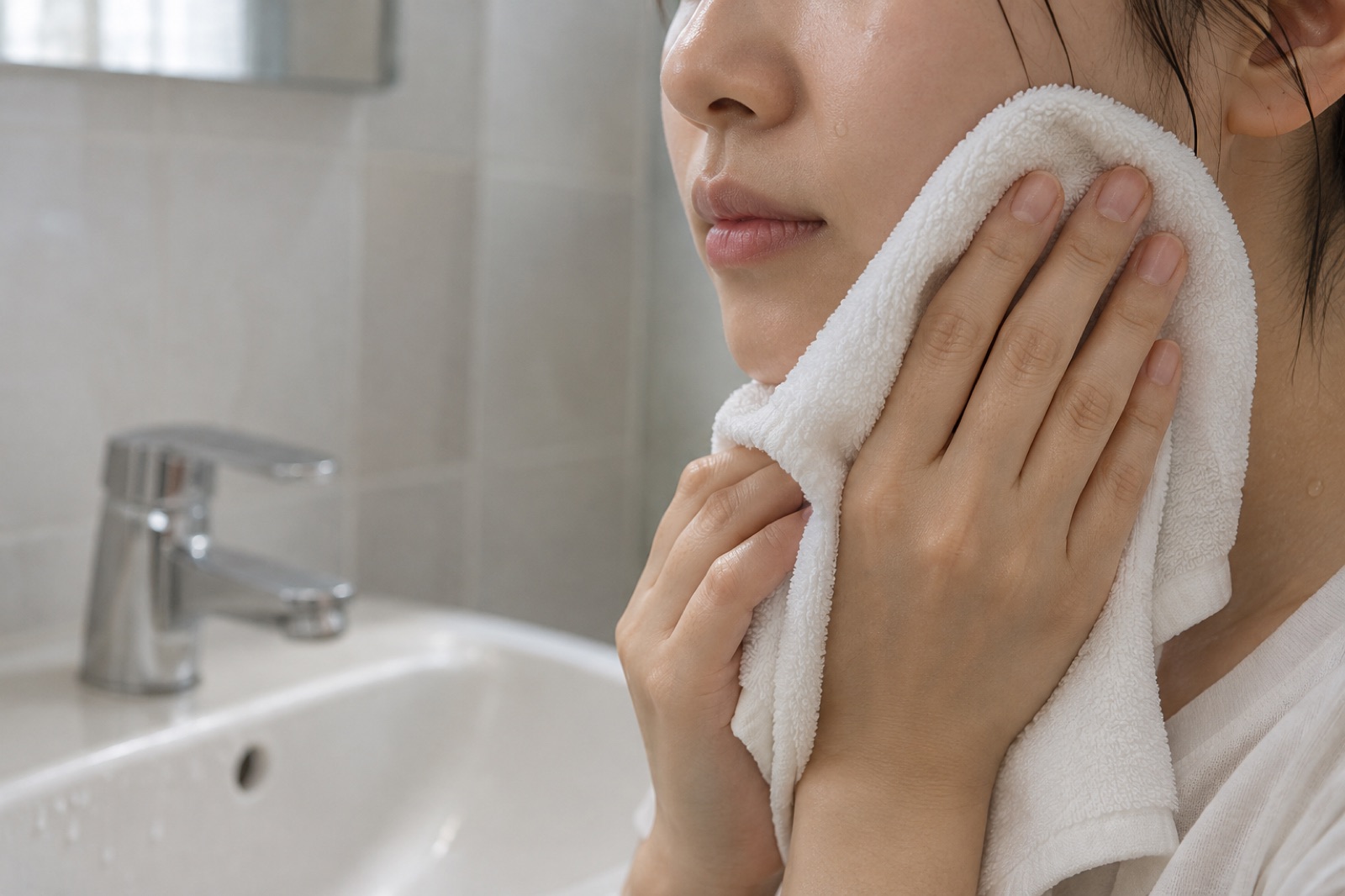
Not squeezing or picking is also part of these 2 weeks. The AAD explains that squeezing a pimple yourself can push its contents deeper and make the inflammation worse, and that bacteria from your hands can raise the risk of infection, and it advises against touching, squeezing or picking at your face. Once you have a squeezed spot, that area’s serum box turns to ‘skipped’ for all 2 weeks, and you have fewer boxes to compare.
If redness or tiny bumps increase, what do you pause first?
If redness or stinging lasts into the next morning, or tiny bumps rise above your baseline line two days in a row, pause the vitamin C serum first and don’t change your other steps. There’s no evidence for putting up with it and applying until your skin adjusts, and don’t retest the serum that caused a reaction on your own within those 2 weeks.
A common question from people whose forehead bumps increased about ten days after starting a vitamin C ampoule is “Is it because it’s too strong, and will it settle once my skin adjusts?” This guide’s evidence has no study in people of whether a single cosmetic ingredient causes tiny bumps on the face, so it can’t settle whether the bumps come from the ampoule or something else. There’s one thing a log can sort out: how the count in the forehead box moved once you paused only the ampoule.
That’s why you pause just one thing, too. If on the day you pause the serum you also switch to a gentler cleanser and bring in a new cream, then even if the boxes go down three days later, you can’t tell what did it. Circle the date you paused, and from that day on write ‘paused’ in the serum box while filling in the other boxes exactly the same way. Whether to bring it back, and in what order, isn’t decided here; that’s for the “bringing products back” guide listed below.
When redness seems to build after you put cream on over the serum, how do you tell which one it is?
No study has looked at vitamin C serum and a cream used together, so there’s no basis for deciding “you can’t use them together.” If you pause only the serum for three days, keep the cream as it is and fill in the redness box, you’ll see which one to look at first.
If redness came down to 0–1 during the three cream-only days, leave a mark on the serum side of your log. If redness stays at 2–3 even with only the cream, it’s the cream’s turn to be checked, but even then don’t change the cream right away; put it off until the following week. If you drop both the serum and the cream in the same week, the ‘changed that day’ box gets two lines and you can’t read either. Either way, if red spots, swelling or itching appear, don’t keep logging; stop both products and move on to seeing a doctor.

Your 2-week log by face area while pimples are up
The table below isn’t a form tested in research; it’s a frame this guide set so you can compare serum days with skipped or paused days under the same conditions. In each area box, write “pimple count / redness 0–3,” and fill in the baseline line on the night you start, before applying the serum.
| Day | Forehead | Left cheek | Right cheek | Chin | Serum (applied · skipped spots · paused) | Changed that day | Still there next morning |
|---|---|---|---|---|---|---|---|
| Baseline | Before applying | — | |||||
| Day 1 | e.g. applied · right cheek and chin skipped | ||||||
| Day 2 | |||||||
| Day 3 | |||||||
| Day 4 | |||||||
| Day 5 | |||||||
| Day 6 | |||||||
| Day 7 | |||||||
| Days 8–14 | Keep going in the same boxes | On paused days, “paused” and the date | |||||
| After 2 weeks | Average redness on serum days | Average redness on skipped or paused days | Total new pimples |
Score redness as 0 none, 1 briefly right after applying, 2 lasts an hour or two, and 3 still there at bedtime. Days when your skin tends to swing anyway, like exam week for a student, the week before your period or a day spent in a face mask, go in the ‘changed that day’ box too, so you can look at those lines separately after 2 weeks.
How do you read your log after 2 weeks?
Line up the boxes from serum days and from skipped or paused days, area by area, and look only at which side had the higher redness numbers and more new pimples. What the log answers is “what was different in this area during these 2 weeks”; it doesn’t judge whether the serum suits you or not.
For example, if your chin kept getting new pimples for all 2 weeks even though it was a skipped area, while your forehead and left cheek, where you applied the serum, stayed at redness 0–1, it’s hard to read the chin pimples as the serum’s fault. First check whether that week’s notes box was crowded with the week before your period or late nights. On the other hand, if redness of 2–3 lasted into the next morning only in areas where you applied the serum, and it came down within three days of pausing, mark that line separately.
Studies that tested cosmetics on acne-prone skin are mostly small and short, with 12 to 299 people and 2 to 16 weeks, and they used finished products that mix several ingredients, so there’s no reference table for holding one person’s 2-week log up against research results. Compare against your own baseline line rather than other people’s reviews. When and in what order to bring the serum back is covered in the “bringing products back” guide listed below.

When is it time to see a dermatologist instead of pausing the serum and waiting?
- If a pimple becomes painful and hard or you see pus, don’t wait it out with the serum paused; see a dermatologist.
- If new pimples keep appearing 2 weeks after you pause the serum, consider taking your log to a dermatologist.
- If red spots, swelling or itching appear, stop both the serum and the cream and talk to a doctor.
- If you’re using a prescribed medication, ask the prescriber first whether to keep the serum going and what to apply while it’s paused.
What this 2-week plan is based on
- In a 2026 split-face trial (PMID 41487026), 16 adults with mild to moderate acne applied a specific finished cream to one side of the face twice a day for 15 days; it wasn’t a vitamin C serum study, and the manufacturer ran it on its own product.
- Korea’s Ministry of Food and Drug Safety (2025) advises checking the directions, precautions and expiration date on cosmetic containers and packaging, not using cosmetics on mucous membranes or damaged skin, and seeing a doctor for care or advice if side effects such as red spots or swelling appear.
- The AAD (updated 2023) and the NHS (reviewed 2023) advise against squeezing acne yourself, and the AAD advises seeing a dermatologist if acne medication used consistently for 4 to 6 weeks hasn’t brought improvement.
Frequently asked questions
Can I use vitamin C serum when I'm breaking out, or will it make it worse? Should I stick to just one product?
This guide's evidence has no study of vitamin C serum applied over pimples, so it can't say that it makes them worse or that it's fine. What you can do is leave a margin about one finger joint wide around pimples and squeezed spots, apply it only to the rest of your face, and log each area for 2 weeks. If you bring in several new products in the same week, you can't read what changed the boxes, so during these 2 weeks don't change any step other than the serum.
My vitamin C ampoule is giving me tiny bumps. Should I stop, or is it just strong and my skin will adjust?
There's no evidence for putting up with it and keeping going until your skin adjusts. If tiny bumps have risen above your baseline line two days in a row, pause only the ampoule, keep your other steps the same, and keep logging the count in each area. Don't retest the ampoule that caused a reaction on your own, and if the bumps keep increasing for more than 2 weeks after pausing, or turn red and fill with pus, see a dermatologist.
My redness seems worse when I put cream on after vitamin C serum. Can't I use the two together?
No study has looked at the two products used together, so there's no basis for deciding you can't. First, pause only the serum, keep the cream as it is, and fill in the redness box for three days. If redness is the same on cream-only days, look at the cream the following week; changing one thing at a time is the only way the 'changed that day' box in your log can tell them apart.
Can I keep using vitamin C serum while my acne is active?
Your log decides this more than a fixed rule does. If the 0–3 redness score stays low on days you apply around the pimples, and new pimples don't rise above your baseline line, carry on the same way; once a day comes when redness lasts into the next morning, pause the serum first. If you're also using a prescribed medication, ask the prescriber first whether to keep the serum going.
If the red pimples don't calm down even after I stop vitamin C serum, do I need to see a doctor?
See a dermatologist if a pimple is painful and hard or you see pus, if new pimples keep appearing for more than 2 weeks, or if red spots, swelling or itching appear. The AAD's advice to see a dermatologist when there's no improvement after 4 to 6 weeks is meant for people who are already using acne medication, so don't read it as a waiting period while you pause the serum. Bringing your 2-week area log to the appointment makes it easier to explain.
I picked off an acne scab. Can I put vitamin C serum on that spot too?
Count a spot where you picked off a scab as broken skin and leave it bare for the serum. Korea's Ministry of Food and Drug Safety advises against using cosmetics on damaged skin, and this guide's evidence also has no study of whether putting cosmetics on squeezed or picked spots helps them close up faster. Write 'skipped' in the serum box of your log, and if the spot swells or oozes, see a doctor.
Why do I get pimples whenever I use an ampoule? I have oily skin.
This guide's evidence has no study in people of whether a single cosmetic ingredient causes pimples or tiny bumps on the face, so it can't settle the reason. What your log can sort out is whether the day you started that ampoule overlapped with a day you changed something else. Pause only the ampoule and log the counts on your forehead, cheeks and chin for 2 weeks, and if pimples keep coming in the same spots while it's paused, have a dermatologist check the cause.
I keep breaking out lately and can't tell if it's my serum or something else. How do I figure it out?
Pausing one thing at a time is the simplest way. Pause only the serum, keep your cleanser, toner and cream the same, log pimple counts and redness by area, and mark days when your skin tends to swing anyway, like the week before your period, late nights at work or a long day in a face mask, in the notes box. If the boxes stay the same with the serum paused, it's time to look somewhere other than the serum, and then you start by rereading the 'changed that day' box.
Sources
- Split-face test of a finished cream with salicylic acid, niacinamide and zinc, 16 adults with mild to moderate acne, 15 days, 2026 (PMID 41487026)A
- Ministry of Food and Drug Safety (Korea), Busan Regional Office — Consumer newsletter: acne cosmetics and precautions when using cosmetics (Korean, 2025-05-30)Institutional
- American Academy of Dermatology (AAD) — Why you shouldn't pop acne yourself (updated 2023-10-17)Institutional
- UK National Health Service (NHS) — Acne: overview and self-care (reviewed 2023-01-03)Institutional
Videos and forum posts never count as evidence for a fact here. Full rules: Editorial policy
What to check when choosing a product for this routine
Check the criteria below before the product name. Each item can be found on the full ingredient list or in the product description.
| Item | What to look for | Why |
|---|---|---|
| Directions on damaged skin | Whether the product page or container says to avoid using it on wounds or spots you've squeezed | You can check that the cream's directions point the same way as this 2-week plan of leaving pimples and scabs bare |
| Where it goes in the routine | Whether it says to use it after ampoule, as the last step of the routine | Even on days you pause the serum, the cream stays in the same spot, so the 'changed that day' box in your log doesn't wobble |
| Fragrance and alcohol on the label | Whether you copied onto one line, before starting the 2-week log, if fragrance and ethanol appear in the full ingredient list | If redness seems to build when cream goes on after serum, you already have a line to look at first between the two products |
| What to do after an unusual reaction | Whether there's wording to stop using it and get advice if red spots, swelling or itching appear | You can decide ahead of time, for the day the redness box climbs to 3, whether to change the cream too or stop and hand it off to a doctor |
| A container you dispense from | Whether it comes out of a tube or pump so your fingers don't touch what's inside | When you apply around pimples and leave them bare, it's easier to put about the same amount on your fingertip each time |
Product from this site's operator · KW Cosmetic Content Team
Revive Therapy N.F CreamThere is no test data on skin with active pimples or on use alongside a vitamin C serum. It's a 50 mL cream with 4 ceramides and 5 types of hyaluronic acid, no added fragrance per its full ingredient list, and it has completed a low-irritation skin patch test. Its product page says to apply it last in the routine, after ampoule, and to avoid areas where the skin is broken. For 2 weeks when you want to keep your last moisturizing step in place even on days you pause the serum, the product we suggest is Revive Therapy N.F Cream.
Fitting it into a routine
Where it goes: After ampoule, the last step of the routine
How to use it: After toner and ampoule, take a suitable amount and spread it gently from the center of the face outward. On areas where dryness bothers you, layer a small amount once more to finish.
Check before you use it: If red spots, swelling, itching or any other unusual reaction appears during or after use, stop using it and consult a dermatologist. Avoid using it on areas with wounds, and check the full ingredient list and expiry date on the latest packaging first.
Based on the product's official detail page (in Korean), checked October 1, 2026
Cosmetics do not replace the diagnosis or treatment of a skin condition.