Moisturizer Over Makeup: A 2-Week Midday Tightness Log
For 2 weeks, write down when and where your skin first felt tight, that day's setting and what kind of product you added, then compare those days with how your skin looks after washing in the evening.

What this note covers6 sections
- Why log the day’s setting along with the time your skin first felt tight?
- On days you add mist, cream or balm, why log the type separately?
- Before you add moisturizer over makeup, what do you read on the container?
- Your 2-week log of what you add when skin feels tight midday
- At what point should you bring this log to a dermatologist?
- What do the three studies behind this log show?
| Item | Detail | Basis |
|---|---|---|
| Setting: winter vs. summer | In a 2011 survey of 754 women in winter (January–March) and summer (June–July), with patches of a cleansing agent (SLS) and retinol on the back and lactic acid and capsaicin on the cheeks, irritation responses differed by where they lived and by season. It did not test moisturizers | 2015 PMID 24665959 · B |
| Timing: winter cheeks before the study | Before a winter study began, transepidermal water loss measured on the cheeks of 16 young women was already on the high side, and at weeks 3 and 6 the cheek that got the cream had higher surface skin conductance | 2003 PMID 14571069 · B |
| Setting: air-conditioned rooms | Studies in which dry-skin symptoms appear in low-humidity, air-conditioned indoor air have been summarized, but the literature on humidity and skin as a whole is inconclusive | 2016 PMID 27306376 · C |
| Log box: what you added | Describes a moisturizer as a product that mixes moisturizing ingredients with different roles. That’s why mist, cream and balm don’t share a single “added” box | Korean Dermatological Association · Institution |
| Length and boxes | For 14 days, you fill in 7 boxes: setting, first tight time and spot, what was on your face then, what you added and where, three 30-minute scores, two evening scores, and stop | Editorial call |
Why log the day’s setting along with the time your skin first felt tight?
Because even with the same cream in the same amount, the time your skin starts to feel tight can shift when the air where you spent the day is different. Logging a heated office, cold wind on the commute, an air-conditioned meeting room and a long day in a mask as separate settings is what lets you compare them on day 14.
A 2015 multicenter survey (PMID 24665959) tested 754 healthy women in six cities in China and in Korea with the same irritants in the winter and summer of 2011, and the responses split clearly by region and by season. It looked only at women, compared a single point in each season, and measured responses to irritants rather than to moisturizers, so this guide doesn’t use it to explain tightness on a winter day. What it does show is that skin responses are hard to read without the season and the place, and that is where the setting box in this log comes from.
In a 2003 split-face study (PMID 14571069), cheek transepidermal water loss was already on the high side in winter before the study started. After cream went on one cheek only, measurements at weeks 3 and 6 showed higher surface skin conductance and lower water loss on the cream side, but that result comes from 16 young women and a single cream. This guide doesn’t turn it into “switch creams in winter”; it uses it only as a reason to give the winter day itself a box. Choosing a cream by season is a separate topic, covered in another guide on fall and winter creams for day and night.

On days you add mist, cream or balm, why log the type separately?
Because even under the same label of “adding more,” whether what went on your face was a watery mist, a cream or a firm balm can change how the 30-minute makeup lifting and shine boxes read. This box doesn’t rank one type over another; it records what you did that day, by name.
The Korean Dermatological Association, a Korean professional society, describes moisturizers in its page on them as products that help the stratum corneum hold on to water and as a mix of moisturizing ingredients that each play different roles. Whether it’s called a mist or a cream, what’s mixed inside differs, so in the box for what you added, write the type along with whether it’s the same product you put on in the morning.
A 2016 literature review on humidity and skin (PMID 27306376) summarized that the water content of the stratum corneum went up when a humidifying mist was used to raise air humidity, which means the room air was humidified, not that a face mist product was tested. The same review also noted studies in which skin measures were better at low humidity, so it could not reach a conclusion. Choosing what to add by ingredient, and how much and how often to apply each day, are covered in when, how much and how often to apply moisturizer.
Before you add moisturizer over makeup, what do you read on the container?
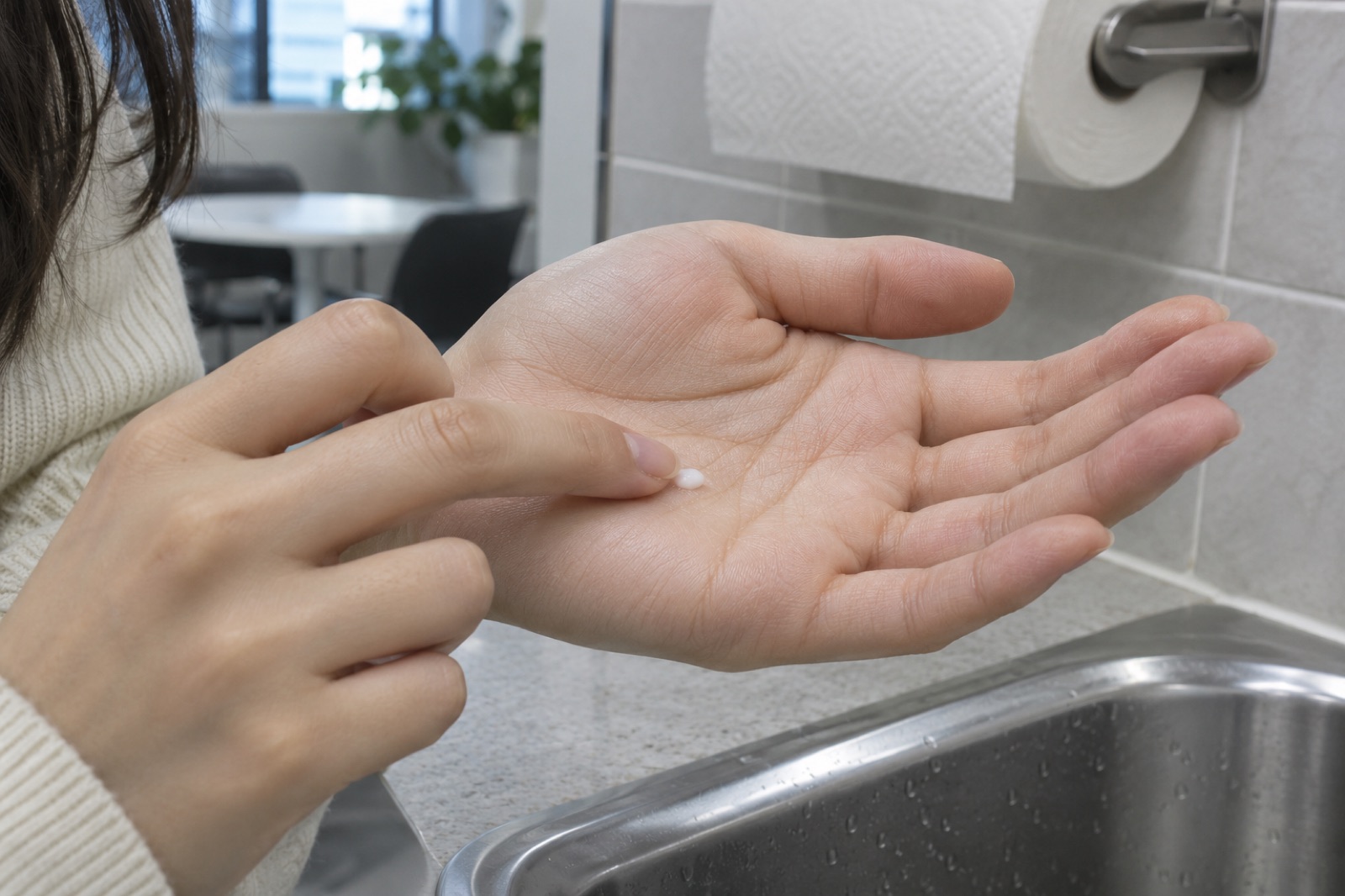
Only whether the directions and cautions for the product you plan to use mention adding more, and whether you’re staying within them. Don’t use more than usual or spread a thick layer over your whole face just because you feel tight midday, so your 2 weeks of entries stay comparable.
If the container says nothing about adding more, mark that day’s entry “outside container directions” next to the spot box. This guide doesn’t decide whether to add anything over makeup, in what order to reapply sunscreen, how to fix makeup that has worn off, or whether to wash your face again midday. For sunscreen, see how much sunscreen to use and when to reapply by type; for makeup, see afternoon touch-ups and evening cleansing on primer days.
Your 2-week log of what you add when skin feels tight midday
Score each box as 0 = nothing, 1 = you notice it only when you look closely or pay attention, 2 = it’s obvious at a glance or you feel it the whole time you’re working. On days you add nothing, leave the 30-minute box as “—” and fill in only the evening box.
| Day | Setting that day (heated indoors · cold wind outdoors · air conditioning · mask · none) | First felt tight: time · spot (beside nose · cheeks · around mouth · forehead) | On your face then (skincare only · up to sunscreen · up to base makeup) | What you added (none · mist · cream · balm) · where | 30 min after adding: makeup lifting · shine · stinging (0–2 each) | Evening after washing: flaking · redness (0–2 each) | Stop mark |
|---|---|---|---|---|---|---|---|
| Day 1 (example) | Heated indoors | 2:30 p.m. · beside nose | Up to sunscreen | Cream · beside nose, one rice grain | 1·0·0 | 0·0 | — |
| Day 2 (example) | Cold wind outdoors + mask | 10:10 a.m. · cheeks | Up to base makeup | None | — | 1·0 | — |
| Day 3 | |||||||
| Day 4 | |||||||
| Day 5 | |||||||
| Day 6 | |||||||
| Day 7 | |||||||
| Day 8 | |||||||
| Day 9 | |||||||
| Day 10 | |||||||
| Day 11 | |||||||
| Day 12 | |||||||
| Day 13 | |||||||
| Day 14 |
| Call | Condition (editorial call) | What to do |
|---|---|---|
| Stop for the day | Stinging hits 2 at 30 minutes after adding, even once | Add nothing more that day, wash it off in the evening and add a stop mark |
| See a doctor | Evening redness of 2 lasts two days in a row, or cracking or itching keeps you up at night | Take your log and the products you were using to a dermatologist |
| Day 14: early in one setting only | When you group days with the same setting, the first tight time comes earlier in only one setting | For the next 2 weeks, change just one thing in the “what you added” box on days in that setting |
| Day 14: not tied to the setting | The first tight time is about the same in every setting | Move on to logging tightness and shine three times a day, which covers your morning routine |
The “what you added” box records what you did that day; it isn’t there to decide what to add the next day. You can set the two evening scores from days you added something next to those from “none” days, but don’t use the score gap to declare either one better.
At what point should you bring this log to a dermatologist?
- If red spots appear where you added it, or the area swells and itches, stop that product no matter which day of the log you’re on and see a dermatologist.
- If evening redness of 2 lasts two days in a row, or cracking or itching keeps you up at night, talk to a dermatologist and bring your log and the products you were using, even if the table isn’t full yet.
- If tightness and flaking remain after 2 weeks regardless of the setting, seeing a doctor comes before adding more product. Whether the tightness comes from the setting or from a product isn’t something to settle at home.
What do the three studies behind this log show?
- A 2015 multicenter survey (PMID 24665959) compared 754 healthy women with patch and stinging tests in winter (January–March) and summer (June–July) 2011, and irritation responses differed clearly by region and season.
- In a 2003 split-face study (PMID 14571069), the cheeks of 16 young women had rather high transepidermal water loss at the winter baseline measurement, and the cream side had higher surface skin conductance at weeks 3 and 6.
- A 2016 literature review on humidity (PMID 27306376) summarized studies linking low-humidity, air-conditioned indoor air with dry-skin symptoms, while stating that the literature as a whole did not reach a conclusion.
Frequently asked questions
My skin feels tight beside my nose and on my cheeks after skincare and sunscreen. What do I do midday without powder?
This guide doesn't decide what to add midday; it covers how to put that day on record. Write down the time and the spot where tightness first showed up (beside the nose, cheeks), mark what was on your face then as 'up to sunscreen,' and if you added nothing, write 'none.' On days you do add something, fill in the same row with makeup lifting, shine and stinging at 30 minutes, plus flaking and redness after washing in the evening, and compare them with the 'none' days.
I layer ampoule and cream, but by afternoon my skin feels stiff again. What should I write down during the day?
Before counting how many layers went on in the morning, write down where you spent the day and when your skin first felt stiff. Pick whichever applies from heated indoors, cold wind outdoors, air conditioning and a mask, and note what time in the afternoon and which spot felt tight first. This log doesn't cover how much to apply in the morning or in what order, so see the separate guide on when and how much to apply.
Can I put moisturizer over makeup when my face dries out at work?
This guide doesn't give a yes or no. First check whether the container or product page of the cream you want to use mentions adding more, and only on days you add it within those directions, write the cream and the spot in the 'what you added' box. If you also note makeup lifting, shine and stinging at 30 minutes and how your skin looks after washing that evening, your log shows what was different from the days you added nothing.
Is it okay to add moisturizer over sunscreen in the afternoon when my face isn't freshly washed?
This guide doesn't decide whether to wash your face again midday or in what order to reapply sunscreen. Instead, mark what was on your face then as 'up to sunscreen,' and don't skip the stinging score in the 30-minute box after you add something. On a day stinging hits 2, add nothing more, wash it off gently in the evening and add a stop mark.
What should I do when my skin gets dry after I put on compact foundation?
On that day, mark the 'on your face then' box as 'up to base makeup' so it's grouped apart from skincare-only days and sunscreen days. What to put over a compact and how to touch up makeup belong to other guides, so here you note only when and where tightness first showed up and, if you added anything, what type it was. On day 14, line them up to see whether tightness was logged earlier only on base-makeup days.
I've tried both face mist and moisturizing cream, but my skin still feels tight when the seasons change. What should I log?
Before deciding which product suits you, log mist days and cream days separately in the 'what you added' box. The two leave different things on your face, so if you lump them into a single 'moisturized' box, you can't compare them on day 14. Fill in the setting box too, and check whether tightness comes early only in one setting no matter what you added.
My face feels dry from the fan and the air conditioning. How can I tell if the airflow is the cause?
You can't sort out at home whether the airflow is to blame, but if you log days under the air conditioner separately in the setting box, you can see whether tightness comes earlier only on those days. A 2016 literature review on humidity and skin summarized studies in which dry-skin symptoms appeared in low-humidity, air-conditioned indoor air, yet it called the literature as a whole inconclusive. Log days without air conditioning as 'none' too, so you can line up both kinds of days.
If midday tightness hasn't settled after more than 2 weeks of care, could it be a skin condition?
That isn't something a home log can decide; it's for a dermatologist to check. If tightness and flaking remain after 2 weeks regardless of setting, if evening redness of 2 lasts two days in a row, or if cracking or itching keeps you up at night, take your log and the products you were using to a dermatologist. Having the settings and what you added logged by date also makes it easier to explain at your appointment.
Sources
- Winter vs. summer patch and stinging responses in 754 healthy women across six cities in China and in Korea, 2015 (PMID 24665959)B
- Winter split-face cream study with cheek measurements at baseline, 3 and 6 weeks, 16 young women, 2003 (PMID 14571069)B
- Ambient humidity and the skin, literature review, 2016 (PMID 27306376)C
- Korean Dermatological Association — Moisturizers (Korean)Institutional
Videos and forum posts never count as evidence for a fact here. Full rules: Editorial policy
What to check when choosing a product for this routine
Check the criteria below before the product name. Each item can be found on the full ingredient list or in the product description.
| Item | What to look for | Why |
|---|---|---|
| Directions for adding more | Whether the product page or container describes adding more, such as 'a small amount once more on dry areas' | You can fill in the 'what you added' box within the use printed on the container, and mark separately any day you used it in a way it doesn't describe |
| Container shape | Whether it lets you squeeze out about the same amount each time during the day, the way a tube you carry in your bag does | You need to log the amount and area in the same unit every day so you can line the settings up side by side on day 14 |
| Fragrance and ethanol on the label | Whether fragrance or ethanol shows up on the full ingredient list, checked together with the lists of everything you put on that morning | On a day a stinging score shows up 30 minutes after you add it over makeup, you can set fragrance ingredients aside first as a candidate when you read the log |
| Routine step wording | Whether it says to apply it as the last step of your routine | You can note in the box whether what you put on last in the morning and what you added midday were the same product or two different ones |
| Stop-use wording | Whether it says not to use it if red spots, swelling or itching appear | If changes like that show up on a day you add more, you can tie the moment you fill in the stop box to the wording on the container |
Product from this site's operator · KW Cosmetic Content Team
Revive Therapy N.F CreamNone of the studies cited here tested this cream or adding cream over makeup (Skin9hari makes no mist or balm). It's a 50 ml tube cream with 4 ceramides and 5 types of hyaluronic acid, no added fragrance per its full ingredient list, with a completed low-irritation test (results vary by person). Its product page says to apply it last, to layer a small amount once more where dryness bothers you, and to stop if red spots, swelling or itching appear. It is a cosmetic, not a medicine. To log your morning cream and your midday top-up as one product, the product we suggest is Revive Therapy N.F Cream.
Fitting it into a routine
Where it goes: After ampoule, the last step of the routine
How to use it: After toner and ampoule, take a suitable amount and spread it gently from the center of the face outward. On areas where dryness bothers you, layer a small amount once more to finish.
Check before you use it: If red spots, swelling, itching or any other unusual reaction appears during or after use, stop using it and consult a dermatologist. Avoid using it on areas with wounds, and check the full ingredient list and expiry date on the latest packaging first.
Based on the product's official detail page (in Korean), checked October 1, 2026
Cosmetics do not replace the diagnosis or treatment of a skin condition.