Cracked Heels: First 2 Weeks of Moisturizing, No Filing
For the 2 weeks after you stop filing, take a day-0 photo and count the visible cracks, then log each day when you applied moisturizer, how much, what covered it and how your heels look the next morning.

What this note covers7 sections
- Moisturizing only, no filing: why log your heels in 2-week blocks?
- What do you write down on day 0, before you start?
- On the first day you apply it, how do you lock in the amount, spot and cover?
- Why log the days you applied and the days you skipped separately?
- Your 2-week no-filing heel moisturizing log
- When should your heels go to a dermatologist instead of the log?
- What did the three studies behind this log look at?
| Item | Detail | Basis |
|---|---|---|
| Comparison interval | A double-blind study of 48 participants with cracked heels had them use one of two creams daily and recorded dryness and how the cracks progressed every 2 weeks over 28 days | 2025 PMID 41166120 · A |
| What was scored | An assessor-blinded study of 40 people with type 2 diabetes had them apply a cream twice a day for 28 days and scored dryness, the feeling of dryness and itch | 2012 PMID 23009311 · A |
| After stopping | In an open-label randomized study that split 71 dialysis patients into a group that applied moisturizer for only 2 weeks and a group that applied it for 8 weeks, the group that stopped saw its stratum corneum hydration readings and dryness scores get worse again | 2021 PMID 34041789 · A |
| Covering ingredients | The Korean Dermatological Association, a Korean medical society, describes occlusives as ingredients that form a film on the skin to hold back water evaporation (petrolatum is the typical example) and emollients as ingredients that fill the gaps between skin cells as they shed | Korean Dermatological Association, “Moisturizers” · Institution |
| Why 2 weeks | All three studies above were in patients, so we don’t carry over their results; 2 weeks is borrowed from their assessment interval and used only as the shortest unit for comparing | Editorial standard |
Moisturizing only, no filing: why log your heels in 2-week blocks?
To tell whether moisturizing alone made a difference, you need a stack of rows logged under the same conditions, and the heel study checked progress every 2 weeks. Two weeks is not a promise of change; it’s the shortest unit for starting a comparison.
A 2025 double-blind study had 48 people with cracked heels use one of two creams daily and recorded dryness and crack progression every 2 weeks over 28 days. Because everyone in it already had cracked heels and the comparison cream was a high-strength urea formula, we leave out the results and borrow only the design: apply daily, check every 2 weeks. A 2012 assessor-blinded study had 40 people with type 2 diabetes apply a cream twice a day for 28 days and scored dryness, the feeling of dryness and itch; because they were patients, we leave out the numbers and borrow only the idea of scoring several things together, as the 0–2 columns.
Keep your shoes, type of socks and the way you wash the same for the 2 weeks. If it’s the week you pulled your winter boots out or started showering at the gym, reset day 0.
What do you write down on day 0, before you start?
The night before you start, take a photo of your heels under the same light from the same distance, and write down the number of cracks and pain when walking (0–2). From that day on, don’t file or peel, and start the “times filed or scratched” column at 0.
Take the photo under the same bathroom light, about a hand’s span from your foot, so you can set it next to the day 14 photo. Count only the cracks you can see, and don’t name a condition from how they look.

On the first day you apply it, how do you lock in the amount, spot and cover?
Within the container’s area of use, directions and cautions, set the amount as one finger segment or a number of pumps, and the spot as heels only or the whole sole, and keep them the same for 14 days. Don’t put it on cracks that are bleeding or oozing.
If the label says it’s for feet, follow those directions, and don’t move face or body products to your feet. In its guidance on moisturizers, the Korean Dermatological Association explains that occlusives form a film on the skin to hold back water evaporation and that emollients fill the gaps between skin cells as they shed. We don’t decide which kind of product is right, or whether socks are; the “covered with” column is there so you don’t mix barefoot days with sock days.
An office worker who applies it before work and pulls socks on right away might log “morning · cotton socks,” and a college student who sleeps barefoot might log “night · nothing.” Keep the first day’s combination for all 2 weeks.
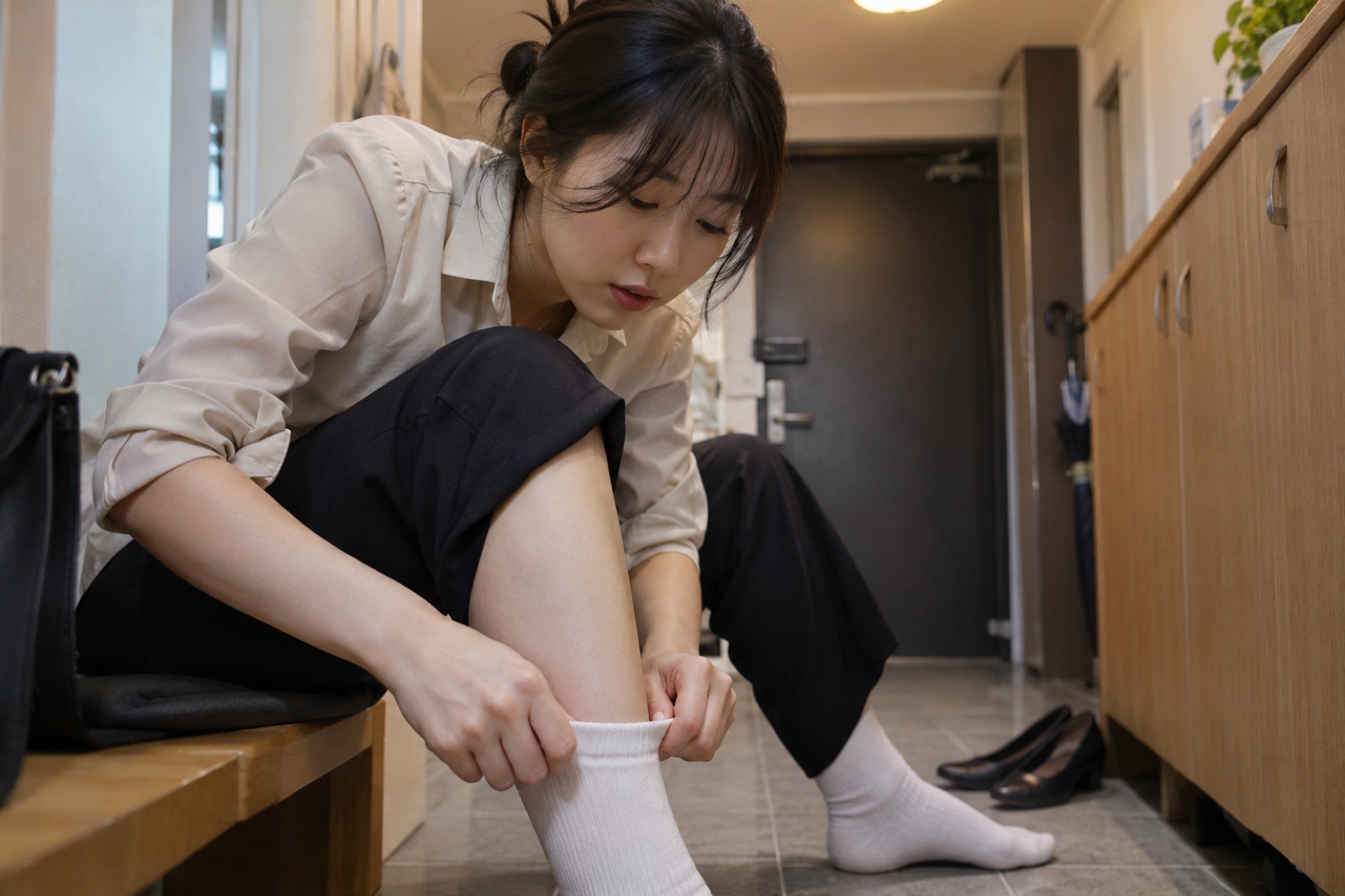
Why log the days you applied and the days you skipped separately?
Because a study saw readings get worse again after people stopped applying moisturizer, you need to look at the morning after a skipped day on its own. If you erase skipped days, you can’t tell whether your 2 weeks were patchy.
A 2021 open-label randomized study split 71 dialysis patients with dry skin into a group that applied moisturizer for only 2 weeks and a group that kept applying it for 8 weeks, and in the group that stopped, stratum corneum hydration readings and dryness scores got worse again. It looked at dialysis patients and one specific product without a placebo control, so we don’t carry over the numbers; we bring over only the pattern of sliding back after stopping, as the skipped-day column.
On a day you worked late and fell straight asleep, or left the container behind on a business trip, just mark it and apply the same way the next day. Don’t use more to make up for a skipped day.

Your 2-week no-filing heel moisturizing log
| Date | How you washed (shower · foot soak, ○ min) | When applied (right after washing · before bed · other) | Amount and spot (finger segments · heels only · whole sole) | Covered with after (nothing · cotton socks · other) | Stinging right after (0–2) | White flaking next morning (0–2) | Visible cracks · pain when walking (0–2) | Times filed or scratched (should be 0) | Skipped day mark | What changed that day (should be none) | Stop / doctor mark |
|---|---|---|---|---|---|---|---|---|---|---|---|
| Day 0 baseline ( / ) | As usual | Not applied | — | — | — | — | 1 photo · cracks __ · pain __ | 0 | — | — | |
| Day 1 ( / ) | e.g., one segment, heels only | e.g., cotton socks | None | ||||||||
| Day 2 ( / ) | |||||||||||
| Day 3 ( / ) | |||||||||||
| Day 4 ( / ) | |||||||||||
| Day 5 ( / ) | |||||||||||
| Day 6 ( / ) | |||||||||||
| Day 7 ( / ) | |||||||||||
| Days 1–7 summary | Skipped __ days | ||||||||||
| Day 8 ( / ) | |||||||||||
| Day 9 ( / ) | |||||||||||
| Day 10 ( / ) | |||||||||||
| Day 11 ( / ) | |||||||||||
| Day 12 ( / ) | |||||||||||
| Day 13 ( / ) | |||||||||||
| Day 14 ( / ) | 1 photo | ||||||||||
| Days 8–14 summary | Skipped __ days | ||||||||||
| Day 14 decision | One of ①, ② or ③ below |
Score 0 (none), 1 (a little) or 2 (clear), and fill in the morning columns before you wash. The flaking column is a record for comparing days with each other; it doesn’t judge your skin’s condition.
- Stop that day: If stinging right after applying hits 2 even once, wash it off that day and stop.
- Move to a doctor visit: If you see any one of blood or oozing, red swelling with warmth, itch spreading between your toes, or one spot that hurts when pressed, leave the rest of the rows blank and go to the section below.
- Decision ①: If the flaking, cracks and pain columns went down in days 8–14 and stinging stayed at 0–1, log 2 more weeks the same way.
- Decision ②: If the columns stayed the same, change just one of timing, amount or cover and log 2 more weeks.
- Decision ③: If the columns went up, stop and bring this log to a medical visit.
The decision row is an editorial standard, not a score of how well something works or a normal range.
When should your heels go to a dermatologist instead of the log?
- If blood shows in a crack that has split open, fluid collects there, or pain comes with every step, don’t fill in the remaining days; take the log and photos you have so far to a dermatologist.
- If the skin around your heel turns red and swollen and feels warm, or itch spreads between your toes, get it checked by a doctor.
- If one spot hurts when pressed, as if something is lodged in it, or the skin has built up thick and cracked deep, have a dermatologist look at it.
- If you’re being seen for diabetes or a circulation problem, follow your care team’s instructions first for any broken skin on your feet.
What did the three studies behind this log look at?
- A 2025 double-blind study (PMID 41166120) assessed 48 participants with cracked heels every 2 weeks over 28 days; this log borrows only that interval, not the results.
- A 2012 assessor-blinded randomized study (PMID 23009311) had 40 people with type 2 diabetes apply a cream twice a day for 28 days; it was a patient study, and this log borrows only the idea of scoring.
- A 2021 open-label randomized study (PMID 34041789) split 71 dialysis patients into 2-week and 8-week application groups, and hydration readings got worse again in the group that stopped; with no placebo control and only patients enrolled, we don’t carry over the numbers.
Frequently asked questions
My heels look fine right after I put lotion on, but a while later they turn white and flaky again. What should I write down?
Write the timing column and the next morning's 'white flaking (0–2)' column on the same row, and mark the days you couldn't apply it separately in the skipped-day column. In a 2021 study of 71 dialysis patients, the group that stopped applying moisturizer saw its stratum corneum hydration readings get worse again. Since that was a patient study, we don't carry it over to your heels; we use it only as the reason to look at the morning after a skipped day on its own. The flaking column is for comparing days with each other, not for judging your skin's condition.
Now that it's getting colder, my heels are turning white and flaky again. If I want to keep this up at home, what do I log first?
Start with the day-0 row, the day before you begin applying. Take a photo of your heels under the same light and from the same distance, count the cracks you can see, rate pain when walking (0–2), and stop filing from that day. Then fill in one row a day for 14 days, and add a note for anything that changed in daily life, like the day you first turned on the heat.
The thick, hard skin on the soles of my feet doesn't budge even when I slather on lotion and wrap them. What should I change and log?
If you change several things at once, you can't tell what caused a change, so change just one of timing, amount or cover and log another 2 weeks. The sources for this guide have no study comparing ways of wrapping the feet, so we don't say which is right; just write in the cover column what you covered them with and for how long. If the skin has built up thick and cracked deep, or it hurts when you walk, see a dermatologist rather than keep logging.
The dry, flaky skin on my heels really shows when I wear sandals. Will it change within 2 weeks?
There's no evidence to promise a change within 2 weeks. A 2025 study of 48 participants with cracked heels assessed them every 2 weeks over 28 days; we borrow only that interval from this patient study, not its results. Two weeks is just the shortest unit for starting to tell whether anything changed. On day 14, set the days 1–7 and days 8–14 columns side by side and decide whether to log 2 more weeks.
If I put lotion on my feet and pull socks on right away before work, does it not absorb?
The sources for this guide have no study measuring whether it absorbs, or whether days you put socks on right away differ from days you waited, so we don't make a call. On days you put socks on right away, write 'cotton socks' in the cover column and read it against the next morning's flaking column. You can only read that column if you keep the same type of socks for the 2 weeks.
I use a gel in the morning and a foot cream at night. How do I log both?
For the 2 weeks, sticking to a single product where you can makes the log easier to read. If you keep using both, split the timing column into morning and night and write what you applied at each, and note any day you drop or add one in the 'what changed that day' column. Read the area of use and cautions on each container separately.
My heels are thick and cracked, and I'm going to see a dermatologist. What should I write down to bring?
Bring your day-0 photo and a recent photo taken from the same distance, the number of cracks, your pain-when-walking scores, what you applied and when, the days you skipped, and how many times you filed or scratched. A photo of the container or its full ingredient list also makes it easier to explain what you used. Don't put a name on the condition at home; show your log at the visit.
My heels are cracked and hurt every time I walk. Should I see a doctor before I fill in the log?
Yes, see a doctor first. If it hurts with every step or the cracks bleed or ooze, don't wait to fill in all 14 days; take the rows and photos you have so far to a dermatologist. If you have diabetes or are being seen for a circulation problem, follow your care team's foot-care instructions first.
Sources
- Double-blind comparison of two creams in 48 participants with cracked heels, daily use, assessed every 2 weeks over 28 days, 2025 (PMID 41166120)A
- Assessor-blinded randomized comparison of foot dryness in 40 patients with type 2 diabetes, twice daily for 28 days, 2012 (PMID 23009311)A
- Multicenter open-label randomized study of moisturizer applied for 2 weeks vs. 8 weeks in 71 dialysis patients, 2021 (PMID 34041789)A
- Korean Dermatological Association — Dermatologic treatments: Moisturizers (Korean)Institutional
Videos and forum posts never count as evidence for a fact here. Full rules: Editorial policy
What to check when choosing a product for this routine
Check the criteria below before the product name. Each item can be found on the full ingredient list or in the product description.
| Item | What to look for | Why |
|---|---|---|
| Directions for feet or body | Whether the product page's directions describe only wetting and washing your face, with no separate directions for using it on your feet or body | Your foot moisturizer and your face wash stay in separate places, so a change in your log can be read only against what you put on your feet |
| Rinse-off foam | Whether it's described as a formula you lather up and rinse off rather than leave on the skin | You can note in the first row of your log that the only thing you leave on your skin is the moisturizer on your feet |
| Foaming tool caution | Whether the directions or cautions include a line saying not to rub a tool such as a foaming net directly on your face | It lets you keep one rule, in the same words, for all 2 weeks: no rubbing, on your heels or on your face |
| Unhealed skin caution | Whether a caution says to avoid the eye area and unhealed or broken skin | The line in your log about not applying anything to heel cracks that have split open can be drawn the same way when you wash your face |
Product from this site's operator · KW Cosmetic Content Team
Revive Therapy A.C CleanserThis cleanser has no test data on heels or feet and is not a foot or body product; Skin9hari has no foot or body products. It's a 150 ml mildly alkaline foam with salicylic acid, AHA and PHA, contains fragrance, and is a low-irritation formula (skin responses vary). Its product page lists the face as the area of use: lather with lukewarm water and rinse, without rubbing the foaming net directly on your face, and avoid the eye area and unhealed skin. While your feet stay with foot products for the 2-week log, for washing only your face with hand lather, the product we suggest is Revive Therapy A.C Cleanser.
Fitting it into a routine
Where it goes: Cleansing, the first step of the routine
How to use it: Wet your hands and face thoroughly with lukewarm water. Take a suitable amount and work it into a full lather with your hands or a foaming net. Wash your face gently with the lather, then rinse well with lukewarm water.
Check before you use it: Do not rub the foaming net directly on your face. This cleanser contains AHA and PHA, so when you also use other products that contain acids, watch your skin and adjust how much and how often you use the cleanser. Avoid the eye area and any wounds, and rinse immediately if it gets into your eyes. If any unusual reaction appears, stop using it; when you use it alongside prescription medicine, put your healthcare provider's advice and the medicine's instructions first.
Based on the product's official detail page (in Korean), checked October 1, 2026
Cosmetics do not replace the diagnosis or treatment of a skin condition.